A push walker can give a toddler a hands-on way to practice standing and moving, but stability, speed control, and play features vary widely. My best overall pick is the VTech Sit-to-Stand Learning Walker, which pairs a removable activity panel with a broad range of interactive play. For a quieter, natural-material option, the Wooden Baby Walker Montessori Push Walker stands out, while the Fisher-Price 2-Sided Steady Speed Panda Walker is aimed at families who want a push toy with speed-control features. The main tradeoffs are wood versus plastic, simple play versus electronic features, and fixed designs versus multi-use formats. Read on for the full comparison and guidance on choosing a walker that fits your child’s stage and your space.

Turn the school run and nap time into listening time
- Thousands of audiobooks, podcasts and originals
- Listen on your phone, tablet or Echo — also offline
- Cancel anytime
Complete the kit


Key Takeaways
- The VTech Sit-to-Stand Learning Walker earns the lead because its removable activity panel supports seated play as well as standing practice; the three color or packaging variants do not change the core model’s role.
- Wooden walkers from Montessori, Pithfor, and TOPBRIGHT favor tactile, non-electronic play, but their activity setups and push-along feel differ from the more feature-rich plastic options.
- The Fisher-Price 2-Sided Steady Speed Panda Walker is the clearest choice here for buyers prioritizing speed control, while many activity-focused models put more emphasis on buttons, sounds, and pretend play.
- Multi-use designs such as the QDRAGON, TOY Life, and HYES models can serve more than one play configuration, but buyers should check which modes match their child’s current abilities.
- Age ranges overlap heavily across the list, so a child’s balance, reach, and readiness to push matter more than an age label alone.
| QDRAGON 3-in-1 Toddler Walker Activity Center for Girls 12-18 Months, Pink |  | Best 3-in-1 Plastic Walker | Age range: 12–18 months | Configurations: 3-in-1 | Number of wheels: 4 | VIEW ON AMAZON | See Our Full Breakdown |
| Wooden Baby Walker Montessori Push Walker with Activity Center |  | Best Wooden Activity Walker | Age range: 12 months and up | Dimensions: 21.3 × 13 × 20.9 inches | Weight capacity: 33 lbs | VIEW ON AMAZON | See Our Full Breakdown |
| Fisher-Price Laugh & Learn Smart Stages Puppy Walker |  | Best for Music and Growing Skills | Age range: 6–36 months | Smart Stages levels: 3 | Songs, sounds, and phrases: 75+ | VIEW ON AMAZON | See Our Full Breakdown |
| Pithfor Wooden Baby Walker with Activity Center for Toddlers 10-36 Months |  | Best for Early Sit-to-Stand Practice | Age range: 10 months–3 years | Material: Wood | Dimensions: 15.6 in W × 13.3 in L × 8.1 in H | VIEW ON AMAZON | See Our Full Breakdown |
| VTech Sit-to-Stand Learning Walker, Pink | 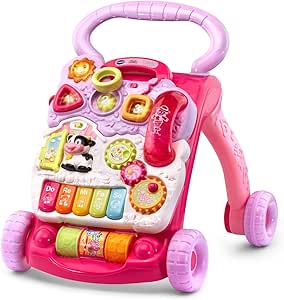 | Best Adjustable-Speed Walker | Age range: 9 months–3 years | Dimensions: 16.5 × 14.2 × 18.1 inches | Walker speed: Adjustable, 2 speeds | VIEW ON AMAZON | See Our Full Breakdown |
| VTech Sit-to-Stand Learning Walker |  | Best Overall for Hands-On Learning | Age range: 9 months to 3 years | Wheels: 4 | Batteries: 2 AA required; included | VIEW ON AMAZON | See Our Full Breakdown |
| Fisher-Price Laugh & Learn Smart Stages Learn with Sis Walker, Pink |  | Best for Music and Stage-Based Learning | Age range: 6 months to 3 years | Songs: 75+ | Smart Stages levels: 3 | VIEW ON AMAZON | See Our Full Breakdown |
| VTech Sit-to-Stand Learning Walker – Blue |  | Best for Adjustable Walking Practice | Age range: 9 months to 3 years | Wheels: 4 | Dimensions: 16.5 in L x 14.2 in W x 18 in H | VIEW ON AMAZON | See Our Full Breakdown |
| Fisher-Price 2-Sided Steady Speed Panda Walker Musical Push Toy |  | Best for Two-Sided Play | Age range: 6 months to 3 years | Wheels: 4 | Dimensions: 19.75 in L x 16 in W x 17 in H | VIEW ON AMAZON | See Our Full Breakdown |
| TOY Life 3-in-1 Baby Push Walker, Sit to Stand Activity Table for 6-36 Months |  | Best Lightweight 3-in-1 Option | Age range: 6 to 36 months | Base dimensions: 17 x 16 inches | Weight: 3.75 pounds | VIEW ON AMAZON | See Our Full Breakdown |
| Pithfor Wooden Baby Walker with Montessori Sensory Toys |  | Best Wooden Sensory Pick | Material: Wood | Dimensions: 13.3 × 15.3 × 20.6 inches | Weight: 3.74 kg | VIEW ON AMAZON | See Our Full Breakdown |
| TOPBRIGHT Wooden Baby Walker with Activity Center for 1 Year Olds |  | Best for Beginner Walkers | Age range: 10–36 months | Material: Natural wood | Activity center: 8-in-1 | VIEW ON AMAZON | See Our Full Breakdown |
| HYES 5-in-1 Push Walker for Toddlers, Blue |  | Best Multi-Mode Play Pick | Age range: 12 months–10 years | Dimensions: 16 × 13 × 7 inches | Weight: 3.29 kg | VIEW ON AMAZON | See Our Full Breakdown |
| YOLAY Baby Walker with Interactive Activity Panel and Batteries |  | Best for Younger Babies | Age range: 6–12 months | Activity panel: 360° interactive panel | Activity features: Shape sorters, spinning gears, light-up buttons | VIEW ON AMAZON | See Our Full Breakdown |
| VTech Sit-to-Stand Learning Walker (Frustration Free Packaging), Lavender |  | Best Established Sit-to-Stand Choice | Age range: 9 months–3 years | Dimensions: 16.5 × 14.2 × 18.1 inches | Material: Plastic | VIEW ON AMAZON | See Our Full Breakdown |
| push walker | Age range | Material | Dimensions |
|---|---|---|---|
| QDRAGON 3-in-1 Toddler Walker | 12–18 months | Plastic | 15.7 × 14.2 × 18.1 inches |
| Wooden Baby Walker Montessori | 12 months and up | Natural solid wood | 21.3 × 13 × 20.9 inches |
| Fisher-Price Laugh & Learn Sma | 6–36 months | — | — |
| Pithfor Wooden Baby Walker wit | 10 months–3 years | Wood | 15.6 in W × 13.3 in L × 8.1 in H |
| VTech Sit-to-Stand Learning Wa | 9 months–3 years | — | 16.5 × 14.2 × 18.1 inches |
| VTech Sit-to-Stand Learning Wa | 9 months to 3 years | — | — |
| Fisher-Price Laugh & Learn Sma | 6 months to 3 years | Sturdy plastic | — |
| VTech Sit-to-Stand Learning Wa | 9 months to 3 years | — | 16.5 in L x 14.2 in W x 18 in H |
| Fisher-Price 2-Sided Steady Sp | 6 months to 3 years | — | 19.75 in L x 16 in W x 17 in H |
| TOY Life 3-in-1 Baby Push Walk | 6 to 36 months | Non-toxic plastic | — |
| Pithfor Wooden Baby Walker wit | Baby, toddler | Wood | 13.3 × 15.3 × 20.6 inches |
| TOPBRIGHT Wooden Baby Walker w | 10–36 months | Natural wood | — |
| HYES 5-in-1 Push Walker for To | 12 months–10 years | ABS plastic | 16 × 13 × 7 inches |
| YOLAY Baby Walker with Interac | 6–12 months | — | — |
| VTech Sit-to-Stand Learning Wa | 9 months–3 years | Plastic | 16.5 × 14.2 × 18.1 inches |
More Details on Our Top Picks
QDRAGON 3-in-1 Toddler Walker Activity Center for Girls 12-18 Months, Pink
The QDRAGON’s main advantage is its 3-in-1 format: it can serve as a sit-to-stand aid, a push walker, and a stationary activity center. That gives families more ways to use it during early walking practice than the Fisher-Price Laugh & Learn Smart Stages Puppy Walker, which emphasizes music and staged learning rather than a detachable panel. Its triangle structure and adjustable wheels are intended to support steadier movement, while the compact listed dimensions may suit a smaller play area better than the wider wooden options here. The tradeoff is a narrower age range and limited room to grow: it is specified for 12–18 months, and larger toddlers may find its size restrictive. Assembly may also take more effort than buyers expect.
Pros:- Three configurations support seated play, sit-to-stand practice, and pushing
- Detachable activity panel can be used separately from the walker
- Adjustable wheels and triangle structure are designed to support steadier walking practice
- Compact listed footprint compared with the larger wooden activity walkers
Cons:- The 12–18-month age range offers less room to grow than models listed through age three
- May be undersized for larger toddlers
- Assembly may be complex
Best for: Families with a 12–18-month-old who want one compact plastic unit for both walking practice and seated activity play.
Not ideal for: Families seeking a walker for a broad age span or a larger toddler, since the stated age range is limited and the product may feel small.
- Age range:12–18 months
- Configurations:3-in-1
- Number of wheels:4
- Material:Plastic
- Dimensions:15.7 × 14.2 × 18.1 inches
- Maximum height:18.1 inches
- Color:Pink
Our verdict“Choose the QDRAGON if you want a versatile, compact plastic walker for an early walker, but skip it if you need a model that will fit a larger child for longer.”
Wooden Baby Walker Montessori Push Walker with Activity Center
This wooden walker is the activity-rich choice for families who want play features alongside walking practice: its 13 Montessori-style activities give little hands more to explore than the Pithfor walker’s eight listed toys. A wide wheelbase, rubberized wheels, and sit-to-stand design make it a more substantial option for children beginning to pull up and push, while the stated 33-pound capacity provides a clear use limit. Natural solid wood and water-based, odor-free paint will appeal to buyers who prefer a wood construction over the plastic VTech Sit-to-Stand Learning Walker. That material and activity count come with a cost in space, though: at 21.3 inches long, it has the largest stated footprint in this batch. Assembly is required, and the data does not specify adjustable wheel speed.
Pros:- Thirteen activities provide a broad range of hands-on play
- Wide wheelbase is designed to support stability during pushing
- Rubberized wheels help protect floors
- Solid wood and water-based, odor-free paint offer an alternative to plastic walkers
Cons:- The 21.3-inch length takes more floor space than the compact QDRAGON
- Requires assembly before use
- No adjustable wheel-speed feature is listed
Best for: Families with room for a larger play station who want a wooden push walker with many hands-on activities and a stated weight limit.
Not ideal for: Apartment households with limited floor space or caregivers who want adjustable walking speed, which is not specified here.
- Age range:12 months and up
- Dimensions:21.3 × 13 × 20.9 inches
- Weight capacity:33 lbs
- Material:Natural solid wood
- Number of activities:13
- Wheel features:Wide wheelbase with rubberized wheels
- Design:Sit-to-stand
Our verdict“Pick this model for a roomy play area and a wood-first, activity-heavy design, but choose a smaller walker if storage space is tight.”
Fisher-Price Laugh & Learn Smart Stages Puppy Walker
The Puppy Walker suits families who want music-led play that changes as a child grows. Its three Smart Stages levels and more than 75 songs, sounds, and phrases cover early concepts including letters, shapes, colors, numbers, and Spanish; the VTech Sit-to-Stand Learning Walker also offers interactive learning, but this Fisher-Price model specifies three learning levels and a larger sound library. Seven hands-on activities and an easy-grasp handle pair floor play with support for pushing on four wheels. Its broad 6–36-month age range also gives it a longer stated window than the QDRAGON. The main tradeoffs are practical: music and lights require batteries, and the bulky design may be awkward to store. Families seeking a quieter or space-saving walker may prefer a simpler activity-panel model.
Pros:- Three learning levels support changing play as skills develop
- More than 75 songs, sounds, and phrases introduce several early-learning topics
- Seven hands-on activities encourage fine-motor play
- Four-wheel base and easy-grasp handle support pushing practice
Cons:- Music and lights require batteries
- Bulky design can be difficult to store in a small space
- Sound-focused features may not suit households seeking quieter play
Best for: Caregivers who want a music-rich walker with staged learning features for a child who will use it from early play through walking practice.
Not ideal for: Families prioritizing quiet play, battery-free use, or easy storage in a small home.
- Age range:6–36 months
- Smart Stages levels:3
- Songs, sounds, and phrases:75+
- Hands-on activities:7
- Wheel base:4-wheel
- Learning topics:Alphabet, shapes, colors, numbers, and Spanish
- Power:Batteries required for music and lights
Our verdict“Choose the Puppy Walker for staged, musical learning and a broad age range, but look elsewhere if batteries, sound, or storage bulk are deal-breakers.”
Pithfor Wooden Baby Walker with Activity Center for Toddlers 10-36 Months
The Pithfor is a straightforward wooden option for families starting walker practice around 10 months. Its eight activity toys include a mirror, drum, bead maze, and shape sorter, giving children play choices without the larger activity count of the Wooden Baby Walker Montessori Push Walker. That simpler setup may appeal to caregivers who want an activity center without making 13 features the main attraction. Anti-slip wheels and sturdy wood are intended to support movement as toddlers work on balance and coordination, and its stated age range extends to 3 years. The listed dimensions are unusual—8.1 inches in height—so buyers should check the product’s full measurements before deciding whether the handle height and overall scale suit their child. Some assembly is also required.
Pros:- Eight varied toys include a bead maze, mirror, drum, and shape sorter
- Wood construction offers a non-plastic alternative to the VTech walker
- Anti-slip wheels are intended to aid controlled movement
- Listed age range covers 10 months through 3 years
Cons:- Listed height of 8.1 inches is unusually low and may require verification before purchase
- Eight activities are fewer than the 13 on the Montessori wooden walker
- Some assembly is required
Best for: Families seeking a wooden walker for early sit-to-stand and walking practice, with a modest selection of tactile toys.
Not ideal for: Buyers who need confirmed handle-height fit or want a documented large activity set; the listed dimensions need clarification and it has eight toys.
- Age range:10 months–3 years
- Material:Wood
- Dimensions:15.6 in W × 13.3 in L × 8.1 in H
- Number of activity toys:8
- Wheel feature:Anti-slip
- Educational objectives:Balance, motor skills, sit-to-stand, and learning to walk
- Activity examples:Mirror, drum, bead maze, and shape sorter
Our verdict“Consider the Pithfor for a wood walker with varied tactile toys, but verify its listed dimensions and choose the Montessori model for more activities.”
VTech Sit-to-Stand Learning Walker, Pink
The VTech earns its place for buyers who want walking pace control and a removable play panel. Its adjustable two-speed walker can be set to suit a child’s developing confidence, while the panel comes off for floor play—more flexible for active practice than the fixed activity station on the Fisher-Price Laugh & Learn Smart Stages Puppy Walker. Piano keys, shape sorters, light-up buttons, rollers, and a handset give the child varied ways to play, and included batteries make initial setup easier than the Puppy Walker’s battery-required listing. The 9-month-to-3-year age range also spans early play and later walking practice. The tradeoffs are its 16.5-by-14.2-inch footprint and ongoing reliance on AA batteries; those may matter more in a small home or for caregivers who prefer simpler, quieter toys.
Pros:- Two speed settings can adapt to a child’s changing walking confidence
- Removable activity panel supports floor play apart from the walker
- Multiple activities include piano keys, shape sorters, lights, rollers, and a handset
- Batteries are included and the stated age range extends to 3 years
Cons:- The 16.5 × 14.2-inch footprint may be bulky in small spaces
- Regular use of electronic features requires AA batteries
- Sound and light activities may be less suitable for families seeking a quiet walker
Best for: Families who want a removable floor-play panel and adjustable walker speed for a child progressing from crawling toward confident steps.
Not ideal for: Households short on storage space or caregivers who prefer a battery-free activity toy.
- Age range:9 months–3 years
- Dimensions:16.5 × 14.2 × 18.1 inches
- Walker speed:Adjustable, 2 speeds
- Activity panel:Removable
- Activities:Piano keys, shape sorters, light-up buttons, rollers, and telephone handset
- Batteries:Included; AA batteries needed for regular electronic use
- Color:Pink
Our verdict“Choose the VTech for adjustable walking speed and a detachable play panel, but skip it if you need a compact or battery-free option.”
VTech Sit-to-Stand Learning Walker
The VTech Sit-to-Stand Learning Walker earns my all-around pick by pairing a removable activity panel with a four-wheel frame for babies moving from floor play toward supported walking. Musical keys, shape sorters, and spinning rollers give little hands something to explore even when the child is not ready to push. Its adjustable speed is a practical advantage over the Fisher-Price Laugh & Learn Smart Stages Learn with Sis Walker, whose listed features emphasize songs and staged content rather than speed control. The tradeoff is that this VTech needs batteries and its assembly may take patience; families seeking a simpler, non-electronic push toy may prefer a different style. It is listed for ages 9 months to 3 years, so its useful window is not open-ended.
Pros:- Removable activity panel supports floor play as well as walker play.
- Adjustable speed can accommodate changes in a child’s walking ability.
- Musical keys, shape sorters, and rollers offer varied fine-motor activities.
- Four wheels provide a broad rolling base.
Cons:- Requires two AA batteries, which may need replacing.
- Assembly can be challenging for some caregivers.
- Listed age range ends at 3 years.
Best for: Families who want one toy for both seated activity-panel play and early supported walking, with adjustable rolling speed.
Not ideal for: Caregivers seeking a battery-free, quick-assembly walker or a product intended for use beyond age 3.
- Age range:9 months to 3 years
- Wheels:4
- Batteries:2 AA required; included
- Activity features:Musical keys, shape sorters, spinning rollers
- Activity panel:Removable
- Speed control:Adjustable
- Warranty:90 days against manufacturer defects
Our verdict“Choose this VTech if you want a versatile learning panel and adjustable rolling speed in one walker.”
Fisher-Price Laugh & Learn Smart Stages Learn with Sis Walker, Pink
For families who want songs and age-based learning prompts to lead the play, the Learn with Sis Walker brings 75+ songs, seven hands-on activities, and three Smart Stages levels together in an easy-to-grasp format. Its listed age range begins at 6 months, earlier than the VTech Sit-to-Stand Learning Walker, which starts at 9 months. That makes it a stronger match for younger babies who are ready to play with a stationary activity panel before pushing. The tradeoff is less emphasis on the adjustable walking pace offered by the VTech, and the activities may feel limited after repeated play. Its four-wheel base and sturdy plastic construction suit indoor play, but its bulk can be awkward where floor space is tight.
Pros:- Three Smart Stages levels adapt learning content as a child grows.
- More than 75 songs provide a strong music focus.
- Seven hands-on activities include light-up piano keys, a roller, and a spinner.
- Listed age range starts at 6 months.
Cons:- May be bulky in small play areas.
- Battery requirement is listed, but whether batteries are included is unspecified.
- Activities may offer less variety after extended use.
Best for: Caregivers of younger babies who want songs, hands-on activities, and learning content that changes across three stages.
Not ideal for: Households with very limited floor space or buyers who prioritize adjustable push speed over music and learning content.
- Age range:6 months to 3 years
- Songs:75+
- Smart Stages levels:3
- Activities:7 hands-on activities
- Examples of activities:Light-up piano keys, nose, roller, spinner, flip page
- Material:Sturdy plastic
- Base:4-wheel base
- Handle:Easy-grasp handle
Our verdict“Pick Learn with Sis for a music-rich, staged play experience, but choose the VTech if adjustable walking speed matters more.”
VTech Sit-to-Stand Learning Walker – Blue
This blue version is the clearest choice in this group for caregivers who want two-speed control to match a child’s developing push skills. Its removable panel can be used on the floor, then attached to the four-wheel frame for walking practice; piano keys, shape sorters, lights, rollers, and a telephone handset keep seated play varied. Compared with the Fisher-Price 2-Sided Steady Speed Panda Walker, this VTech lists adjustable speed, while the Panda emphasizes two-sided play and Smart Stages learning. The cost of that versatility is a fairly large footprint at 16.5 by 14.2 inches, plus AA batteries that are not included. It shares much of its play concept with the other VTech Sit-to-Stand model, so buyers should choose based on the specific listing and its documented dimensions rather than expecting a different category of walker.
Pros:- Two-speed control can suit different stages of walking practice.
- Removable activity panel supports floor and walker play.
- Multiple activities include piano keys, shape sorters, lights, rollers, and a handset.
- Product dimensions are listed for space planning.
Cons:- Requires AA batteries that are not included.
- The 16.5-by-14.2-inch base may be cumbersome in small spaces.
- Overlaps substantially in concept with the other VTech Sit-to-Stand model in this roundup.
Best for: Families who want adjustable walking pace, a detachable play panel, and documented dimensions for planning indoor space.
Not ideal for: Small-room households or buyers who want batteries included and a more compact push walker.
- Age range:9 months to 3 years
- Wheels:4
- Dimensions:16.5 in L x 14.2 in W x 18 in H
- Speed control:Two-speed control
- Activity panel:Removable
- Activity features:Piano keys, shape sorters, light-up buttons, rollers, telephone handset
- Batteries:AA batteries required; not included
- Warranty:90 days against manufacturer defects
Our verdict“Choose this VTech when adjustable speed and a detachable activity panel matter more than a compact footprint.”
Fisher-Price 2-Sided Steady Speed Panda Walker Musical Push Toy
The Panda Walker stands out for a two-sided layout that supports play while sitting as well as pushing, with three shape blocks included for hands-on sorting. Its light-up steering wheel and Smart Stages content cover the alphabet, counting, and opposites, giving it a different emphasis from the VTech Sit-to-Stand Learning Walker’s detachable panel and adjustable speed. The Panda’s listed age range starts at 6 months, so it can suit babies who are not yet walking, while its 3.8-pound weight may make it easier for an adult to reposition than a bulkier option. The tradeoff is a sizeable 19.75-by-16-inch footprint, and the product is listed for indoor use only. Buyers should also expect assembly and may find the repeated activities less engaging over time.
Pros:- Two-sided design supports sitting play and walking practice.
- Includes three shape blocks for hands-on sorting.
- Smart Stages content covers alphabet, counting, and opposites.
- Listed weight is 3.8 pounds.
Cons:- Large 19.75-by-16-inch footprint can take up substantial floor space.
- Listed for indoor use only.
- Requires assembly, and activities may become repetitive.
Best for: Families wanting a sit-and-push toy with two-sided activities, shape blocks, and early learning content for babies from 6 months.
Not ideal for: Buyers needing an outdoor walker, a compact base, or a product with a removable activity panel and adjustable speed.
- Age range:6 months to 3 years
- Wheels:4
- Dimensions:19.75 in L x 16 in W x 17 in H
- Weight:3.8 pounds
- Maximum height:2 feet
- Included components:1 walker and 3 shape blocks
- Learning features:Smart Stages; alphabet, counting, and opposites
- Use:Indoor
Our verdict“Choose the Panda Walker for two-sided sitting-to-pushing play, but favor the VTech if adjustable speed is your priority.”
TOY Life 3-in-1 Baby Push Walker, Sit to Stand Activity Table for 6-36 Months
The TOY Life makes the most sense for families who want a walker that can change into an activity table, rather than a dedicated push toy with a larger song library. At 3.75 pounds, it is listed as lighter than the Fisher-Price Panda Walker, and the 17-by-16-inch base gives buyers a useful size reference. Its detachable light-up music panel, spinning gears, shape sorter, and piano offer seated play before a child is ready to push. Compared with the VTech Sit-to-Stand Learning Walker, this model adds the table format but does not list adjustable speed control; that matters for caregivers focused on controlling the rolling pace as walking skills develop. It also requires adult assembly and batteries that are not included, so its versatility comes with setup and supply needs.
Pros:- Three-in-one design converts between walker and activity-table use.
- Listed weight of 3.75 pounds supports easier transport around the home.
- Detachable panel combines lights, music, gears, a shape sorter, and a piano.
- Includes four table legs and a play ball.
Cons:- Batteries are required but not included.
- Adult assembly is required.
- No adjustable walking-speed control is listed, unlike the VTech Sit-to-Stand models.
Best for: Families seeking a lightweight walker that converts into an activity table for sitting play and early walking practice.
Not ideal for: Caregivers who want adjustable speed control, included batteries, or a walker that arrives ready to use without assembly.
- Age range:6 to 36 months
- Base dimensions:17 x 16 inches
- Weight:3.75 pounds
- Configurations:3-in-1 walker and activity-table design
- Included components:Detachable light-up music panel, 4 table legs, play ball, screwdriver, sticker sheet
- Material:Non-toxic plastic
- Batteries:Required; not included
- Assembly:Adult assembly required
Our verdict“Pick the TOY Life for a light, convertible activity-table format, but choose a VTech if adjustable push speed is more important.”
Pithfor Wooden Baby Walker with Montessori Sensory Toys
The Pithfor stands out for families who want a wooden push walker with hands-on activities rather than lights and electronic sounds. Its mirror, bead maze, xylophone, and shape sorter give a new walker reasons to pause and play, making it more activity-focused than the simpler walking practice offered by some push toys. Compared with the TOPBRIGHT Wooden Baby Walker, the listed Pithfor features are easier to identify, while TOPBRIGHT specifies adjustable speed controls and a broader 10-to-36-month age range.
The tradeoff is weight: at 3.74 kg, this may be harder for a small toddler to push than a lighter-feeling plastic option such as the VTech Sit-to-Stand Learning Walker. Its pink-only color listing also limits choice. I’d shortlist it for a child drawn to tactile play, but not for families prioritizing a lighter walker or multiple color options.
Pros:- Combines walking practice with a mirror, bead maze, xylophone, and shape sorter.
- Wooden construction offers a different feel from plastic activity walkers such as the VTech Sit-to-Stand.
- Anti-slip wheels are specified to support steadier movement.
- Compact listed dimensions make its footprint easy to compare with bulkier activity centers.
Cons:- At 3.74 kg, it may be difficult for some toddlers to push independently.
- The listing offers limited color choice, with pink specified.
- The supplied data does not specify adjustable wheel speed.
Best for: Families seeking a wooden first walker with several tactile activities to hold a toddler’s interest between walking attempts.
Not ideal for: Younger or smaller toddlers who may struggle to push a 3.74 kg walker, and buyers who want a choice of colors.
- Material:Wood
- Dimensions:13.3 × 15.3 × 20.6 inches
- Weight:3.74 kg
- Maximum height:34 cm
- Age range:Baby, toddler
- Activity features:Mirror, bead maze, xylophone, shape sorter
- Wheel feature:Anti-slip wheels
Our verdict“Choose the Pithfor if tactile wooden play matters more than a lighter frame or adjustable speed controls.”
TOPBRIGHT Wooden Baby Walker with Activity Center for 1 Year Olds
For a child just moving from sitting to standing, the TOPBRIGHT’s strongest distinction is its combination of a sit-to-stand design and adjustable speed controls. Those controls give caregivers a way to tune walking practice for a beginner, a detail not specified for the Pithfor Wooden Baby Walker with Montessori Sensory Toys. Its 8-in-1 activity center and included shape blocks also give a child play options when they are not ready to keep walking.
The stated 10-to-36-month range makes it a more clearly age-defined wooden option than the Pithfor, but the product data does not give dimensions or weight, so I can’t judge how easily it fits a small room or is moved around. Assembly is required, and the listing notes that it may be large for tight play areas. I’d favor it over the VTech Sit-to-Stand Learning Walker when wood and speed adjustment matter more than a familiar electronic play-panel format.
Pros:- Adjustable speed controls are useful for tailoring rolling pace to a beginner.
- Sit-to-stand design supports play before a child is ready to walk.
- Eight activity types and included shape blocks add options beyond pushing.
- Natural wood and stated ASTM F963 and EN71 safety standards are listed.
Cons:- Assembly is required and may take effort.
- The product may be too large for small play areas.
- Dimensions and item weight are not supplied, limiting space and handling comparisons.
Best for: Caregivers of 10-to-36-month-olds who are beginning to pull up and want adjustable walking resistance alongside wooden activities.
Not ideal for: Families with very limited floor space or buyers who want a ready-to-use walker without assembly.
- Age range:10–36 months
- Material:Natural wood
- Activity center:8-in-1
- Speed control:Adjustable
- Safety standards:ASTM F963, EN71
- Included components:Assembly hardware, handlebar, instruction manual, walker frame, wooden wheels
- Number of items:1
- Model number:1213132025ig0001
Our verdict“Pick TOPBRIGHT for a beginner who needs adjustable rolling speed and a wooden activity center, provided you have room to assemble it.”
HYES 5-in-1 Push Walker for Toddlers, Blue
The HYES is the most adaptable play concept in this group: its five modes include a push walker, scooter, motorbike, entertainment table, and activity center. That range suits families who want one product to serve several kinds of play, rather than a dedicated walker like the Pithfor Wooden Baby Walker. A removable educational panel adds color- and shape-focused play, while adjustable speed is a useful feature for walking practice.
That versatility comes with a more complicated footprint and setup. At 16 × 13 × 7 inches and 3.29 kg, it is not automatically the easiest choice for a crowded room, and the product requires assembly. Its stated age range extends to 10 years, but that broad claim does not mean older children will get the same value from the walker mode. I’d choose HYES for varied play, not for a straightforward, compact first walker.
Pros:- Five modes offer more kinds of play than dedicated walkers such as the Pithfor.
- Removable play panel supports activity use apart from walking.
- Adjustable speed is specified for walking practice.
- ABS plastic construction keeps the design distinct from the wooden choices.
Cons:- Its multifunction design may be bulky for small play spaces.
- Assembly is required.
- Electronic features require a battery, adding an ongoing replacement need.
Best for: Families wanting a single toy that can shift between walking practice, seated activity, and several pretend-vehicle play modes.
Not ideal for: Buyers seeking a simple, space-conscious first walker or a wooden design with tactile components.
- Age range:12 months–10 years
- Dimensions:16 × 13 × 7 inches
- Weight:3.29 kg
- Material:ABS plastic
- Number of modes:5
- Modes:Push walker, scooter, motorbike, entertainment table, activity center
- Included components:Push walker set
- Speed control:Adjustable
Our verdict“Choose HYES if multiple play modes matter more than a simple footprint or a focused wooden walker design.”
YOLAY Baby Walker with Interactive Activity Panel and Batteries
YOLAY is the only option here specifically listed for babies aged 6–12 months, giving it a younger starting point than the HYES 5-in-1, which begins at 12 months, or the VTech Sit-to-Stand Learning Walker, listed from 9 months. Its removable tray and 360° interactive panel bring play within reach, while the wide anti-slip base and adjustable speed are aimed at steadier movement as a baby explores.
The age window is also its main limitation: families looking for a walker with a stated toddler range will get more runway from VTech or TOPBRIGHT. YOLAY’s lights and sounds depend on AA batteries, although batteries are included, so it can be used without a separate initial battery purchase. The wide base may take up valuable floor space. I’d favor it for early sensory play and supervised walker use, rather than a longer-lasting toddler option.
Pros:- Its stated 6-to-12-month range starts earlier than the HYES and VTech options.
- Removable tray and 360-degree panel offer different ways to play.
- Adjustable speed and a wide anti-slip base are specified.
- AA batteries are included for the electronic features.
Cons:- The listed age range ends at 12 months, limiting its stated use as a child grows.
- Lights and sounds rely on batteries, which may need replacement.
- The base may be bulky for small spaces.
Best for: Caregivers seeking an activity-rich option for a 6-to-12-month-old, with batteries included and adjustable speed.
Not ideal for: Families wanting a walker specified for use beyond 12 months or with a smaller room footprint.
- Age range:6–12 months
- Activity panel:360° interactive panel
- Activity features:Shape sorters, spinning gears, light-up buttons
- Tray:Removable activity tray
- Speed control:Adjustable
- Base:Wide, anti-slip
- Wheels:Durable
- Batteries:Included; AA type
Our verdict“Choose YOLAY for a younger baby who will benefit from an interactive tray, but look to VTech or TOPBRIGHT for a longer stated age range.”
VTech Sit-to-Stand Learning Walker (Frustration Free Packaging), Lavender
The VTech earns a distinct place as a sit-to-stand walker with a removable learning panel. Children can play with its piano keys, shape sorters, spinning rollers, and telephone handset while seated, then use the walker as their mobility develops. That two-stage setup makes it more adaptable than YOLAY’s 6-to-12-month-focused design, while offering a different play style from the wooden TOPBRIGHT, which emphasizes sensory activities and adjustable speed.
Its 9-month-to-3-year range gives families a clear age window, and the 16.5-by-14.2-inch footprint is specified for planning space. The compromises are plastic construction and dependence on AA batteries for musical and light-up play; regular use may mean replacements. Assembly may also be challenging. I’d choose it when a removable panel and varied electronic activities matter more than wooden materials or a no-battery play experience.
Pros:- Removable activity panel supports seated play as well as walker use.
- Piano keys, shape sorters, rollers, and handset provide varied activities.
- Age range is specified from 9 months to 3 years.
- Dimensions are listed, making room planning easier than with TOPBRIGHT.
Cons:- Electronic features require two AA batteries, and replacements may be needed for regular use.
- Plastic construction may not suit buyers seeking a wooden walker.
- Assembly may be complex for some caregivers.
Best for: Families who want a removable activity panel for seated play and a walker mode with a clearly stated range through age three.
Not ideal for: Buyers prioritizing wood, avoiding battery-powered activities, or seeking a walker with fewer assembly steps.
- Age range:9 months–3 years
- Dimensions:16.5 × 14.2 × 18.1 inches
- Material:Plastic
- Color:Lavender
- Batteries:2 AA included; replacement recommended for regular use
- Activity features:Musical piano keys, shape sorters, spinning rollers, telephone handset
- Activity panel:Removable
- Warranty:90 days against manufacturer defects
Our verdict“Pick the VTech for a removable electronic play panel and a clearly defined sit-to-stand age range, but skip it if batteries or plastic are dealbreakers.”

How We Picked
I compared these 15 products as push walkers and early-walking play aids, not as substitutes for adult supervision or a guarantee of walking progress. The ranking gives priority to usable support during pushing, the ability to adapt to seated or standing play, and features that have a clear purpose rather than simply adding more activity. I also weighed build materials, the apparent complexity of setup and play, and whether a design offers a distinct advantage for a specific household or child.
The VTech Sit-to-Stand Learning Walker ranks first for its flexible activity-panel format and broad play appeal. Other places reflect more focused strengths: the Panda model emphasizes speed control, wooden options offer a different sensory and material experience, and multi-mode walkers suit families seeking varied configurations. Similar VTech color and packaging listings remain separate entries, but they are not treated as different designs. Product descriptions do not provide every practical detail, so I avoid claims about performance or durability that cannot be established from the listed features.
Factors to Consider When Choosing Push Walker
Walker labels and feature counts can make unlike products seem interchangeable. I’d start with how your child is moving now, then check how the walker behaves on your floors and whether its play functions will be useful after the first few weeks.
Match the Walker to Your Child’s Current Skills
An age range is a starting point, not proof that a child is ready to push a walker. Look for steady supported standing, a comfortable grip height, and the ability to take steps while holding support; if those skills are still developing, a removable activity panel can offer play while seated. Avoid buying a more elaborate model because it claims to cover many months if its push function is not usable yet. A walker should move only when the child can manage it with an adult close by. This is why flexible formats, such as the VTech sit-to-stand design, may suit families whose child is not yet ready for continuous pushing.
Think About Floor Grip and Movement
A walker that moves too freely can be frustrating or unsafe for a new stander, while one that barely rolls may discourage a child from pushing. Floor type matters: smooth hardwood, rugs, and transitions between rooms can change how wheels behave. Speed-control features, like the Panda model’s stated steady-speed emphasis, may be especially appealing for early practice, but buyers should still check the manufacturer’s guidance and supervise closely. Do not assume that a heavier-looking frame automatically provides the right resistance. If you can, compare wheel design and any stated control features with the surfaces where your child will use it most.
Choose Play Features Your Child Will Actually Use
Electronic lights, songs, buttons, and sounds can hold attention, but they add stimulation and may call for batteries or sound management. Wooden sensory toys usually offer a quieter, more tactile experience, though they may have fewer kinds of activities. Consider whether your child enjoys cause-and-effect buttons or prefers turning, sliding, and touching objects. More activities are not automatically better if the walker becomes distracting from pushing practice. A simpler option can be the better fit for a child who loses focus easily or for a shared space where sound matters.
Decide Between Wood, Plastic, and Multi-Mode Designs
Wooden models can appeal to buyers seeking a natural-material look and hands-on sensory play, while plastic walkers often offer more electronic functions and removable or repositionable panels. Material alone does not tell you how stable a walker will feel, so check the base, handle, wheel arrangement, and assembly instructions. Multi-mode products may be useful when a family wants a play table or activity center as well as a push walker, but extra configurations can mean more parts and setup. Check whether the modes are genuinely useful at your child’s stage rather than treating a high mode count as a benefit by itself. Choose the simplest format that covers the play and movement needs you have now.
Check Space, Storage, and Everyday Setup
A walker needs enough open floor area for turning and stopping, not just a clear path down a hallway. Measure doorways and storage spots, and account for toys or furniture that could interrupt movement. If you expect to move the walker between rooms, consider how easy it is to lift, reconfigure, or store; a larger activity center may be less convenient even when it offers more play options. Battery-powered models also bring a small recurring task: keeping suitable batteries available and managing sound. Before choosing, check assembly requirements and the maker’s care instructions so that cleanup and storage fit your routine.
Treat Safety and Supervision as Part of the Purchase
A push walker is a toy for closely supervised practice, not a device that makes a child independently safe. Use it on a level, open surface away from stairs, thresholds, hot objects, and other hazards, and stay within reach. Inspect the handle, wheels, fasteners, and activity parts for looseness or damage before use. Follow the product’s age, weight, assembly, and care directions rather than relying on a general category assumption. If your child has a medical or developmental concern affecting balance or movement, ask a qualified pediatric professional before choosing a walker.
Frequently Asked Questions
Should I choose a wooden walker or an electronic plastic walker?
Choose based on the play experience you want, not on the material alone. The wooden Montessori, Pithfor, and TOPBRIGHT options lean toward tactile, quieter activities, while VTech and Fisher-Price models emphasize interactive features. Electronic play may hold a child’s attention, but it can add sound and battery upkeep. Wood may better suit a family seeking simpler sensory play, though specific activity layouts vary. Check the handle, base, and wheel details for the individual model before deciding which feels like the better match.
Is a walker with more than one mode worth choosing?
It can be useful if the extra configuration meets a real need at your child’s current stage. Models such as the QDRAGON, TOY Life, and HYES advertise multiple play modes, while the VTech option’s removable panel offers a more specific seated-to-standing use. A mode count does not tell you how stable or easy the walker is to reconfigure. Check what each mode actually does, whether parts need frequent assembly changes, and whether your child can use those modes now. If you only expect to use it for pushing, a simpler design may be easier to live with.
What matters more for a beginner: speed control or an activity panel?
It depends on the child’s immediate needs. A child who is ready to push but moves too quickly may benefit from a model designed around steadier movement, such as the Panda walker’s stated speed-control focus. A child who is still building confidence while standing may get more use from a removable activity panel that supports play without requiring continuous walking. Neither feature replaces adult supervision or a suitable floor surface. Use your child’s balance and interest in play as the deciding factors, rather than choosing by feature count.
Are the pink, blue, and lavender VTech listings different walkers?
The listed products are versions of the VTech Sit-to-Stand Learning Walker, with color or packaging differences identified in their names. The roundup treats them as separate listings because they are separate entries, but their stated core design and role are the same. I would not assume that a color or packaging label signals a different feature set. Check the specific listing for its included parts, instructions, and any version details before ordering. If those match, choose the version that best fits your preferences.
Can I use a push walker on rugs or between rooms?
That depends on the wheels, rug pile, and floor transitions, so there is no single answer for every model. A thick rug or raised threshold can stop wheels abruptly, while a smooth floor may let a walker roll more readily. Before regular use, test the route with an adult holding the walker and check that it moves in a controlled way. Keep practice in an open area away from stairs and clutter, and supervise at arm’s reach. If the walker catches or moves too freely on your flooring, choose a different surface or a model whose stated wheel features better suit your home.
Conclusion
My best overall recommendation is the VTech Sit-to-Stand Learning Walker for families who want one design that can support seated activity and later pushing. For a best value-style pick based on practical versatility rather than extra electronics, compare the TOY Life 3-in-1 with the QDRAGON 3-in-1 and choose the mode setup that best fits your child; the listings do not provide enough detail to name a universal winner on cost. For a best premium-style choice among these options, I’d look to the wooden Montessori or TOPBRIGHT walkers if material and tactile play matter more than electronic features. Beginners may prefer the VTech’s removable activity panel, while families seeking a more controlled push experience should examine the Fisher-Price Panda. For quieter, hands-on play, start with the wooden Pithfor or Montessori options; whichever you choose, match it to your child’s present abilities and supervise every use.