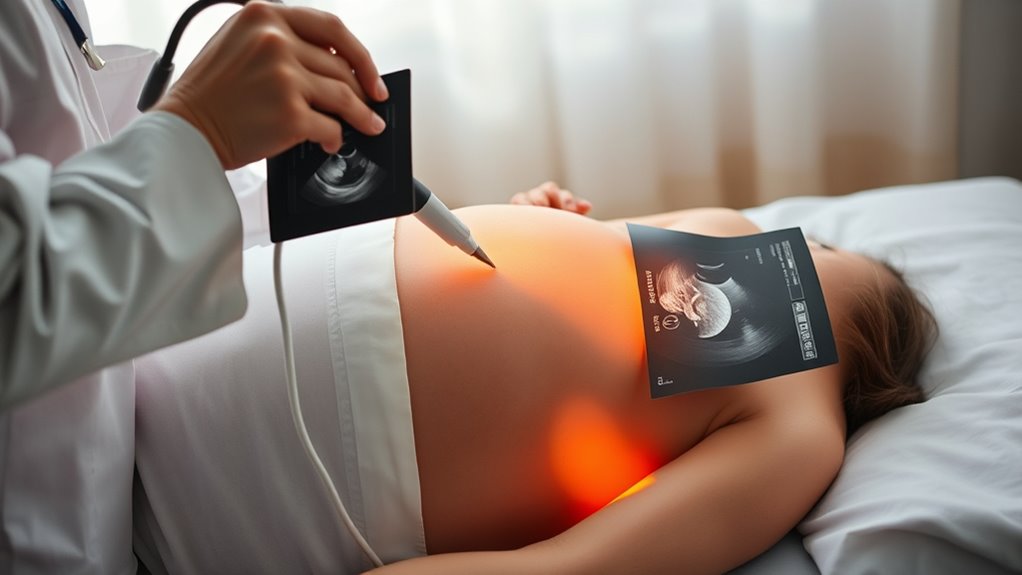

A dating ultrasound is essential for precisely determining your due date by measuring your fetus’s size, especially in early pregnancy. It’s more accurate than relying on last menstrual period, particularly if your cycles are irregular or dates are uncertain. This scan helps monitor fetal growth and adjust the due date if needed, ensuring better pregnancy management. If you want to understand how this technology improves confidence in your pregnancy timeline, continue exploring the details.
Key Takeaways
- Dating ultrasound accurately estimates gestational age, ensuring precise due date calculation.
- It measures fetal structures, such as crown-rump length, for reliable pregnancy dating.
- Early ultrasounds reduce errors compared to last menstrual period estimates.
- Fetal growth assessment during ultrasound helps verify or adjust the due date.
- First-trimester ultrasounds provide the most accurate dating for pregnancy management.

Are you curious about how healthcare providers determine your pregnancy’s due date? One of the most accurate methods they rely on is a dating ultrasound. This procedure uses advanced ultrasound technology to assess fetal growth and give a precise estimate of how far along you are in your pregnancy. When you have this ultrasound done early in your pregnancy, typically between 6 and 12 weeks, it provides valuable information about your baby’s development and helps establish a reliable due date.
Ultrasound technology allows your healthcare provider to visualize your fetus and measure specific structures, such as the crown-rump length (CRL). This measurement is especially useful early on because fetal growth is quite consistent during the first trimester. Unlike relying solely on your last menstrual period, which can sometimes be inaccurate due to irregular cycles or forgetfulness, ultrasound measurements offer a direct assessment of fetal size. This helps reduce errors and provides a more accurate estimate of your pregnancy’s gestational age.
Fetal growth is a key factor in determining due date accuracy. During the ultrasound, your provider looks at how your baby is developing compared to standard growth charts. If your fetus is growing at a typical rate, the estimated due date will be quite precise. However, if there’s a significant difference between the ultrasound measurement and your last period date, the due date might be adjusted accordingly. This guarantees you have the most accurate timeline for your pregnancy, which is essential for monitoring fetal development and planning medical care.
The first-trimester ultrasound is particularly reliable because fetal development is fairly uniform at this stage. After this point, growth patterns can vary more widely. That’s why early ultrasound assessments are considered the gold standard for dating pregnancies. They help detect any potential concerns early and give you and your healthcare team a clear understanding of your baby’s growth trajectory. Additionally, precise dating can improve the accuracy of ultrasound technology by reducing gestational age errors, ensuring better pregnancy management.
Frequently Asked Questions
Can a Dating Ultrasound Determine the Baby’s Gender?
A dating ultrasound typically can’t determine your baby’s gender accurately, especially early on. However, around 18-22 weeks, ultrasound technology can often reveal the gender, making it perfect for a fun gender reveal. Keep in mind, though, that it’s not always 100% reliable. If you’re enthusiastic to know, you might consider genetic testing options that provide a more definitive answer.
How Early Can a Dating Ultrasound Be Performed?
You can typically have a dating ultrasound as early as 6 to 8 weeks into your pregnancy. This early scan helps confirm pregnancy viability and establish accurate pregnancy milestones. Thanks to advances in ultrasound technology, your healthcare provider can measure the embryo and estimate the due date reliably. Early ultrasounds are essential for tracking your pregnancy progress and ensuring your baby’s development stays on schedule.
Does the Quality of Ultrasound Equipment Affect Accuracy?
Did you know that outdated ultrasound equipment can reduce accuracy by up to 20%? The quality of ultrasound equipment definitely matters. Modern equipment technology and proper ultrasound calibration ensure clearer images and precise measurements, which are vital for determining your due date. When you use the latest technology, your healthcare provider can assess your pregnancy more accurately, giving you peace of mind and better prenatal care.
Are There Risks Associated With Early Ultrasounds?
Early ultrasounds are generally safe, but you should be aware of pregnancy safety concerns. Ultrasound technology uses sound waves, which are non-invasive and don’t emit ionizing radiation like X-rays. However, excessive or unnecessary ultrasounds might pose risks, such as tissue heating or cavitation. It’s best to follow your healthcare provider’s recommendations and avoid frequent scans to guarantee safety for you and your baby.
How Often Should Ultrasounds Be Done During Pregnancy?
You should have ultrasounds scheduled at key points, typically around 8-14 weeks for dating, 18-22 weeks for anatomy, and later as needed. These scans help monitor fetal growth, check placental placement, and detect any issues early. Your doctor may recommend additional ultrasounds if complications arise. Regular scans guarantee you stay informed about your baby’s development and help plan for a healthy pregnancy and delivery.
Conclusion
In the gentle dance of anticipation, a dating ultrasound guides you with quiet certainty, helping to shape the journey ahead. While it softly whispers the expected arrival, remember that life’s delicate timing often holds subtle surprises. Trust this tender glimpse into your future, knowing it’s a gentle anchor amid the blossoming mystery. Embrace the clarity it offers, even as the beautiful unknown continues to unfold, weaving hope and reassurance into your path.