📊 Full opportunity report: How To Align Parental Consent Workflows With Privacy Practices on IdeaNavigator AI — validation score, market gap, and execution plan.

Turn the school run and nap time into listening time
- Thousands of audiobooks, podcasts and originals
- Listen on your phone, tablet or Echo — also offline
- Cancel anytime
TL;DR
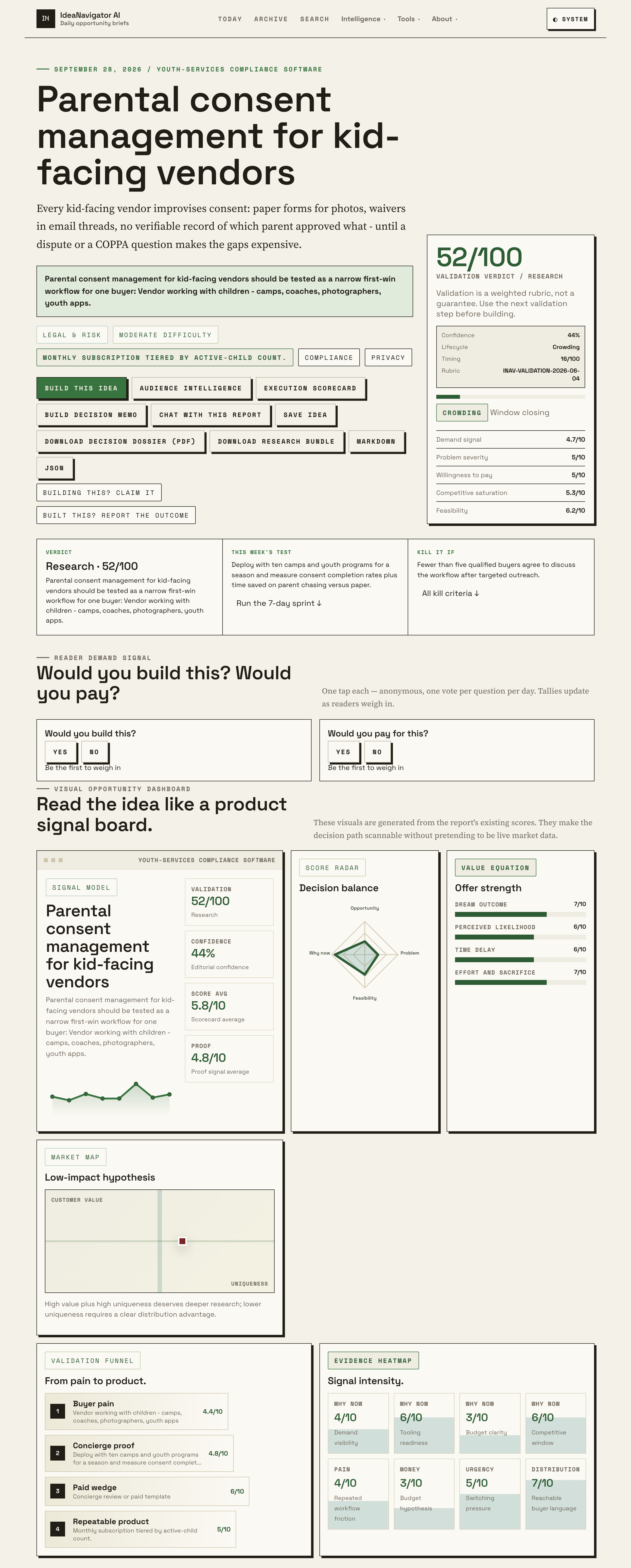
IdeaNavigator AI has outlined a proposed parental-consent workflow for vendors serving children, including camps, coaches, photographers and youth apps. The concept calls for phone-based forms, per-child records and audit exports, but no deployed product, pilot results or legal assessment is reported.
IdeaNavigator AI has outlined a proposed consent-management workflow for businesses that work with children, including camps, coaches, photographers and youth apps. The proposal describes a phone-based way for parents to approve specific uses of children’s photos and data, with records vendors could retrieve later; it does not report a launched product or completed pilot.
The proposal frames the opportunity around a practical recordkeeping problem: youth-serving vendors may collect permissions through paper forms, email waivers and other separate processes. That can make it difficult to establish which parent approved which use, according to the problem description in the IdeaNavigator AI proposal. It says the gaps may become costly when a dispute arises or a vendor faces a question about compliance with children’s privacy rules.
The suggested minimum product would give each vendor a branded consent flow that parents can complete on a phone. Proposed permission categories include photo use, data collection, medical matters and liability. The system would keep a consent ledger for each child, track expiry dates and provide an audit export. It would also use identity checks selected according to the perceived risk of each consent request, though the proposal does not specify how those checks would work.
For validation, IdeaNavigator AI proposes trying the workflow with 10 camps and youth programs for one season. The suggested measures are consent completion rates and time spent following up with parents compared with paper-based processes. The proposal also describes a possible business model: monthly subscriptions priced by the number of active children. These are proposed steps and features; no participating organizations, pricing, measured results or release date are identified.
Records Could Reduce Consent Gaps
A single, accessible record of permissions could help a camp or other youth program answer basic questions: which parent gave consent, for which child, and for what purpose? That may matter when photo permissions differ from data collection permissions, or when an earlier approval has expired. The proposal’s focus on separate categories and expiry tracking reflects those recordkeeping needs.
The potential value depends on whether the workflow is accurate and workable for families and staff. If a process is confusing, difficult to access or asks for more information than necessary, parents may not complete it and vendors may retain their existing workarounds. The proposed pilot would test completion and staff follow-up time, but those measures alone would not establish whether the records meet legal requirements or prevent disputes.
For readers who run youth programs, the idea presents a possible operational tool rather than a new legal standard. Its practical importance remains conditional: the concept would need to be built, tested with real programs and reviewed against applicable privacy and consent obligations before vendors could judge its fit.
A Proposed First Buyer
The concept identifies one initial customer group: vendors that work directly with children, such as camps, coaches, photographers and youth apps. It places the idea within youth-services compliance software and recommends starting with a narrow workflow for that buyer instead of attempting to serve every organization that handles children’s information at once.
IdeaNavigator AI presents the proposal against a stated backdrop of expanding children’s privacy enforcement, updates to the U.S. Children’s Online Privacy Protection Act (COPPA), state laws and parents’ concerns about photo and data use. Those points are the proposal’s rationale for acting now; it does not cite particular enforcement actions, statutes, survey results or legal analysis. The material therefore does not establish which rules apply to a specific vendor or how a proposed workflow would satisfy them.
The suggested season-long test would serve as an early check on demand and operations. Ten programs would be a proposed trial group, not evidence that a trial has begun. Comparing digital completion and follow-up time with paper processes could help assess whether the workflow is useful, while leaving legal adequacy and broader customer demand as separate questions.
Product and Legal Fit Unknown
No product launch, pilot, customer commitments or measured outcomes are reported. The proposal does not identify a developer, a release schedule, subscription prices or the technical design for identity verification and audit exports. It also gives no evidence that parents or youth-serving vendors have tested the suggested flows.
The legal scope is also unresolved. The proposal refers broadly to COPPA and state laws but does not name specific provisions or explain how requirements vary by service, data type, age or jurisdiction. It does not establish whether the proposed consent records would be sufficient for any particular legal obligation. Vendors would need advice based on their own activities and the rules that apply to them.
Further questions include how parents would prove authority to consent, how vendors would handle shared custody or disputed permissions, and how records could be corrected, withdrawn or deleted. The proposal does not say how long records would be retained, what security protections would apply, or how a vendor would respond if a parent could not use the phone-based process.
Pilot Would Test Daily Use
The next step described is a season-long trial with 10 camps and youth programs. A trial could track whether parents complete requests and whether staff spend less time chasing forms than they do with paper processes. No start date, trial partners or results are given, so it is not clear whether this test is planned, underway or awaiting a product.
Before a trial could answer the broader questions, a working product would need defined consent categories, identity checks, record access and expiry handling. Programs would also need a process for changes in permission and for parents who cannot complete a digital form. The proposal does not set out those procedures or report that they have been developed.
Any later assessment would need to distinguish operational convenience from legal compliance. Completion rates and staff time could show how the workflow performs in participating programs; they would not by themselves show that consent was valid in every situation or that a vendor met all applicable privacy duties. IdeaNavigator AI has not reported an outcome or a follow-up milestone.
Source: IdeaNavigator AI
Key Questions
Has a parental-consent product launched?
No launch is reported. IdeaNavigator AI describes a proposed product and a possible pilot, without a release date or confirmation that development has begun.
Who is the proposed workflow for?
The proposal names camps, coaches, photographers and youth apps as examples of vendors that work with children.
What would the proposed tool do?
It would let parents complete vendor-branded permissions on a phone and give vendors per-child consent records, expiry tracking and audit exports. These features are proposed, not reported as available.
Would using it establish legal compliance?
That has not been established. The proposal does not provide a legal assessment or show that the suggested records satisfy any particular law. Requirements can depend on the vendor’s activities and applicable rules.
How would the idea be tested?
IdeaNavigator AI proposes a season-long test with 10 camps and youth programs, measuring consent completion and staff time spent following up with parents. No trial results or participating organizations are named.
Source: IdeaNavigator AI
Fall Picks
fall essentials
As an affiliate, we earn on qualifying purchases.