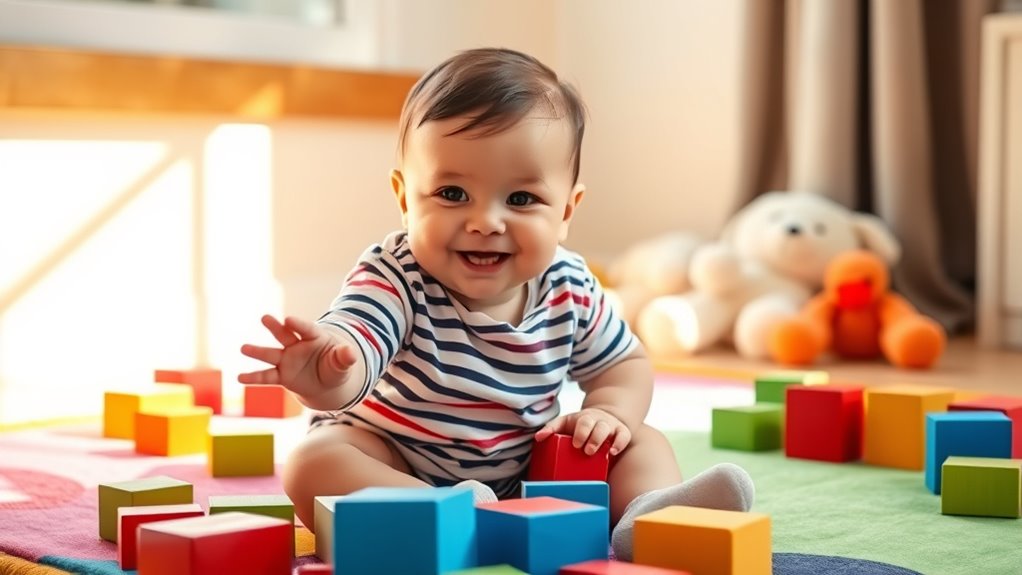

To help your baby stack blocks, start with a stable seating position and provide blocks of different sizes for gripping practice. Use cups or cans for added variety. Demonstrate stacking using a hand-over-hand technique, guiding their hands as they attempt to balance the blocks. Celebrate each stacking success to keep their motivation high. As you explore different shapes and sizes, you’ll discover even more ways to enhance their stacking experience and support their development.
Key Takeaways
- Ensure your baby has a stable seating position to enhance focus during stacking activities.
- Provide blocks of varying sizes to improve grasping skills and encourage exploration.
- Use the hand-over-hand technique to guide your baby’s hands while stacking blocks.
- Celebrate every stacking attempt to build your baby’s confidence and persistence.
- Introduce different shapes and sizes of blocks to challenge balance and encourage creativity.
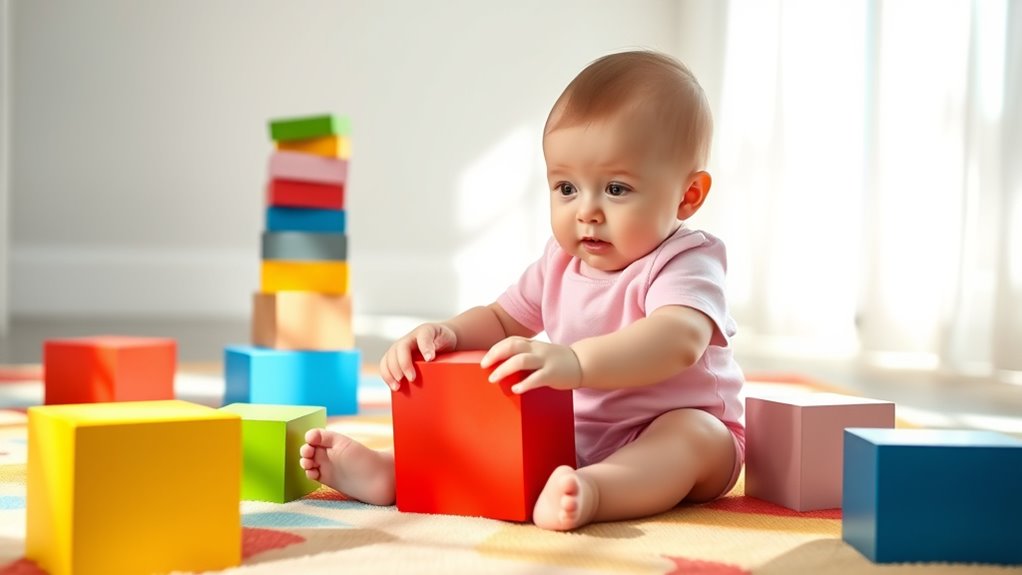
When your baby reaches around 7 to 9 months, introducing stacking blocks can be a fantastic way to spark their sensory exploration. At this age, babies love to mouth and bang blocks together, helping them understand different textures and weights. This sensory play is crucial for their development as they begin to grasp the properties of objects around them. As you watch your little one engage with these blocks, you’ll see their motor skills start to blossom.
Early block play is instrumental in developing hand-eye coordination and fine motor skills. By encouraging your baby to stack, you’re helping them refine their grasp and control over their movements. To foster this skill, model how to stack the blocks yourself. As they watch you carefully place one block on top of another, they’ll be eager to imitate your actions. This parental involvement not only enhances their learning experience but also strengthens your bond.
Encouraging block stacking refines your baby’s motor skills while strengthening your bond through shared play and learning.
As your baby grows, you’ll notice their stacking abilities evolve. Between 11 to 12 months, they might try to stack one block on another, even if they struggle with balance. By 12 to 16 months, many toddlers can stack two blocks without them toppling over, and by 16 to 18 months, they can manage three blocks. By 2 to 3 years, they’ll be stacking more blocks and starting to create simple structures. It’s fascinating to witness this progression, and your encouragement plays a significant role.
To help your baby succeed, ensure they sit in a stable position while playing. This stability allows them to focus better on their hand movements. Providing objects of varying sizes can also be beneficial, as it encourages practice in grasping. You might even use alternative items like cups or cans for added variety. If they struggle, try guiding their hands with a hand-over-hand technique to demonstrate the stacking motion.
Celebrate each attempt, even if the blocks fall over. This praise fosters persistence and encourages them to try again. As they engage in stacking, they’re developing fine motor skills, problem-solving abilities, and even language skills through contextual vocabulary.
Introduce different shapes and sizes of blocks as they advance. This not only enriches their experience but also challenges them to think critically about balance and structure. Remember, each stack they build is a step toward mastering new skills and enjoying the joy of creation. With your support, they’ll thrive in their stacking adventures.

Fisher-Price Baby’s First Blocks & Rock-a-Stack Toy Set
- Includes Stacking Ring and Blocks: Baby's First Blocks and Rock-a-Stack set
- Colorful Rock-a-Stack: 5 rings and rocker base for fun
- Stacking and Sorting: 10 colorful blocks with storage bucket
As an affiliate, we earn on qualifying purchases.
As an affiliate, we earn on qualifying purchases.
Frequently Asked Questions
What Age Do Babies Typically Start Stacking Blocks?
Babies typically start stacking blocks between 10 to 15 months old. At first, they might only manage to place one block on top of another.
As they grow, you’ll notice them becoming more skilled, stacking two or three blocks independently by 16 to 18 months.
This activity is crucial for their fine motor skills and cognitive development, so it’s exciting to watch them progress and gain confidence in their abilities!
Are There Specific Block Types That Are Best for Stacking?
When choosing block types for stacking, consider both soft and wooden options.
Soft blocks are lightweight, safe, and perfect for sensory play, making them great for younger babies. Wooden blocks, on the other hand, are durable and teach shapes and sizes, ideal for older toddlers.
Both types enhance fine motor skills and hand-eye coordination. You’ll want to provide a variety to keep your baby engaged and encourage their stacking abilities effectively.
How Can I Encourage My Baby if They Get Frustrated?
Frustration can feel overwhelming, yet it also presents a chance for growth.
To encourage your baby during these moments, offer praise for their efforts, even when they struggle. Acknowledge their feelings, showing you understand their frustration.
Simplify tasks to prevent overwhelm, and provide gentle support when needed. Maintain patience and consistency, turning these challenges into valuable learning experiences.
What Safety Precautions Should I Take While Baby Plays With Blocks?
When your baby plays with blocks, prioritize safety by creating a secure environment.
Clear the area of tripping hazards and sharp objects, and always supervise them to prevent accidents. Choose sturdy blocks that are age-appropriate and large enough to avoid choking hazards.
Use soft flooring to cushion falls, and regularly inspect the blocks for any damage.
Don’t forget to store them safely when not in use to keep everything organized and secure.
How Can Stacking Blocks Benefit My Baby’s Development?
Stacking blocks benefits your baby’s development in numerous ways.
It enhances fine motor skills, helping your little one gain muscle control and dexterity. As they stack, they explore problem-solving and spatial reasoning, boosting cognitive growth.
You’ll notice improvements in their focus and emotional resilience through trial and error. Plus, it promotes imaginative play, encouraging creativity.
Engaging in stacking also strengthens your bond, making it a fun and educational experience for both of you.

Melissa & Doug Wooden Building Blocks, 100-Piece Set of Sorting & Stacking Toys in 4 Colors and 9 Shapes, Classic Toddler Toys for Girls & Boys Ages 2+ – FSC Certified
- Endless Building Possibilities: Stack, balance, and knock down blocks
- 100 Durable Wooden Blocks: Includes 4 colors and 9 shapes
- Storage in Sturdy Toy Box: Neatly store blocks with carrying handle
As an affiliate, we earn on qualifying purchases.
As an affiliate, we earn on qualifying purchases.
Conclusion
Helping your baby stack blocks is a fun way to boost their fine motor skills and hand-eye coordination. Remember, it’s all about patience and practice—don’t rush the process. Celebrate their small victories, as every block stacked is a step toward their development. Before you know it, they’ll be building towers that reach for the sky! So, keep encouraging them; after all, practice makes perfect, and soon they’ll be stacking like a pro!

Jyusmile Baby Toys 6-12 Months, Montessori Toy for Babies 6-12 Months, Incl Stacking Building Blocks & Soft Infant Teething Toys & Sensory Balls for Toddlers 0-3-6-9-12 Month
- 3-in-1 Baby Toy Set: Includes 24 pieces with blocks, rings, balls
- Educational Developmental Toys: Teaches colors, shapes, textures, and skills
- Sensory Stacking Toys: Includes stacking rings, textured balls, squeak sounds
As an affiliate, we earn on qualifying purchases.
As an affiliate, we earn on qualifying purchases.
Melissa & Doug Wooden Building Blocks, 100-Piece Set of Sorting & Stacking Toys in 4 Colors and 9 Shapes, Classic Toddler Toys for Girls & Boys Ages 2+ – FSC Certified
- Endless Building Possibilities: Stack, balance, and knock down blocks
- 100 Durable Wooden Blocks: Includes 4 colors and 9 shapes
- Storage in Sturdy Toy Box: Neatly store blocks with carrying handle
As an affiliate, we earn on qualifying purchases.
As an affiliate, we earn on qualifying purchases.