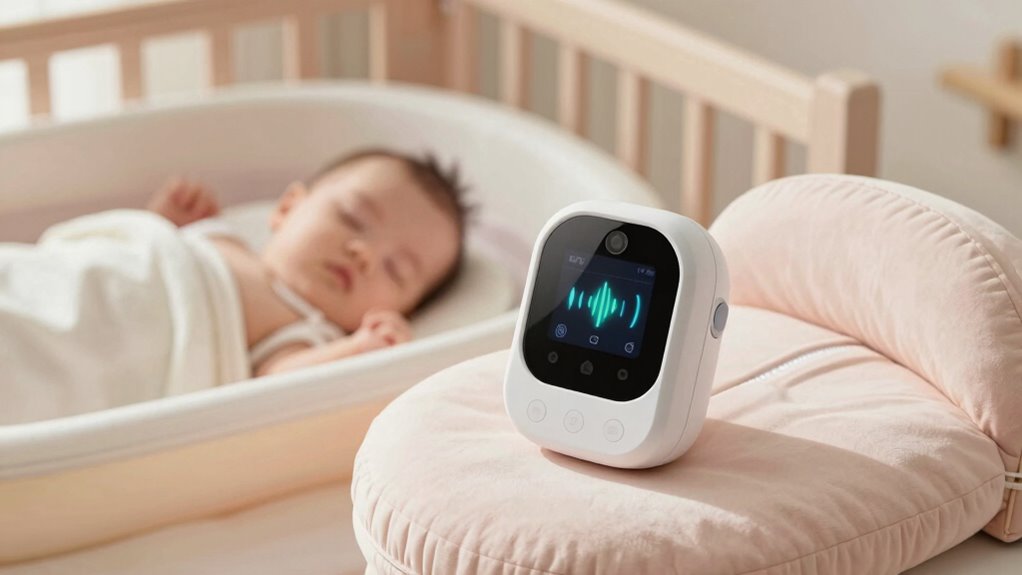

The best baby monitor with breathing detection for most families is the Babysense True Sleep HD, pairing a camera and audio monitor with two non-contact under-mattress sensors and no Wi-Fi. For a wearable alternative, the Snuza Hero tracks movement at the baby’s diaper, while the Nanit Smart Baby Video Monitor adds a Wi-Fi camera and sleep-tracking features. The main choice is between wearable and under-mattress sensing, with camera access, connectivity, and setup needs as further tradeoffs. Breathing and movement monitors have different sensing methods, so match the device to your sleep setup and follow its instructions. Read on for how the seven options compare and which type of family each suits best.

Turn the school run and nap time into listening time
- Thousands of audiobooks, podcasts and originals
- Listen on your phone, tablet or Echo — also offline
- Cancel anytime
Complete the kit


Key Takeaways
- Babysense True Sleep HD stands out for combining a camera and audio monitor with two non-contact under-mattress sensors in a no-Wi-Fi setup.
- Babysense 7 strips the setup back to two sensor pads and no Wi-Fi, making it a focused choice for families who already have a separate way to monitor video or sound.
- Snuza Hero and Levana Oma Sense attach to the baby rather than sitting under the mattress, a meaningful difference for families who want a portable wearable sensor.
- Nanit’s two listings serve different needs: the camera-and-floor-stand version is camera-centered, while the system with an 8-inch display pairs its smart monitor with a dedicated screen.
- Lollipop adds Wi-Fi video, crying detection, and sleep tracking, but it does not replace a dedicated breathing-movement sensor in this lineup.
| Nanit Smart Baby Video Monitor – Camera & Floor Stand – 1080p Wi‑Fi Camera |  | Best for Connected Sleep Insights | Video resolution: 1080p HD | Connectivity: Wi-Fi; local network viewing supported | Night vision: Infrared | VIEW ON AMAZON | See Our Full Breakdown |
| Levana Oma Sense Portable Baby Breathing Movement Monitor |  | Best Wearable Breathing-Movement Pick | Age range: 0–6 months | Technology: Patented Wakeup Technology | Monitoring method: Wearable abdominal-movement monitoring | VIEW ON AMAZON | See Our Full Breakdown |
| Snuza Hero Baby Movement Monitor with Patented Sensor Technology |  | Best Compact Wearable Monitor | Model: 10SUH23 | Sensor type: Activity | Battery life: Up to 6 months | VIEW ON AMAZON | See Our Full Breakdown |
| Babysense True Sleep HD Baby Monitor with Camera and Audio + Baby Sleep Movement Monitor, No WiFi, 2 Non-Contact Under Mattress Sensors |  | Best All-in-One No-Wi-Fi Crib System | Display size: 5 inches | Sensor type: Two non-contact under-mattress sensors | Connectivity: No Wi-Fi | VIEW ON AMAZON | See Our Full Breakdown |
| Babysense 7 Baby Movement Monitor System with 2 Sensor Pads, Non-Wearable, No WiFi |  | Best Value in a Dedicated Movement-and-Video System | Monitor screen: 2.4 inches | Camera resolution: Full HD 1080p | Camera movement and zoom: Pan 355°, tilt 90°, and 4x zoom | VIEW ON AMAZON | See Our Full Breakdown |
| Lollipop Baby Monitor (Turquoise) – Smart Wi-Fi Camera with Crying Detection and Sleep Tracking |  | Best for Contactless AI Alerts | Video resolution: 1080p Full HD | Monitoring features: Breathing, sleep, crying, and boundary-crossing detection | Connectivity: Wi-Fi | VIEW ON AMAZON | See Our Full Breakdown |
| Nanit Smart Baby Video Monitor System with Floor Stand & 8″ Display Screen |  | Best for Multi-Screen Sleep Tracking | Camera resolution: 1080p HD | Display: 8-inch touchscreen | Portable display battery life: 3–6 hours | VIEW ON AMAZON | See Our Full Breakdown |
| baby monitors with breathing detection | Connectivity |
|---|---|
| Nanit Smart Baby Video Monitor | Wi-Fi; local network viewing supported |
| Levana Oma Sense Portable Baby | No Wi-Fi, radio, or Bluetooth |
| Snuza Hero Baby Movement Monit | No Wi-Fi or cords |
| Babysense True Sleep HD Baby M | No Wi-Fi |
| Babysense 7 Baby Movement Moni | No Wi-Fi or app |
| Lollipop Baby Monitor | Wi-Fi |
| Nanit Smart Baby Video Monitor | — |
More Details on Our Top Picks
Nanit Smart Baby Video Monitor – Camera & Floor Stand – 1080p Wi‑Fi Camera
I’d choose the Nanit when breathing detection is not the only priority and I also want detailed video, sleep analytics, and customizable room alerts. Its 1080p camera, infrared night vision, and two-way audio support everyday visual monitoring, while Nanit Insights adds sleep analysis and coaching during the included three-month trial. Unlike the Levana Oma Sense and Babysense 7, this is a Wi-Fi camera rather than a dedicated movement monitor: the supplied details do not describe breathing or movement detection. That distinction matters for families seeking a monitor specifically to alert them to absent movement. The tradeoff is a more connected setup, with advanced analytics requiring a subscription after the trial and full functionality depending on Wi-Fi. I’d rank it for broader sleep monitoring, not as a substitute for a movement sensor.
Pros:- 1080p video with infrared night vision supports clear viewing in dark rooms
- Motion, sound, temperature, and humidity alerts can suit families who want more than basic video notifications
- Multiple caregiver access is paired with 256-bit AES encryption and two-factor authentication
- Floor-stand or wall-mount setup gives more placement flexibility than the wearable Levana Oma Sense
Cons:- The supplied product details do not list breathing or movement detection
- Advanced sleep analytics require a paid subscription after the three-month trial
- Full functionality depends on Wi-Fi connectivity
Best for: Parents who want high-resolution video, room-condition alerts, and sleep analytics in a connected camera system
Not ideal for: Families specifically seeking a breathing or movement sensor, or those who want monitoring without Wi-Fi or an ongoing subscription
- Video resolution:1080p HD
- Connectivity:Wi-Fi; local network viewing supported
- Night vision:Infrared
- Audio:Two-way
- Alerts:Customizable motion, sound, temperature, and humidity
- Mount options:Floor stand or wall mount
- Security:256-bit AES encryption and two-factor authentication
- Included trial:Three-month Nanit Insights Sleep Plan
Our verdict“Choose the Nanit for connected video and sleep insights, but pick the Levana Oma Sense or a Babysense movement system if breathing or movement alerts are your main need.”
Levana Oma Sense Portable Baby Breathing Movement Monitor
The Levana Oma Sense is the most direct fit here for parents seeking a wearable movement monitor: it tracks abdominal movement and responds to a lack of detected movement with randomized vibrations, followed by an audible alarm if needed. Its no-wireless design sets it apart from the Nanit camera, which offers video and sleep insights but does not list breathing detection in the supplied details. It also avoids under-mattress sensor placement, unlike the Babysense 7, though it must be attached to the baby’s clothing or diaper. That makes portability simple but adds a daily fit-and-attachment step. The age range is limited to birth through six months, so this is a focused early-infancy option rather than a monitor that grows with a child. I’d skip it if you want video, room audio, or long-term use from one device.
Pros:- Tracks abdominal movement and provides alerts when movement is not detected
- Randomized vibration stimulation may prompt a response before the audible alarm
- No Wi-Fi, radio, or Bluetooth connection is required
- Medical-grade materials and a visual flashing-light indicator are specified
Cons:- Designed only for infants aged zero to six months
- Must attach to a diaper, pants, or onesie, adding a fit check to routine use
- Does not provide video monitoring or the camera features available with Babysense True Sleep HD
Best for: Caregivers of newborns through six months who want a portable abdominal-movement monitor without Wi-Fi, radio, or Bluetooth
Not ideal for: Families wanting video monitoring, a device usable beyond six months, or a system that does not need to attach to clothing or a diaper
- Age range:0–6 months
- Technology:Patented Wakeup Technology
- Monitoring method:Wearable abdominal-movement monitoring
- Alert types:Vibration, audible alarm, and flashing light
- Materials:Medical grade
- Connectivity:No Wi-Fi, radio, or Bluetooth
Our verdict“Choose the Levana for portable, connection-free movement monitoring during the first six months if you are comfortable attaching it to your baby’s clothing.”
Snuza Hero Baby Movement Monitor with Patented Sensor Technology
For a compact movement monitor, the Snuza Hero SE keeps the setup simple: it clips to a diaper, detects movement with an activity sensor, and gives visual and audible alerts without Wi-Fi or cords. At 1.38 ounces, it is a portable alternative to the larger crib-based Babysense 7, whose sensor pads need to sit under the mattress. The Snuza’s stated battery life of up to six months also reduces routine charging, although the battery must eventually be replaced. Unlike the Levana Oma Sense, the supplied description does not mention vibration stimulation; its listed alerts are visual and audible. This is a movement monitor, not a video camera or medical diagnostic device, and the product is not suitable for co-sleeping or bed-sharing. I’d favor it for straightforward portability, not for a complete room-monitoring setup.
Pros:- Compact 1.38-ounce design clips to a diaper for portable use
- No Wi-Fi, cords, or under-mattress sensor pads are required
- Visual and audible alerts provide more than one notification method
- Battery life is specified as up to six months
Cons:- Requires battery replacement for continued operation
- Not suitable for co-sleeping or bed-sharing, according to the product details
- Does not include video or two-way audio like Babysense True Sleep HD
Best for: Parents who want a lightweight, cord-free movement monitor that attaches to a diaper and can be moved between sleep spaces
Not ideal for: Families who co-sleep or bed-share, want a camera and audio monitor, or prefer a non-wearable sensor pad system
- Model:10SUH23
- Sensor type:Activity
- Battery life:Up to 6 months
- Materials:Plastic and silicone
- Dimensions:2.76 × 1.57 × 0.79 inches
- Weight:1.38 ounces
- Alerts:Visual and audible
- Connectivity:No Wi-Fi or cords
Our verdict“Pick the Snuza Hero SE for compact, wearable movement monitoring without a network connection, provided you do not need video or bed-sharing compatibility.”
Babysense True Sleep HD Baby Monitor with Camera and Audio + Baby Sleep Movement Monitor, No WiFi, 2 Non-Contact Under Mattress Sensors
The Babysense True Sleep HD combines under-mattress movement sensing with a dedicated video-and-audio monitor, making it a stronger fit than the camera-only Nanit for families who want both crib movement alerts and local viewing. Its two non-contact sensor pads monitor micro-movements through the mattress, while the 5-inch display, pan-and-tilt camera, night vision, and night light support hands-on nursery monitoring. Two-way audio, lullabies, and white noise add soothing options without relying on an app or internet connection. Compared with the Babysense 7, this bundle emphasizes a larger display and camera features alongside movement monitoring. The tradeoff is that it is a dedicated local system: there is no Wi-Fi remote access, and the sensors require batteries that may need replacement. I’d choose it for a crib-centered setup, not for checking in from outside the home.
Pros:- Two non-contact under-mattress sensors monitor movement without attaching a device to the baby
- 5-inch display and adjustable PTZ camera provide a dedicated local viewing setup
- Two-way audio, lullabies, and white noise add remote soothing options
- Infrared night vision and a night light support nighttime monitoring
Cons:- No Wi-Fi means no internet-based remote viewing
- Sensor batteries may need frequent replacement
- Under-mattress placement makes it less portable than the Snuza Hero SE
Best for: Families who want under-mattress movement monitoring, a larger local display, and camera-based soothing features without Wi-Fi
Not ideal for: Caregivers who need app-based viewing away from home or want a wearable monitor that can move easily between sleep spaces
- Display size:5 inches
- Sensor type:Two non-contact under-mattress sensors
- Connectivity:No Wi-Fi
- Camera:Remote PTZ camera with night light
- Night vision:Infrared
- Audio features:Two-way audio, lullabies, and white noise
- Sensor power:Alkaline batteries
- Model:TRUESLEEP-1CAM
Our verdict“Choose Babysense True Sleep HD for a local, crib-based system that pairs movement sensing with video and soothing features, rather than remote app access.”
Babysense 7 Baby Movement Monitor System with 2 Sensor Pads, Non-Wearable, No WiFi
The Babysense 7 suits families who want non-wearable movement sensing and a dedicated monitor without Wi-Fi or a subscription. Its two sensor pads sit under the mattress, while the included camera offers pan, tilt, zoom, and night vision; the system can also expand to up to four cameras. Compared with the Babysense True Sleep HD, this model lists a smaller 2.4-inch screen but specifies 1080p camera resolution, two included cameras, and up to 20 hours in ECO Mode. The tradeoff is a more involved crib setup: the pads need correct placement beneath the mattress, and the local-only design cannot provide app access away from home. I’d favor it over the wearable Snuza when a fixed crib setup and multi-camera expansion matter more than portability.
Pros:- Two under-mattress pads provide non-wearable movement monitoring
- Camera includes pan, tilt, 4x zoom, and night vision
- No Wi-Fi, app, or subscription is required for operation
- System supports expansion to up to four cameras
Cons:- Sensor pads require under-mattress placement, which can complicate setup
- No app or internet-based remote access is available
- The bundle includes two cameras, and additional cameras must be purchased separately
Best for: Families who want a subscription-free, local movement-and-video system with two sensor pads and room to add cameras
Not ideal for: Parents who need remote app viewing, want a portable wearable monitor, or do not want to place sensors beneath the mattress
- Monitor screen:2.4 inches
- Camera resolution:Full HD 1080p
- Camera movement and zoom:Pan 355°, tilt 90°, and 4x zoom
- Sensor pads:Two ultra-sensitive under-mattress pads
- Connectivity:No Wi-Fi or app
- Battery life:Up to 20 hours in ECO Mode
- Camera expandability:Up to 4 cameras
- Alarm:Loud alarm and flashing light if no movement is detected
- Included cameras:2
Our verdict“Choose the Babysense 7 for a fixed crib setup with local movement alerts and expandable video, but skip it if remote app access or portability is a priority.”
Lollipop Baby Monitor (Turquoise) – Smart Wi-Fi Camera with Crying Detection and Sleep Tracking
The Lollipop pairs contactless breathing and sleep monitoring with 1080p live video, making it a flexible choice for parents who want more than movement alerts alone. Its AI can also flag crying and movement beyond designated borders, while continuous audio, lullabies, and secure family sharing add useful day-to-day functions. Compared with the Babysense True Sleep HD, which uses dedicated under-mattress sensors and does not require Wi-Fi, Lollipop relies on a connected camera and network for its full feature set. That makes it less suited to households prioritizing offline monitoring, but more appealing to parents who want app-based alerts and video in one system. A free plan is available, though extended features and triggered-video storage may be limited or require a subscription.
Pros:- Contactless AI breathing and sleep monitoring without a wearable sensor
- 1080p live video provides a clear view through the app
- Crying and boundary-crossing alerts add monitoring beyond breathing
- Free plan and secure family sharing support everyday access
Cons:- Full functionality depends on a reliable Wi-Fi connection
- Extended features may require a subscription
- Triggered-video storage duration is limited
Best for: Parents who want app-based, contactless breathing and sleep alerts alongside live video, crying detection, and secure sharing with family.
Not ideal for: Families seeking breathing monitoring that works without Wi-Fi, or those who prefer a dedicated sensor system over camera-based AI.
- Video resolution:1080p Full HD
- Monitoring features:Breathing, sleep, crying, and boundary-crossing detection
- Connectivity:Wi-Fi
- Audio:Continuous audio monitoring, lullabies, and nature sounds
- Plan options:7-day free trial and a forever-free plan
- Family sharing:Secure cloud invitations for family members
Our verdict“Choose Lollipop if you want contactless AI breathing alerts integrated with app video and crying detection, but skip it if Wi-Fi independence is your priority.”
Nanit Smart Baby Video Monitor System with Floor Stand & 8″ Display Screen
This Nanit system stands out for combining 1080p video and AI sleep insights with an included 8-inch touchscreen display, so caregivers are not limited to checking a phone. It tracks sleep patterns, room conditions, and milestones, while two-way audio and background audio mode support everyday monitoring. Compared with the Lollipop Baby Monitor, its supplied display and offline local monitoring provide another way to check in when internet service is disrupted; however, the listed breathing features are less explicit than Lollipop’s contactless breathing detection. The portable display’s 3–6-hour battery life also makes it better for shorter stretches away from its charger than all-day portability. Basic streaming and alerts are free, but advanced analytics require a subscription, and initial setup needs a Wi-Fi router and internet connection.
Pros:- Included 8-inch touchscreen gives caregivers a dedicated viewing option beyond a phone
- AI automatically tracks sleep patterns and milestones
- Local monitoring is available during internet outages
- Temperature and humidity sensors add nursery-condition information
Cons:- Advanced analytics require a paid subscription after the free trial
- Portable display battery lasts only 3–6 hours
- Initial camera setup requires a Wi-Fi router and internet connection
Best for: Caregivers who want an included touchscreen monitor, app and smart-speaker viewing, plus sleep tracking and nursery temperature and humidity readings.
Not ideal for: Buyers whose main requirement is clearly specified breathing detection, or families who need a portable display to run unplugged for a full day.
- Camera resolution:1080p HD
- Display:8-inch touchscreen
- Portable display battery life:3–6 hours
- Portable display charging time:Under 2.5 hours
- Sensors:Temperature and humidity
- Audio:Two-way audio with background audio mode
- Mount options:Floor stand or wall mount
- Compatibility:iOS, Android, Alexa, and Google Home
- Age range:0–4 years
Our verdict“Pick this Nanit for flexible viewing and sleep insights with a dedicated display, but choose a monitor with explicit breathing detection if that is your main deciding factor.”
How We Picked
I ranked these baby monitors with breathing detection by how directly their listed features address movement monitoring, then weighed what a family gets alongside that function: video and audio, connection type, portability, and setup requirements. I gave extra weight to options that clearly specify a breathing or movement sensor and make its placement understandable. Wearable sensors, under-mattress pads, and camera-based sleep features serve different purposes, so I treated them as distinct approaches rather than interchangeable claims.
Babysense True Sleep HD leads because it combines two non-contact sensors with a camera and audio unit while staying off Wi-Fi. Babysense 7 follows for a simpler movement-focused setup, while the wearable Levana and Snuza models suit families prioritizing portable sensing over a nursery camera. The Nanit models rank as camera-led systems with sleep-related features, and Lollipop ranks as a smart video option rather than a dedicated movement monitor. The product details provided do not establish clinical performance or medical use, so the rankings focus on stated features, practical fit, and tradeoffs—not health claims.
| baby monitors with breathing detection | Connectivity |
|---|---|
| Nanit Smart Baby Video Monitor | Wi-Fi; local network viewing supported |
| Levana Oma Sense Portable Baby | No Wi-Fi, radio, or Bluetooth |
| Snuza Hero Baby Movement Monit | No Wi-Fi or cords |
| Babysense True Sleep HD Baby M | No Wi-Fi |
| Babysense 7 Baby Movement Moni | No Wi-Fi or app |
| Lollipop Baby Monitor | Wi-Fi |
| Nanit Smart Baby Video Monitor | — |
Factors to Consider When Choosing Baby Monitors With Breathing Detection
Before choosing among wearable sensors, under-mattress pads, and smart cameras, decide what kind of alert and monitoring setup you actually want. These systems differ in where they detect movement, what else they monitor, and how much connectivity they require; a feature label alone does not make them equivalent.
Choose the sensing method around your sleep setup
An under-mattress sensor avoids attaching a device to the baby, but it depends on compatible placement beneath the sleep surface. A wearable monitor travels with the baby and can suit families who value portability, though it must be attached as directed and may need repositioning after changes such as a diaper change. Do not assume a sensor designed for one sleep surface will work the same way on another. Check the manufacturer’s instructions for mattress and crib compatibility before buying. If you expect to use the monitor in more than one sleep space, portability and sensor-placement requirements may matter more than camera features.
Separate movement alerts from video and sleep tracking
A monitor that offers video, crying detection, or sleep tracking is not automatically a dedicated breathing-movement monitor. Check exactly what the product detects, where its sensor sits, and what event triggers an alert. Families who want a view of the nursery may prefer a camera system, while those prioritizing movement sensing may find a dedicated sensor more relevant. Some products combine these functions, while others require a separate camera or audio device. Avoid choosing based on a broad label such as “smart monitoring” without confirming the specific sensing function you need.
Decide whether Wi-Fi fits your household
No-Wi-Fi systems can simplify the connection setup and appeal to families who prefer a dedicated local monitor. Wi-Fi cameras can support remote viewing and connected features, but they depend on a network and may involve app setup or account management. Think about where you need to check the monitor: at home with a dedicated screen, or away from the nursery through a connected device. Confirm which parts of the system still work if your internet connection is unavailable. A camera with a display may offer a different routine than a phone-first camera, even when both provide video.
Plan for sensor placement and everyday upkeep
Placement affects how a monitor fits into everyday care, so read the setup directions before the first night rather than improvising. Wearable sensors need correct attachment, while under-mattress systems need the pads positioned as specified beneath the sleep surface. Ask whether the device needs charging, batteries, cleaning, or periodic repositioning, and check what the package includes. For households using multiple sleep spaces, think through how much setup must be repeated each time. A system that looks simple on paper may be less convenient if its required placement conflicts with your routine.
Treat alerts as monitoring information, not medical advice
Breathing and movement monitors are not substitutes for safe-sleep practices or medical care, and product descriptions do not establish that a device can prevent or diagnose a health problem. Read the alert instructions carefully, including what the device monitors and what you should do when it signals. Ask your child’s clinician whether a specific monitor makes sense if you have a medical concern or have been advised to use one. Avoid buying extra features on the assumption that they provide clinical reassurance. The most useful system is one you can set up as directed and interpret without mistaking an alert for a diagnosis.
Frequently Asked Questions
Are an under-mattress sensor and a wearable movement monitor interchangeable?
No. Under-mattress pads and wearable sensors detect movement from different positions and have different setup requirements. A pad must be placed beneath the sleep surface as its manufacturer directs, while a wearable unit must be attached to the baby correctly. The right choice depends on the sleep setup, portability needs, and instructions for the specific device. Check compatibility rather than assuming one type can replace the other.
Should I choose a breathing monitor with a camera?
Choose a camera if seeing the nursery or checking video is part of what you want from the system. A camera adds a visual monitoring function, but video and breathing-movement sensing are separate capabilities; confirm both are explicitly included if you want both. A dedicated movement monitor may better fit someone who already has a camera or does not need video. Also compare how each model connects and whether it uses a phone app or a separate display.
Is a no-Wi-Fi monitor the better choice?
It depends on where and how you want to monitor. No-Wi-Fi models such as the Babysense options may appeal if you prefer a setup that does not rely on home internet, while Wi-Fi cameras can offer connected viewing features. A network-dependent camera may not suit a household that wants remote access without internet service. Check the product’s instructions for what remains available during a connection outage. Decide whether a dedicated screen or phone access better matches your routine before focusing on connectivity alone.
Can I use a movement monitor with any mattress or crib?
Do not assume that every sensor works with every sleep surface. Under-mattress pads rely on the placement and compatibility instructions for that specific model, and wearable devices have their own attachment directions. Review the manufacturer’s stated setup requirements for the mattress, crib, and any additional sleep space you plan to use. If the instructions do not clearly cover your setup, ask the manufacturer before relying on the device. Correct setup matters more than choosing a model with extra features.
Can a breathing-detection monitor replace guidance from my child’s clinician?
No. A consumer monitor is a monitoring device, not a diagnosis or treatment, and its alerts should not be read as a medical assessment. Follow safe-sleep guidance and the monitor’s own instructions. If you have a health concern or have been told to monitor your baby’s breathing or movement, ask your child’s clinician which approach is appropriate. Product features alone do not establish that a monitor is suitable for a medical need.
Conclusion
Best overall: I recommend the Babysense True Sleep HD for families who want movement sensing, camera, and audio in one no-Wi-Fi setup. Best value: Babysense 7 is the more focused pick when you want two non-wearable sensor pads and do not need a camera included. Best for beginners: the True Sleep HD is a straightforward starting point for someone who wants the main monitoring pieces together, provided its placement instructions fit the sleep setup. Best premium: Nanit’s camera-and-floor-stand system with an 8-inch display suits buyers who prioritize a dedicated screen and connected camera features, while its breathing-related feature fit should be checked against the exact product details. Best for specific needs: choose Snuza Hero or Levana Oma Sense for a portable wearable approach, and Lollipop for smart video and crying detection rather than dedicated movement sensing. Match the sensing method to your routine, then verify compatibility and setup guidance before deciding.
Fall Picks
fall essentials
As an affiliate, we earn on qualifying purchases.