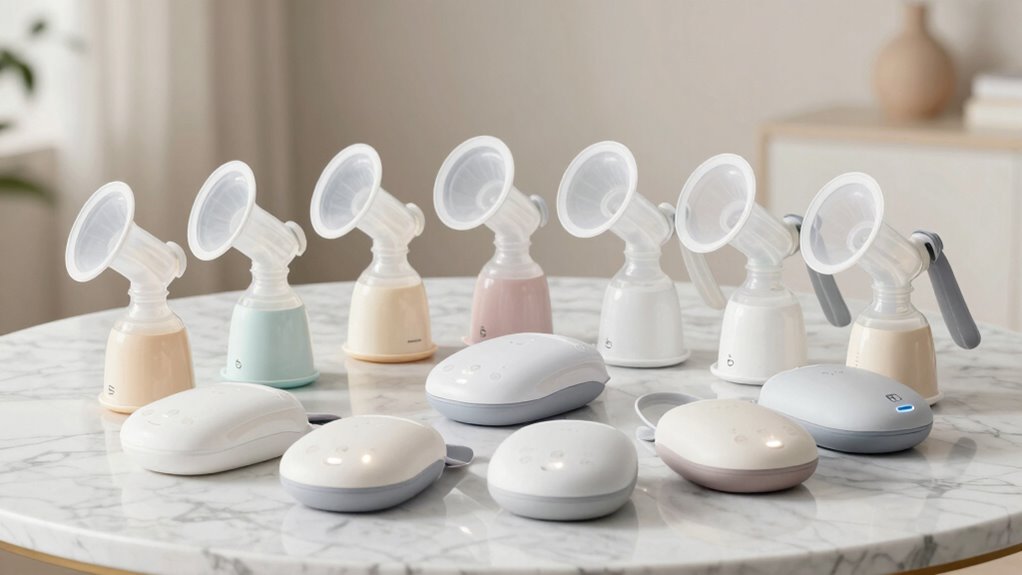
If you want a wearable breast pump with strong suction, the Lulia Hands-Free model with a stated 380 mmHg maximum is the clearest choice by published suction figure. The Paruu P16 Pro is another standout, listing 309 mmHg alongside a long stated battery runtime, while the eufy S1 and Momcozy Wellness 1 add heat-focused features. A high maximum does not guarantee better milk removal: flange fit, comfort, and usable controls matter just as much. Heated models add another tradeoff, bringing extra features and care needs rather than a direct suction advantage. Read on for how these 15 options compare and which one best fits your priorities.

Turn the school run and nap time into listening time
- Thousands of audiobooks, podcasts and originals
- Listen on your phone, tablet or Echo — also offline
- Cancel anytime
Complete the kit


Key Takeaways
Published suction figures separate the clearest high-suction contenders: the Lulia Hands-Free model lists 380 mmHg, while the Paruu P16 Pro lists 309 mmHg; specifications alone do not establish real-world output.
The MY-375 and Paruu P16 Pro offer adjustable control: both list four modes and 12 levels, giving more adjustment steps than the nine-level models in this lineup.
Heat is a separate buying priority, not a suction ranking: the NCVI, Momcozy Wellness 1, and eufy S1 emphasize warming features, which may appeal to buyers who want heat but add another factor beyond vacuum strength.
Flange sizing varies widely: the Lulia Hands-Free model lists 17, 19, 21, and 24 mm options, while the HORIGEN D6 lists a 15–25 mm double-sealed flange; buyers should verify what is included and what fits.
App control and simple onboard controls serve different routines: Momcozy M5 and Wellness 1 offer app-connected features, while models such as the S21 foreground straightforward mode and vacuum-level adjustments.


| wearable breast pump with strongest suction | Modes | Flange sizes |
|---|---|---|
| Wearable Hands-Free Breast Pum | 4 | — |
| NCVI Heated Breast Pump Wearab | — | — |
| Paruu P16 Pro Wearable Breast | 4: Stimulation, Expression, Lactation, Traction | — |
| MomMed Wearable Breast Pump | 3: Stimulation, Expression, Auto | — |
| Lulia Breast Pump Hands Free | 4: Massage, Expression, Comfort, Mixed | 17 mm, 19 mm, 21 mm, 24 mm |
| Momcozy M5 Smart APP Controlle | — | 17mm, 19mm, 21mm, 24mm |
| Momcozy M5 Smart APP Controlle | — | 17mm, 19mm, 21mm, 24mm |
| Momcozy Wellness 1 Wearable Br | 4 | — |
| eufy Heated Wearable Breast Pu | — | 17mm–24mm |
| Breast Pump Hands Free | 4 | 19mm, 21mm, 24mm |
| HORIGEN D6 Hands-Free Wearable | Stimulation, pumping, mixed | 15 mm, 17 mm, 21 mm, 25 mm |
| Lulia Hands-Free Wearable Brea | 4: massage, comfort, suction, mixed | 17 mm, 19 mm, 21 mm, 24 mm |
| Paruu P10 Pro Wearable Electri | 4: stimulation, expression, lactation, traction | — |
| Wearable Breast Pump S12 | — | 17 mm, 19 mm, 21 mm |
| Paruu P20 Hands-Free Wearable | 4: stimulation, expression, lactation, traction | 19 mm, 21 mm, 24 mm |
More Details on Our Top Picks
Wearable Hands-Free Breast Pump MY-375 – Strong Suction, Low Noise, Portable Electric Pump with 4 Modes & 12 Levels, 19/21/24 mm Inserts, 2-Pack (White)
The MY-375 leads this group on stated suction, reaching up to 350 mmHg—above the Paruu P16 Pro’s 309 mmHg and the NCVI’s 300 mmHg. That headroom gives buyers who need a stronger vacuum range a more compelling starting point, while four modes and 12 levels leave room to tune intensity rather than relying on a single strong setting. Its three included insert sizes also offer more fit flexibility than the P16 Pro’s 24 mm-only flange. A 210 ml collection bowl can reduce interruptions for emptying, and operation below 40 dB is quieter on paper than the other listed models with stated noise figures. The tradeoff is a roughly 150-minute battery, or up to six sessions, so frequent users may need to plan charging. Buyers seeking the strongest listed suction should still treat fit and comfort as personal factors, not assume peak vacuum will suit everyone.
Pros:- Highest stated maximum suction among these five models at 350 mmHg
- Four modes and 12 intensity levels allow a broad range of settings
- Includes 19 mm, 21 mm, and 24 mm silicone inserts
- 210 ml bowl and stated noise below 40 dB support longer, quieter sessions
Cons:- Battery runtime is about 150 minutes, or up to six sessions, before recharging
- A high maximum suction figure does not establish that the pump will feel comfortable or work best for every user
Best for: Wearable-pump shoppers prioritizing the highest stated suction in this group, with multiple intensity settings and several included insert sizes.
Not ideal for: People who need a longer stated runtime than about six sessions per charge, or who prefer to avoid choosing among suction settings and insert sizes.
- Maximum suction:Up to 350 mmHg
- Modes:4
- Intensity levels:12
- Battery runtime:About 150 minutes; up to 6 sessions per charge
- Noise level:Below 40 dB
- Milk bowl capacity:210 ml (7 oz)
- Included insert sizes:19 mm, 21 mm, 24 mm
- Weight:240 g
- Material:BPA-free, food-grade silicone
Our verdict“Choose the MY-375 if strong stated suction and adjustable settings matter more to you than extending time between charges.”
NCVI Heated Breast Pump Wearable, 360° All-Around Heat +30% Output for Mom
The NCVI takes a different route from the suction-first MY-375: its 360° heating feature is the main distinction, intended to support comfort and let-down, while its stated 300 mmHg suction sits below both the MY-375’s 350 mmHg and the Paruu P16 Pro’s 309 mmHg. That makes it a less convincing pick for shoppers focused narrowly on the highest available vacuum, but a more targeted option for someone who wants warmth built into a cordless wearable. The 180-minute stated runtime is longer than the MY-375’s 150 minutes and the P16 Pro’s 160, with up to eight sessions claimed. Four included flange sizes, through 28 mm, provide a wider stated size range than either of those rivals. At 42 dB, it is not the quietest option with published noise data, and replacement parts require a separate purchase. Heating and suction results can vary by fit and user; the listed output claim is not a guarantee.
Pros:- 360° heating is a distinctive comfort feature among these five models
- Stated 180-minute runtime and up to eight sessions exceed the MY-375 and P16 Pro figures
- Includes 19 mm, 21 mm, 24 mm, and 28 mm flange sizes
- Cordless wearable design supports hands-free pumping
Cons:- Stated suction of 300 mmHg is lower than the MY-375 and Paruu P16 Pro
- Replacement parts must be purchased separately
- 42 dB is louder on paper than the MY-375’s below-40 dB specification
Best for: Pumping parents who value built-in all-around warmth, a longer stated runtime, and flange options that include 28 mm.
Not ideal for: Shoppers whose main criterion is the highest stated suction, or those who want replacement parts included with their pump.
- Suction power:300 mmHg
- Heating:360° all-around heat
- Battery capacity:2000 mAh
- Usage time:180 minutes; up to 8 sessions stated
- Noise level:42 dB
- Included flange sizes:19 mm, 21 mm, 24 mm, 28 mm
Our verdict“Pick the NCVI if built-in heat and its longer stated runtime matter more to you than leading suction strength or the quietest listed operation.”
Paruu P16 Pro Wearable Breast Pump, Hands-Free Electric Breast Pump with 160-Minute Battery, Night Light, 4 Modes & 12 Levels, 309 mmHg Suction, 24 mm Flange, Storage Bag & Dust Cover, 2 Pack
The P16 Pro pairs a built-in night light with four modes and 12 suction levels, making it the most specifically equipped of these five for checking a pump during low-light sessions. Its 309 mmHg maximum sits between the NCVI’s 300 mmHg and the MY-375’s 350 mmHg: a substantial stated range, though not the strongest figure in this lineup. The 160-minute battery also falls between those models’ stated runtimes. USB-C charging and the included storage bag and dust cover suit someone who moves the pumps between home and a bag, while the MY-375 offers a larger 210 ml bowl and more included insert sizes. The clearest compromise is fit: the supplied flange is 24 mm only, so buyers who need another size may need additional parts. Its body may also feel bulky under clothing, making discretion less certain than the wearable format alone suggests.
Pros:- Built-in night light can help with low-light pumping sessions
- Four modes and 12 suction levels offer varied settings
- 160-minute stated battery life with USB-C charging
- Includes a storage bag and dust cover for carrying and storage
Cons:- Maximum stated suction of 309 mmHg is below the MY-375’s 350 mmHg
- Only a 24 mm flange size is listed
- Description notes the pump may feel bulky under clothing
Best for: Parents who pump in dim rooms and want a night light, adjustable modes, and a carry bag and dust cover.
Not ideal for: Buyers who need multiple flange sizes included, prioritize the highest suction figure, or want a particularly low-profile fit.
- Suction:309 mmHg
- Modes:4: Stimulation, Expression, Lactation, Traction
- Suction levels:12
- Battery life:160 minutes
- Charging:USB-C fast charging
- Flange size:24 mm
- Included accessories:Storage bag and dust cover
- Night light:Yes
Our verdict“Choose the P16 Pro if nighttime convenience and included carry accessories outweigh having the strongest suction or broader flange sizing.”
MomMed Wearable Breast Pump (Model S21) – Double Electric Hands-Free, Leak-Proof, 3 Modes, 12 Vacuum Levels, Portable and Quiet
The MomMed S21 is the least specified choice for buyers comparing raw suction strength: its product data lists 12 vacuum levels but gives no maximum mmHg figure, so I can’t rank its peak suction against the MY-375, Paruu P16 Pro, or NCVI. Its appeal is instead a straightforward set of three modes—Stimulation, Expression, and Auto—plus a stated leak-proof design. That simpler mode menu may suit buyers who do not need the four-mode variety offered by the MY-375 and Lulia. The S21 is listed at under one pound and below 45 dB, though those figures do not make it quieter on paper than the MY-375’s below-40 dB rating. A broad accessory bundle includes a nipple ruler, cleaning brushes, and storage bags. The important tradeoff is missing information: battery runtime and maximum suction are unspecified, leaving less certainty for anyone choosing primarily by strength or session planning.
Pros:- Twelve vacuum levels allow adjustments within its three-mode setup
- Three named modes provide a simpler menu than the four-mode MY-375 and Lulia
- Includes a nipple ruler, cleaning brushes, storage bags, valves, and diaphragms
- Listed as under one pound, with a stated leak-proof design
Cons:- No maximum suction figure is provided for comparison with the MY-375 or P16 Pro
- Battery life details are not specified
- Stated noise below 45 dB is less specific and potentially louder than the MY-375’s below-40 dB claim
Best for: First-time wearable-pump buyers who want three clearly named modes, 12 vacuum levels, and a kit with sizing and cleaning accessories.
Not ideal for: Shoppers ranking pumps by maximum suction or battery endurance, since neither a peak vacuum figure nor runtime is provided.
- Modes:3: Stimulation, Expression, Auto
- Vacuum levels:12
- Weight:Under 1 pound
- Noise level:Below 45 dB
- Design:Double electric, wearable, hands-free
- Listed included accessories:Silicone breast shields, flange inserts, nipple ruler, valves, diaphragms, adjustment buckles, storage bags, cleaning brushes, charging cables, manual
- Leak protection:Leak-proof design stated
Our verdict“Consider the S21 if you value its included sizing and cleaning tools, but choose a model with a published maximum suction figure if peak strength is your priority.”
Lulia Breast Pump Hands Free, 4 Mode and 9 Level Wearable Breast Pump
Lulia’s strongest case is fit flexibility rather than a published suction advantage: it includes 17 mm, 19 mm, 21 mm, and 24 mm flange sizes, the broadest stated size selection in this group. That range contrasts with the Paruu P16 Pro’s single 24 mm flange and gives more buyers a starting point for finding a comfortable fit. Its four modes and nine intensity levels offer fewer adjustment steps than the MY-375’s 12, though the 180-minute battery matches the NCVI’s stated runtime and exceeds the MY-375’s 150 minutes. A closed system, LED screen, and memory function add practical details for repeated sessions. The key limitation for a strongest-suction roundup is that no maximum mmHg figure is supplied, so it cannot be placed above the MY-375 or directly ranked by peak vacuum. Its stated battery life also means charging remains part of routine use.
Pros:- Four included flange sizes: 17 mm, 19 mm, 21 mm, and 24 mm
- Four modes and a memory function support repeatable setup
- 180-minute stated battery life matches the NCVI and exceeds the MY-375’s listed runtime
- Closed-system design and LED screen are specified
Cons:- No maximum suction figure is provided for comparison with the MY-375 or P16 Pro
- Nine intensity levels offer fewer adjustment steps than the MY-375 and P16 Pro
- Requires charging between uses, with fit still dependent on selecting the right flange
Best for: Wearable-pump buyers who need a wider range of included flange sizes and want a closed system with a display and saved settings.
Not ideal for: People choosing chiefly by maximum suction, since no mmHg figure is listed, or those who want more than nine intensity levels.
- Modes:4: Massage, Expression, Comfort, Mixed
- Intensity levels:9
- Battery life:180 minutes
- Flange sizes:17 mm, 19 mm, 21 mm, 24 mm
- Material:BPA-free, food-grade
- Display:LED screen
- System:Closed-system
- Memory function:Yes
Our verdict“Choose Lulia if flange-size choice and saved settings matter more than a verifiable maximum suction figure.”
Momcozy M5 Smart APP Controlled Wearable Breast Pump, 2-Pack Quill Gray
The Momcozy M5 Smart earns its place for buyers who want to fine-tune pumping from a phone rather than rely on a basic control panel. Its app-controlled modes and levels, paired with four flange sizes, give more room to adjust fit and routine than the Breast Pump Hands Free 4 Modes & 9 Levels, whose listed controls are on the pump. At 232g, each unit is light enough to suit discreet, mobile use. The description mentions baby-mimicking suction, but provides no mmHg figure, so I would not rank it above the eufy S1 on verified suction strength alone. The main tradeoffs are the need for a smartphone to access full functionality and missing battery-life details, which make it harder to plan a full day of sessions.
Pros:- App control supports convenient adjustments without reaching for the pump.
- Four listed flange sizes offer a wider fit range than the 19mm, 21mm, and 24mm set on the 4 Modes & 9 Levels pump.
- At 232g, the listed unit weight supports a lightweight wearable setup.
- BPA-free, food-grade silicone is specified for the pump material.
Cons:- No suction strength in mmHg is provided, limiting direct comparison for buyers focused on strongest suction.
- Battery capacity and runtime are not specified.
- Full app functionality requires a smartphone.
Best for: Pumping parents who want app-based adjustments, multiple flange-size options, and a lightweight double-pump setup.
Not ideal for: Buyers prioritizing a published high suction figure or detailed battery runtime, and anyone who does not want to use a smartphone while pumping.
- Weight:232g
- Pack:2 pumps
- Color:Quill Gray
- App control:Yes
- Flange sizes:17mm, 19mm, 21mm, 24mm
- Material:BPA-free, food-grade silicone
Our verdict“Choose the M5 if app control and lightweight wear matter more to you than a published suction figure or clearly stated battery runtime.”
Momcozy M5 Smart APP Controlled Wearable Breast Pump, 2-Pack Cozy Red
This Cozy Red M5 suits parents who want pumping adjustments and milk tracking available through an app. Its stated suction approach is designed to mimic a natural latch, while the 17mm, 19mm, 21mm, and 24mm flange options give buyers more sizing choices than the eufy S1, whose listed range is 17–24mm without individual sizes specified. But the M5 description gives no suction measurement, so it is a weaker fit for a roundup focused on the strongest documented pull: the eufy states up to 300 mmHg. The two M5 color listings share the same core specs, so this Cozy Red version makes the most sense when the color is preferred, not as a performance upgrade over the Quill Gray M5. App dependence and unspecified battery details are practical limitations.
Pros:- App control supports adjustments and milk tracking.
- Four listed flange sizes allow more specific sizing choices.
- Cordless, discreet design is suited to pumping away from a fixed setup.
- BPA-free, food-grade silicone is specified.
Cons:- No mmHg suction rating is provided for comparison with the eufy S1’s stated 300 mmHg maximum.
- Battery capacity and runtime are not specified.
- Full functionality depends on smartphone access.
Best for: Parents who want to track milk and adjust a wearable pump through an app, with several flange sizes available.
Not ideal for: Buyers who want a pump with a published suction rating, stated battery runtime, or controls that do not depend on a phone.
- Weight:232g
- Flange sizes:17mm, 19mm, 21mm, 24mm
- Material:BPA-free, food-grade silicone
- Connectivity:App-controlled
- Pump format:2-pack
- Color:Cozy Red
Our verdict“Pick the Cozy Red M5 for app-based tracking and fit options, but choose the eufy S1 if a documented suction maximum is your priority.”
Momcozy Wellness 1 Wearable Breast Pump with Heated Flange & App Control
The Momcozy Wellness 1 takes a different route from the suction-first eufy S1: its distinguishing feature is a heated flange with gentle vibration massage, not a published mmHg maximum. Warmth is adjustable from 99°F to 106°F, and the pump offers 12 suction levels across four modes, giving users several ways to tune a session. Its 2200mAh battery is rated for up to 10 sessions, a useful planning detail absent from the eufy S1 specifications supplied here. Capacity is also generous at 180ml. I would not choose it solely to maximize suction, since no suction figure is listed and heat functions add complexity. Buyers should also weigh app dependence and the more involved cleaning noted in the product information.
Pros:- Heated flange temperature is adjustable from 99°F to 106°F.
- Twelve suction levels and four modes allow session adjustments.
- 2200mAh battery is rated for up to 10 sessions per charge.
- 180ml capacity provides more stated room than the 150ml capacity of the 4 Modes & 9 Levels pump.
Cons:- No suction strength in mmHg is listed, unlike the eufy S1’s stated maximum of 300 mmHg.
- Full customization requires a smartphone app.
- Cleaning may be more involved than with a simpler wearable pump.
Best for: Parents who value adjustable warmth and massage, plus a stated multi-session battery runtime, over a documented maximum suction figure.
Not ideal for: Suction-focused buyers who want a verified mmHg rating, or parents seeking the simplest pump to wash and operate without an app.
- Capacity:180ml / 6oz
- Heated flange temperature:99°F–106°F
- Suction levels:12
- Modes:4
- Battery capacity:2200mAh
- Battery life:Up to 10 sessions per charge
Our verdict“Choose the Wellness 1 for heated massage, adjustable settings, and stated battery endurance—not for a clearly ranked maximum suction strength.”
eufy Heated Wearable Breast Pump S1 with HeatFlow Technology
Among these five options, the eufy S1 is the clearest pick for buyers comparing stated suction strength: its maximum is listed as up to 300 mmHg. That gives it a more useful point of comparison than either Momcozy M5, which lists no mmHg figure, or the heated Wellness 1, which emphasizes warmth and massage instead. HeatFlow technology and customizable pumping rhythms add comfort-focused features, while its 46 dB noise figure speaks to discreet use. The stated suction maximum does not establish that every user will find it comfortable or productive; fit and personal response still matter. Its main gaps are battery-life and replacement-part details, and the supplied information says troubleshooting may require checking product Q&A. I rank it first here for documented suction, not for the most complete ownership information.
Pros:- Published suction maximum of up to 300 mmHg gives a concrete comparison point.
- HeatFlow technology adds a warming feature not listed for the M5 models.
- Listed noise level of 46 dB supports discreet pumping.
- Flange sizes span 17mm to 24mm.
Cons:- Battery capacity and runtime are not provided in the supplied specifications.
- Replacement-part availability is not specified.
- Troubleshooting suction or heating concerns may require consulting product Q&A.
Best for: Parents who want a wearable pump with a published suction maximum and heat-assisted pumping features.
Not ideal for: Buyers who need confirmed battery runtime, readily specified replacement parts, or a full set of troubleshooting details before choosing.
- Suction power:Up to 300 mmHg
- Flange sizes:17mm–24mm
- Noise level:46 dB
- Materials:BPA-free, food-grade silicone
- Design:Ergonomic, lightweight, slim
- Heating technology:HeatFlow
Our verdict“Choose the eufy S1 if a documented high suction maximum matters more than complete battery and replacement-part information.”
Breast Pump Hands Free, Wearable Electric Breastfeeding Pump with 4 Modes & 9 Levels, Portable, Discreet, Smart Display, 2 Pack
This 4 Modes & 9 Levels double pack is a straightforward choice for parents who want adjustable sessions without depending on an app. Its smart display and Type-C charging make the controls and charging method easy to understand, while the 0.53 lb listed weight and 150ml capacity suit portable use. Compared with the app-controlled Momcozy M5, it gives up phone-based customization and tracking but avoids requiring a smartphone for routine adjustments. For this strongest-suction roundup, the biggest limitation is that no mmHg maximum is supplied; the eufy S1 offers a clearer suction comparison at up to 300 mmHg. The three included flange sizes also provide fewer listed sizing choices than the M5. Battery life is described as 8–10 sessions, though actual use may vary.
Pros:- Four modes and nine suction levels allow adjustment on the pump.
- Smart display provides a direct control option without the M5’s app dependence.
- 2200mAh battery is listed for 8–10 sessions per charge.
- Type-C charging is specified.
Cons:- No mmHg suction rating is provided, unlike the eufy S1.
- Only three flange sizes are listed, fewer than the four sizes supplied for the M5.
- Battery life may vary with usage.
Best for: Parents who want a portable double wearable pump with on-device settings, Type-C charging, and a stated battery-session range.
Not ideal for: Buyers who need a documented suction maximum or a wider range of listed flange sizes than 19mm, 21mm, and 24mm.
- Weight:0.53 lb
- Battery capacity:2200mAh
- Charging:Type-C
- Flange sizes:19mm, 21mm, 24mm
- Suction levels:9
- Modes:4
- Capacity:Up to 150ml / 5oz
Our verdict“Choose this model for direct controls and stated battery-session guidance, but favor the eufy S1 if a published suction maximum is your deciding factor.”
HORIGEN D6 Hands-Free Wearable Breast Pump
The HORIGEN D6 is a sensible pick for buyers who want adjustable suction without making noise the main tradeoff. Its three modes and nine levels offer room to tune a session, while the stated noise level below 40 dB is lower than the Lulia pump’s approximately 50 dB. That quieter operation may suit night pumping or shared spaces, though the D6 does not provide a stated mmHg figure, so I can’t rank its maximum suction against models such as the Lulia 380 mmHg or Paruu P10 Pro at 338 mmHg. Its included 15–25 mm flange sizes and 6 oz pair capacity add flexibility. The limitation is endurance: six to eight sessions per charge may mean frequent charging for heavier daily use, and the 30-minute shutoff can interrupt longer sessions.
Pros:- Three modes and nine suction levels allow session adjustments.
- Stated noise level below 40 dB is quieter than the Lulia’s approximately 50 dB.
- Four flange sizes, from 15 mm to 25 mm, offer a broad fit range.
- Hands-free design and clothing attachment support discreet multitasking.
Cons:- No suction-pressure figure is provided, making maximum suction hard to compare.
- Six to eight sessions per charge may not cover heavier pumping schedules.
- Automatic shutoff after 30 minutes may not suit longer sessions.
Best for: Pumping parents who prioritize low noise and need several flange-size options for a more tailored fit.
Not ideal for: Buyers choosing primarily by documented maximum suction pressure, or those who need more than six to eight sessions between charges.
- Modes:Stimulation, pumping, mixed
- Intensity levels:9
- Flange sizes:15 mm, 17 mm, 21 mm, 25 mm
- Cup capacity:6 oz (pair)
- Battery charge time:2 hours
- Sessions per charge:6–8
- Noise level:<40 dB
- Automatic shutoff:30 minutes
Our verdict“Choose the HORIGEN D6 for quiet operation and flexible sizing, but pick a pump with a stated mmHg rating if maximum suction is your deciding factor.”
Lulia Hands-Free Wearable Breast Pump, 380 mmHg, 2 Pack
The Lulia earns its place here with a clearly stated 380 mmHg suction pressure, the highest documented figure among these five products. That makes it easier to compare on the roundup’s main criterion than the HORIGEN D6, whose suction pressure is not specified. Four modes and nine levels provide adjustment, while a memory function can reduce repeated setup between sessions. The tradeoff is that a pressure rating alone does not show how suction will feel or perform for an individual, so fit and comfort still matter. Its approximately 50 dB noise level is also higher than the D6’s stated under-40 dB operation. A 150 ml cup and five to six sessions per charge are practical for routine use, but the electrical components require careful cleaning rather than washing.
Pros:- Published 380 mmHg suction pressure makes its stated maximum easy to compare.
- Four modes and nine levels offer several adjustment options.
- Memory function and LED display help recall settings and track sessions.
- Four flange sizes cover 17 mm through 24 mm.
Cons:- Approximately 50 dB is louder than the HORIGEN D6’s stated level below 40 dB.
- Battery runtime is limited to up to 160 minutes, or about five to six sessions.
- Electrical components are not washable and need careful cleaning.
Best for: Buyers who want a wearable pump with a published high suction-pressure figure and several modes for adjusting sessions.
Not ideal for: Noise-sensitive users, or parents who need washable electrical components or longer battery endurance than five to six sessions.
- Suction pressure:380 mmHg
- Modes:4: massage, comfort, suction, mixed
- Suction levels:9
- Noise level:Approximately 50 dB
- Milk capacity:150 ml (5 oz)
- Battery runtime:Up to 160 minutes; about 5–6 sessions
- Flange sizes:17 mm, 19 mm, 21 mm, 24 mm
- Material:BPA-free food-grade silicone
Our verdict“Pick the Lulia if a published 380 mmHg rating matters most, and look elsewhere if quiet operation or simpler cleaning takes priority.”
Paruu P10 Pro Wearable Electric Breast Pump, 2 Pack
The Paruu P10 Pro pairs a 338 mmHg stated suction rating with a wider, deeper tunnel, making it a distinct option for buyers who want strong suction alongside room for a less constricted fit. Its rating is below the Lulia’s 380 mmHg, but the P10 Pro adds a traction mode designed for flat or inverted nipples—something the Lulia’s listed modes do not specifically offer. Four modes with nine levels each allow adjustment, and the 180 ml container holds more than the Lulia’s 150 ml cup. That larger capacity can mean fewer interruptions to empty the collection container. The drawbacks are practical: the wider, deeper body may feel bulky under clothing, and battery life is not specified, making it harder to plan a full day of pumping compared with the P20’s stated runtime.
Pros:- Stated 338 mmHg suction pressure provides a useful comparison point.
- Wider 27 mm tunnel and 41 mm depth may suit buyers seeking more room.
- Traction mode adds a targeted option for flat or inverted nipples.
- 180 ml (6 oz) container holds more than the Lulia’s 150 ml capacity.
Cons:- Its stated suction pressure is lower than the Lulia’s 380 mmHg.
- Battery runtime is not specified, so session planning is less predictable.
- The wider, deeper design may feel bulky for some wearers.
Best for: Parents seeking a roomy tunnel, a traction mode for flat or inverted nipples, and a stated suction rating above 300 mmHg.
Not ideal for: Those who need a confirmed battery runtime or a more discreet, low-profile pump under fitted clothing.
- Suction power:45 kPa (338 mmHg)
- Modes:4: stimulation, expression, lactation, traction
- Suction levels:9 per mode
- Tunnel diameter:27 mm
- Tunnel depth:41 mm
- Container capacity:180 ml (6 oz)
- Battery:1200 mAh rechargeable
- Noise level:Below 50 dB
Our verdict“Choose the P10 Pro for its roomy tunnel and traction mode, but favor the Lulia if the highest stated suction pressure is your main priority.”
Wearable Breast Pump S12, Double Electric Hands-Free, 2 Pack
The S12 stands out for low weight and 12 suction levels, not for a verifiable suction-pressure lead. At 230 g, it is lighter than the Paruu P20’s listed 245 g, which may matter to parents wearing a pump while moving around. Its adjustable range also offers more steps than the HORIGEN D6’s nine levels, though neither product supplies an mmHg figure; buyers focused on measurable maximum suction should look to the Lulia or Paruu P10 Pro instead. The S12 lists over 100 minutes of battery life, less than the P20’s stated up-to-180-minute runtime, and it includes only 17 mm, 19 mm, and 21 mm flange sizes. That narrower size selection may require extra care with fit. Cleaning can also take effort, and the stated battery duration may not cover extended pumping schedules.
Pros:- At 230 g, it is lighter than the Paruu P20’s listed 245 g.
- 12 suction levels provide more adjustment steps than the HORIGEN D6’s nine.
- Over 100 minutes of battery operation supports multiple sessions.
- BPA-free food-grade silicone and PP are specified.
Cons:- No suction-pressure figure is listed, limiting comparison of maximum suction.
- Included flange sizes stop at 21 mm, offering less range than the HORIGEN D6.
- Battery life is stated as over 100 minutes, below the P20’s up-to-180-minute runtime.
- Cleaning may be cumbersome.
Best for: Parents who value a lighter wearable pump and want 12 adjustment levels for fine-tuning suction.
Not ideal for: Buyers who need a published mmHg suction rating, broader included flange sizing, or battery life beyond 100 minutes.
- Weight:230 g
- Suction levels:12
- Battery life:Over 100 minutes
- Flange sizes:17 mm, 19 mm, 21 mm
- Material:BPA-free food-grade silicone and PP
- Pump type:Double electric, hands-free
Our verdict“The S12 suits buyers who put low weight and adjustable settings ahead of a documented high suction-pressure rating.”
Paruu P20 Hands-Free Wearable Electric Breast Pump, 2 Pack
The Paruu P20 is the stronger fit for buyers who want a longer stated runtime and more suction adjustments than the P10 Pro. It offers 12 levels and up to 180 minutes of operation, compared with the P10 Pro’s nine levels and unspecified battery life. That makes session planning easier, although it does not prove the P20 has stronger peak suction: no mmHg figure is provided. For a suction-first comparison, the Lulia’s stated 380 mmHg and the P10 Pro’s 338 mmHg offer clearer benchmarks. The P20’s four modes include traction, and its listed flange sizes are 19 mm, 21 mm, and 24 mm. At 245 g, it is slightly heavier than the S12, and its stated size range is less broad than the HORIGEN D6’s. Routine cleaning remains part of using a wearable collection system.
Pros:- Up to 180 minutes of runtime is longer than the S12’s stated over-100-minute battery life.
- 12 suction levels provide more adjustment steps than the P10 Pro’s nine.
- Four modes include traction.
- Visible milk volume supports monitoring while pumping.
Cons:- No mmHg suction rating is supplied, so peak suction cannot be compared directly.
- At 245 g, it is heavier than the S12’s 230 g.
- Listed flange sizes cover 19–24 mm, a narrower range than the HORIGEN D6’s.
Best for: Parents who want 12 suction levels, multiple modes, and a stated runtime of up to 180 minutes between charges.
Not ideal for: Buyers who need a published peak suction rating, a pump lighter than the S12, or flange sizes outside 19–24 mm.
- Modes:4: stimulation, expression, lactation, traction
- Suction levels:12
- Flange sizes:19 mm, 21 mm, 24 mm
- Battery capacity:1350 mAh
- Runtime:Up to 180 minutes
- Weight:245 g
- Included items:2 pumps, dust cover, stand
Our verdict“Choose the P20 for longer stated runtime and fine-grained adjustment, but choose the Lulia or P10 Pro if published suction pressure is the deciding measure.”

How We Picked
I compared the 15 models against the needs implied by strong suction in a wearable format: published vacuum specifications where available, adjustment range, flange sizing, and features that affect everyday use. I also weighed portability, battery details, noise claims, leak-management features, heat, app control, and included accessories. A listed maximum vacuum is useful for comparison, but it does not prove that a pump will remove more milk for every user; fit and comfort can change the result.
The ranking favors options with clearer suction information and practical adjustment or fit details, then distinguishes models with meaningful extras such as heat, app control, or longer stated battery life. Picks without a published suction figure are not treated as weak by default; they rank lower on this specific brief because the strength claim is harder to compare. Variants of the same Momcozy M5 are included as separate listed products, but their shared model features do not count as separate performance advantages.
Factors to Consider When Choosing Wearable Breast Pump With Strongest Suction
Choosing a strong wearable pump is less about chasing the largest number and more about finding a combination of comfortable vacuum, a workable fit, and a routine you can sustain. These factors can help you compare claims without mistaking a specification for a promise about your own output.
Read Suction Figures as One Clue
A maximum vacuum figure describes a device setting, not how much milk every user will express. Pump makers may report specifications differently, and a high setting can feel uncomfortable before it proves useful. A pump with more adjustment steps may let you find a tolerable level more precisely, but extra levels do not automatically mean stronger effective suction. Compare stated figures only when the units and measurement context are clear. If no figure is listed, treat that as missing comparison information rather than proof of poor performance. Prioritize a setting you can use comfortably and consistently over a number that sounds impressive.
Get Flange Fit Right Before Chasing More Vacuum
Flange size affects comfort and how effectively the pump can work, so do not assume the size included in a wearable will fit. Measure according to guidance from a lactation professional or a reliable sizing resource, and check whether the listed sizes refer to the flange itself or inserts. Inserts can expand compatibility, but they add parts to clean and may change how the assembly sits. A poor fit can cause discomfort or make stronger suction feel less effective. Check whether replacement sizes are available before buying, especially if your size is outside the common range. If pumping hurts, increasing the vacuum is not a sound fix.
Choose Heat for Its Role, Not as a Suction Substitute
Heated flanges may appeal to people who specifically want warmth during pumping, but heat does not establish that a pump has stronger suction. Consider whether the heating feature is adjustable, how it is powered, and whether it changes cleaning or charging routines. Extra electronics can add steps and components compared with a simpler wearable. Buyers who mainly want a high stated vacuum may get more value from a model with clearer suction specifications and fit options. Those who want warmth should compare the full feature set rather than assuming heat will improve every pumping session. Follow the manufacturer’s instructions for temperature, use, and cleaning.
Balance Wearable Convenience Against Capacity and Visibility
A wearable pump sits inside a bra, which can free your hands but may feel bulkier than a traditional pump setup. Clothing, movement, and the pump’s placement can affect discretion and comfort. Check the collection capacity and whether the pump is easy to position without looking; a smart display or app can help with controls but may not solve alignment. Leaks are a practical concern if you bend or move, so review the assembly and sealing instructions before relying on a wearable away from home. If you need frequent pumping sessions, think about how many collection parts you will need between washes. Convenience is most useful when the device matches your clothing and routine, not just when it is cordless.
Account for Cleaning, Charging, and Spare Parts
Wearable pumps can have several small components that need regular washing and drying, and intricate assemblies may take longer to reassemble. Before choosing, check which parts contact milk, which are dishwasher-safe if any, and whether the motor or electronics must stay dry. Battery life figures describe a stated condition and may differ with heat, suction settings, or session length. A second set of washable parts can be more useful than an extra app feature if you pump repeatedly through the day. Also confirm that replacement valves, seals, and collection cups can be obtained. A pump that is easy to maintain can be more practical than one with a longer feature list.
Decide Whether App Control Adds Real Convenience
App control can let you adjust settings or review session details without reaching inside clothing, but it can also add setup, pairing, and phone-dependence. Ask whether the pump retains usable controls when the phone is unavailable or the app is not convenient. Night lighting, displays, and preset modes may matter more than an app for overnight sessions or quick starts. A simpler model can be easier to operate during a busy day, while connected features may suit someone who values remote adjustments. Check what data the app collects and whether its core functions work offline if privacy or connectivity matters to you. Choose connected controls for a specific routine benefit, not just because they are present.
Frequently Asked Questions
Does the Lulia model’s 380 mmHg claim mean it will remove more milk than the Paruu P16 Pro?
No. The Lulia Hands-Free model lists a higher maximum figure than the P16 Pro’s stated 309 mmHg, but those specifications alone cannot predict an individual pumping result. Flange fit, comfort, breast response, and correct assembly all affect how useful suction feels. A stronger setting may be uncomfortable rather than productive for some users. Compare the figures as manufacturer-stated data, then prioritize fit and a tolerable range of settings. If output is a concern, a lactation professional can help assess the pump and fit.
Should I choose a heated wearable pump or one with a higher stated suction figure?
Choose based on the feature you value most, because heat and suction strength describe different things. The NCVI, Momcozy Wellness 1, and eufy S1 foreground warming features, while the Lulia Hands-Free and Paruu P16 Pro provide the clearest listed vacuum figures in this group. Heat adds a feature to manage and does not guarantee stronger milk removal. If vacuum comparison is your priority, start with models that publish a figure and adjustable settings. If warmth is a specific preference, compare heat controls, cleaning, and battery use alongside suction information.
Are 12 suction levels meaningfully better than nine?
Not automatically. Twelve levels offer more adjustment points on paper, which may help some users find a comfortable setting, but the difference depends on the actual range and how each step feels. A pump with fewer levels can still suit someone whose preferred setting is easy to reach. The MY-375 and Paruu P16 Pro list 12 levels, while several options, including the Lulia models, list nine. Fit, comfort, and mode choices matter at least as much as the number of levels. Do not increase vacuum simply to reach the top setting.
What should I verify before buying a wearable pump for a flange size that is not standard?
Confirm the exact flange or insert sizes included, whether they are compatible with the pump, and whether other sizes are sold separately. Product titles can describe a range without making clear which pieces come in the box. The Lulia Hands-Free model lists several insert sizes, and the HORIGEN D6 lists a 15–25 mm double-sealed flange, but buyers should still verify the package details. Check measurement guidance and seek professional help if sizing is uncertain or pumping is painful. A wearable that seals poorly may be uncomfortable and can undermine its practical value, regardless of its suction claim.
Is an app-controlled wearable worth choosing over a model with simpler onboard controls?
It depends on whether app access solves a routine problem for you. Momcozy’s M5 and Wellness 1 include app-connected features, while simpler options may be quicker to operate without pairing a phone. App control can be useful for discreet adjustments, but it adds another device and may depend on connectivity or battery. Check whether the pump can still start and change settings through onboard controls. If you mostly want straightforward pumping, prioritize easy controls and cleaning; choose an app model when its connected functions offer a clear benefit.
Conclusion
For the clearest combination of a stated high vacuum and multiple listed flange options, I’d start with the Lulia Hands-Free Wearable Breast Pump as the best overall match for this specific suction-focused roundup. The Paruu P16 Pro is a strong alternative for buyers who value its stated 309 mmHg suction, 12 levels, and long listed battery runtime. For best value, I’d compare the simpler MY-375 or S21 against your fit and control needs rather than paying for heat or app features you will not use. Beginners may prefer the S21’s straightforward controls or the MY-375’s broader adjustment range, while premium-feature shoppers can look at the heated, app-connected eufy S1 or Momcozy Wellness 1. For specific needs, consider the Lulia model for its listed size options, HORIGEN D6 for its double-sealed flange design, or the heat-focused NCVI; whichever you choose, fit and comfortable use matter more than a maximum suction figure alone.