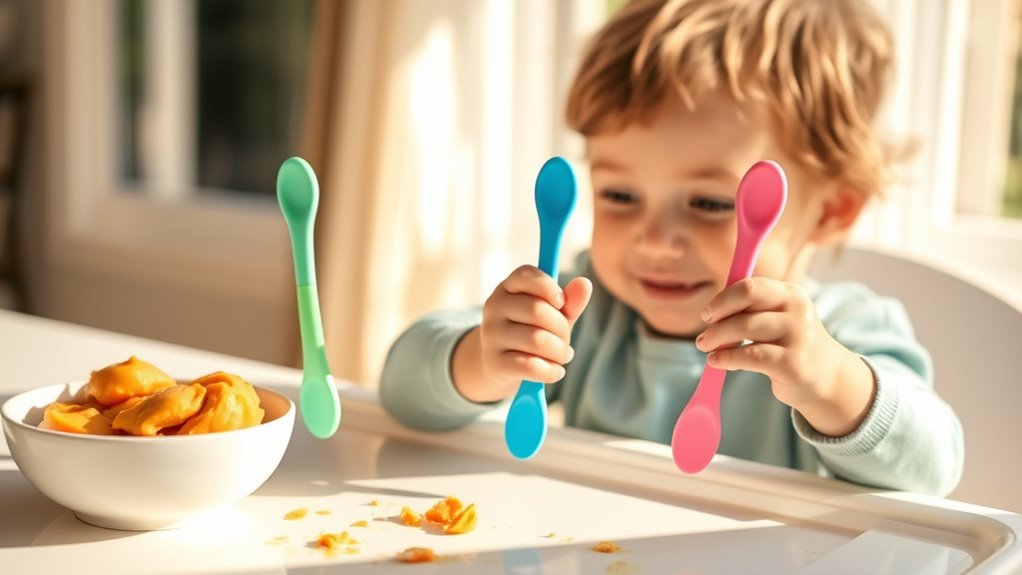

The best toddler feeding spoons balance a child-friendly grip with a bowl that suits the foods your child eats. Munchkin Raise Toddler Fork and Spoon Set is my best overall pick for its raised handles, while NumNum Baby Self-Feeding Spoons stand out for early self-feeding and OXO Tot On-the-Go Fork and Spoon Set for meals away from home. The main tradeoffs are soft silicone versus firmer toddler utensils, spoon-only simplicity versus fork-and-spoon versatility, and compact travel sets versus multipacks for home. Age range and your child’s grip may matter more than the number of pieces in a set. Read on for how all 15 options compare and which type fits your routine.

Turn the school run and nap time into listening time
- Thousands of audiobooks, podcasts and originals
- Listen on your phone, tablet or Echo — also offline
- Cancel anytime
Complete the kit


Key Takeaways
- Munchkin Raise earns the overall lead because its raised handles address a practical mealtime problem—utensils resting directly on the table—while still serving as a fork-and-spoon set.
- NumNum is the clearest early self-feeding choice: its spoon design has a different job from conventional bowls meant to scoop larger bites.
- The roundup divides into two useful groups: soft-tip baby spoons for gentle early feeding and toddler fork-and-spoon sets for developing independent meals.
- Multipacks such as the Munchkin Soft Tip 12 Pack and PandaEar 7-Pack favor replacements and rotation, while a travel case or compact set favors outings over quantity.
- More pieces do not automatically mean better value; fit, grip, food type, and whether a child needs a spoon alone or a fork-and-spoon pair are stronger buying signals.
| Vicloon Silicone Baby Feeding Spoons, 4-Pack |  | Best for Teething Beginners | Material: Food-grade silicone | Quantity: 4 spoons | Length: 14 cm (5.5 in) | VIEW ON AMAZON | See Our Full Breakdown |
| OXO Tot On-the-Go Fork and Spoon Set, Dusk |  | Best for Travel | Included: Fork, spoon, and carrying case | Utensil head material: Stainless steel | Fork tines: Rounded | VIEW ON AMAZON | See Our Full Breakdown |
| Toddler Self-Feeding Utensil Set with Travel Case, Green |  | Best for Guided Self-Feeding | Color: Green | Set includes: Spoon, fork, and travel case | Utensil length: 5.7 inches | VIEW ON AMAZON | See Our Full Breakdown |
| Munchkin Raise Toddler Fork and Spoon Set, BPA-Free, Blue/Green |  | Best for Everyday Toddler Meals | Set contents: Listed as 3 forks and 3 spoons; other product details list 4 pieces | Recommended age: 12 months and up | Material: BPA-free | VIEW ON AMAZON | See Our Full Breakdown |
| Munchkin Soft Tip Baby Spoons, BPA-Free, 12 Pack | 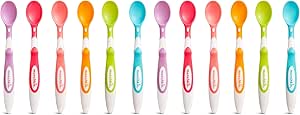 | Best for Spoon-Only Mealtime Rotation | Brand: Munchkin | Quantity: 12 spoons | Material: Plastic | VIEW ON AMAZON | See Our Full Breakdown |
| Eascrozn Toddler Fork and Spoon Set, 6-Piece |  | Best for Matching Fork-and-Spoon Spares | Pieces: 6: 3 forks and 3 spoons | Materials: 18/8 stainless steel and food-grade silicone | Color: Blue listed; description mentions three colors | VIEW ON AMAZON | See Our Full Breakdown |
| Munchkin Raise Toddler Fork and Spoon Set, BPA Free, 4 Pack |  | Best for Keeping Tips Off the Table | Pieces: 4: 2 forks and 2 spoons | Recommended age: 12 months and up | Materials: Plastic and stainless steel | VIEW ON AMAZON | See Our Full Breakdown |
| Dr. Brown’s Designed to Nourish TempCheck Spoons, 4-Pack |  | Best for Checking Food Temperature | Pieces: 4 spoons | Material: 100% silicone | Temperature indicator: Changes from color to clear at about 105°F (40.56°C) and higher | VIEW ON AMAZON | See Our Full Breakdown |
| Pimoys Toddler Utensils Set, 6-Piece Fork and Spoon Set |  | Best for a Clearly Sized Stainless-Steel Set | Pieces: 6: 3 forks and 3 spoons | Materials: 18/8 stainless steel with plastic handles | Dimensions: Approximately 5.4 × 1.2 inches | VIEW ON AMAZON | See Our Full Breakdown |
| NumNum Baby Self-Feeding Spoons, 2-Pack, Blue and Orange |  | Best for Early Self-Feeding Practice | Pieces: 2 spoons | Recommended age: 6–18 months | Color: Blue and orange | VIEW ON AMAZON | See Our Full Breakdown |
| NETANY 6-Piece Silicone Baby Feeding Spoons |  | Best for Gentle Early Feeding | Material: Food-grade silicone | Pieces: 6 | Length: 6.3 in | VIEW ON AMAZON | See Our Full Breakdown |
| KeaBabies Silicone Baby Spoons, 3-Pack, Slate |  | Best for Growing Feeding Skills | Material: Food-grade silicone | Pieces: 3 | Color: Slate | VIEW ON AMAZON | See Our Full Breakdown |
| SAMiGO Silicone Baby Self-Feeding Spoons, 6+ Months |  | Best for Beginner Self-Feeders | Material: Food-grade silicone | Recommended age: 6–18 months | Safety feature: Built-in guard or stopper | VIEW ON AMAZON | See Our Full Breakdown |
| PandaEar 7-Pack Silicone Baby Feeding Spoons |  | Best for Extra Spares | Brand: PandaEar | Pieces: 7 | Material: Silicone | VIEW ON AMAZON | See Our Full Breakdown |
| Dr. Brown’s Designed to Nourish Soft-Tip Toddler Feeding Spoons, 6-Pack |  | Best for Jar Feeding | Brand: Dr. Brown’s | Pieces: 6 | Item type: Soft-tip toddler feeding spoons | VIEW ON AMAZON | See Our Full Breakdown |
| toddler feeding spoon | Material | Care | Color | Pieces |
|---|---|---|---|---|
| Vicloon Silicone Baby Feeding | Food-grade silicone | Dishwasher-safe and boil-safe | — | — |
| OXO Tot On-the-Go Fork and Spo | — | Dishwasher safe | Dusk | — |
| Toddler Self-Feeding Utensil S | — | — | Green | — |
| Munchkin Raise Toddler Fork an | BPA-free | — | Blue/Green | — |
| Munchkin Soft Tip Baby Spoons | Plastic | — | Multicolor | — |
| Eascrozn Toddler Fork and Spoo | — | Dishwasher-safe and boil-safe in specs; listing also says hand wash only | Blue listed; description mentions three colors | 6: 3 forks and 3 spoons |
| Munchkin Raise Toddler Fork an | — | Dishwasher-safe, top rack only | Pink and purple | 4: 2 forks and 2 spoons |
| Dr. Brown’s Designed to Nouris | 100% silicone | Dishwasher- and sterilizer-safe | — | 4 spoons |
| Pimoys Toddler Utensils Set | — | Dishwasher-safe | — | 6: 3 forks and 3 spoons |
| NumNum Baby Self-Feeding Spoon | Food-grade silicone | Dishwasher-safe; do not microwave or steam-sterilize | Blue and orange | 2 spoons |
| NETANY 6-Piece Silicone Baby F | Food-grade silicone | — | — | 6 |
| KeaBabies Silicone Baby Spoons | Food-grade silicone | Dishwasher-safe | Slate | 3 |
| SAMiGO Silicone Baby Self-Feed | Food-grade silicone | — | — | — |
| PandaEar 7-Pack Silicone Baby | Silicone | Dishwasher-safe | Multicolor | 7 |
| Dr. Brown’s Designed to Nouris | Plastic | Dishwasher- and sterilizer-safe | — | 6 |
More Details on Our Top Picks
Vicloon Silicone Baby Feeding Spoons, 4-Pack
For a toddler still chewing more than scooping, the Vicloon four-pack puts soft, food-grade silicone ahead of the firmer utensil feel of the OXO Tot On-the-Go Fork and Spoon Set. Its lightweight, 14 cm spoons are suited to early practice and gentle contact with tender mouths, while dishwasher and boiling-water care offer practical cleanup options. Four spoons also give caregivers a small rotation for meals and washing. The tradeoff is the narrow stage it serves: these are described for infants learning to self-feed, not for a more capable toddler who needs a sturdier spoon or a fork. Compared with the Munchkin Raise Toddler Fork and Spoon Set, this set favors soft tips over table-rest features and a fuller toddler utensil assortment.
Pros:- Soft food-grade silicone is gentle for early feeding practice
- Lightweight spoons are manageable for small hands
- Resists chewing and teething
- Dishwasher-safe and boil-safe for flexible cleaning
Cons:- First-stage focus may limit usefulness as a child grows
- Set includes spoons only, with no fork for broader self-feeding practice
Best for: Caregivers of younger babies who are beginning self-feeding and want soft, chew-resistant spoons that can be sterilized.
Not ideal for: Families seeking utensils for an older toddler who is ready for a fork or a more conventional spoon shape.
- Material:Food-grade silicone
- Quantity:4 spoons
- Length:14 cm (5.5 in)
- Head width:3.2 cm (1.26 in)
- Care:Dishwasher-safe and boil-safe
- Free from:BPA, PVC, and phthalates
Our verdict“Choose the Vicloon set for soft, simple spoons during early self-feeding, but pick a toddler fork-and-spoon set as skills advance.”
OXO Tot On-the-Go Fork and Spoon Set, Dusk
The OXO Tot On-the-Go set is the clearest travel pick here: a compact case keeps both utensils contained in a diaper bag or lunchbox, unlike the Munchkin Soft Tip Baby Spoons, which are sold as a larger spoon-only supply. Its deep stainless steel spoon is better suited to scooping meals away from home, and the rounded fork tines give a toddler a second utensil without sharp points. Curved, non-slip handles and a flat spot to prevent rolling support easier handling at the table. The tradeoff is that stainless steel feels firmer than the silicone tips on the Vicloon Silicone Baby Feeding Spoons, so this set is less suited to a baby who is still chewing utensils. It also offers just one fork and one spoon, not a spare rotation.
Pros:- Carrying case keeps utensils contained in a bag or lunchbox
- Deep spoon supports scooping
- Curved, non-slip handles are designed for little hands
- Dishwasher-safe utensils
Cons:- Firmer stainless steel heads may not suit babies who chew utensils
- Only one spoon is included, so there is no spare for rotation
Best for: Families packing meals for toddlers who can use firmer utensils and want a fork and spoon stored together.
Not ideal for: Caregivers of very young, teething babies who prefer soft silicone tips or need several spoons for daily rotation.
- Included:Fork, spoon, and carrying case
- Utensil head material:Stainless steel
- Fork tines:Rounded
- Handle design:Curved, non-slip, with a flat spot to prevent rolling
- Care:Dishwasher safe
- Color:Dusk
Our verdict“Pick OXO Tot for tidy meals on the go with a toddler ready for stainless steel, rather than for early teething or spoon-only feeding.”
Toddler Self-Feeding Utensil Set with Travel Case, Green
For a child who needs help directing a utensil toward the mouth, this set’s bendable, shape-retaining handles offer a more adjustable approach than the fixed handles on the OXO Tot On-the-Go Fork and Spoon Set. The rounded tips are described for sensitive gums, while the dinosaur-textured, non-slip grips give small hands a tactile hold. A transparent case is useful for keeping the fork and spoon together outside the house, and top-rack dishwasher cleaning or brief boiling-water sterilization adds flexibility. Its stated age range of 6–18 months is narrower than the 12-month-and-up Munchkin Raise set, and the utensil material is not specified. That missing detail makes it harder to compare feel and construction, so buyers seeking clearly identified silicone or metal may prefer the Vicloon or OXO options.
Pros:- Bendable handles can be shaped to support a child’s grip
- Rounded tips are designed for sensitive gums
- Travel case keeps the spoon and fork together
- Top-rack dishwasher-safe and suitable for brief boiling-water sterilization
Cons:- Recommended age range is limited to 6–18 months
- Utensil material is not specified
- The case adds a piece to keep track of during cleanup
Best for: Caregivers of babies in the stated 6–18-month range who want adjustable handles to support early utensil practice.
Not ideal for: Buyers who need a clearly specified utensil material or a set intended to serve an older toddler beyond 18 months.
- Color:Green
- Set includes:Spoon, fork, and travel case
- Utensil length:5.7 inches
- Recommended age:6–18 months
- Handle:Bendable, shape-retaining, non-slip with dinosaur texture
- Tip design:Rounded edges
- Cleaning:Top-rack dishwasher-safe; boiling-water sterilization for 1–2 minutes
- Free from:BPA, phthalates, and latex
Our verdict“Choose this set for adjustable early self-feeding practice, but select OXO Tot or Munchkin Raise for a more clearly defined older-toddler fit.”
Munchkin Raise Toddler Fork and Spoon Set, BPA-Free, Blue/Green
The Munchkin Raise set suits mealtime practice once a child is ready for regular toddler utensils: its raised rest-style bases keep utensil tips off the table between bites, a practical difference from the travel-focused OXO Tot On-the-Go set, which prioritizes a carrying case. With forks and spoons in the set, it supports more than spoon practice, and its stated age guidance begins at 12 months. The drawback is uncertainty about what arrives: the title says six pieces, while other product details list four. That conflict makes it difficult to know how many complete utensils a household will receive. The top-rack-only care instruction is also less flexible than the dishwasher and boiling options listed for the Toddler Self-Feeding Utensil Set with Travel Case.
Pros:- Raised base helps keep utensil tips off table surfaces
- Forks and spoons support varied toddler meals
- Designed for toddler-sized hands and mouths
- BPA-free
Cons:- Set size is unclear: title says six pieces, while other details list four
- Top-rack-only care is more restrictive than options that allow boiling
- Raised bases do not provide a travel case for keeping utensils contained
Best for: Families starting everyday fork-and-spoon practice around 12 months who value utensil tips resting above the table.
Not ideal for: Buyers who need a confirmed piece count or want utensils with broader cleaning instructions than top-rack care.
- Set contents:Listed as 3 forks and 3 spoons; other product details list 4 pieces
- Recommended age:12 months and up
- Material:BPA-free
- Color:Blue/Green
- Item weight:6.08 ounces
- Care instructions:Top rack only
- Special feature:Raised base keeps tips off surfaces
Our verdict“Pick Munchkin Raise for everyday toddler meals and cleaner table rests if the uncertain piece count does not affect your decision.”
Munchkin Soft Tip Baby Spoons, BPA-Free, 12 Pack
When the priority is having a clean spoon ready for each feeding, the 12-count Munchkin Soft Tip set offers a much larger rotation than the four-spoon Vicloon Silicone Baby Feeding Spoons. Shallow bowls and soft, rounded tips are aimed at babies learning solids, while the long, ergonomic handles can reach the bottom of baby food jars. That length helps caregivers serve jarred food, but it makes these less focused on a toddler’s independent utensil control than the compact OXO Tot On-the-Go spoon. They are plastic rather than silicone, and the product details do not provide a dishwasher or sterilization instruction, so buyers should not assume care methods beyond the listed information. This is a practical infant-feeding supply, not a fork-and-spoon set designed to grow with a toddler.
Pros:- Twelve spoons provide a generous rotation between feedings and washes
- Soft, rounded tips are designed to be gentle on gums
- Shallow bowls suit babies learning to eat solids
- Long handles reach the bottom of baby food jars
Cons:- Plastic construction may not suit buyers seeking silicone utensils
- Infant-focused design may have limited use as a child grows
- Care instructions are not specified in the supplied product details
Best for: Caregivers feeding early solids who want many shallow-bowl spoons and handles long enough to reach food jars.
Not ideal for: Families seeking silicone utensils, a travel-ready fork-and-spoon set, or a spoon designed for an older toddler’s independent use.
- Brand:Munchkin
- Quantity:12 spoons
- Material:Plastic
- BPA-free:Yes
- Color:Multicolor
- Dimensions:9 in L × 2.2 in W
- Weight:59 g
- Model number:11448
Our verdict“Choose these spoons for a large infant-feeding rotation and jar access, but move to a toddler-focused set as self-feeding skills develop.”
Eascrozn Toddler Fork and Spoon Set, 6-Piece
The Eascrozn set suits families who want several matching utensils for self-feeding, with three spoons and three forks rather than a spoon-only pack. Its silicone handles give small hands a less slippery grip, while rounded stainless-steel ends and a protective barrier are intended to make early utensil practice more manageable. Compared with the Pimoys Toddler Utensils Set, it offers the same six-piece fork-and-spoon mix, but adds a stated mouth-entry barrier; Pimoys, by contrast, lists approximate dimensions. The tradeoff is an unclear care claim: the details say dishwasher-safe, while the listing also says hand wash only. Color information is also inconsistent, with blue in the specs and three colors in the description, so I would not choose it for a specific color set.
Pros:- Six utensils include three spoons and three forks
- Food-grade silicone handles are designed for a non-slip grip
- Rounded 18/8 stainless-steel ends and a protective barrier
- BPA-free materials
Cons:- Dishwasher-safe and hand-wash-only care claims conflict
- Color listing is inconsistent between blue and three colors
- No utensil dimensions are provided in the supplied specs
Best for: Families who want multiple toddler-sized forks and spoons with grippy handles and do not mind checking the care instructions before washing.
Not ideal for: Buyers who need clear, consistent dishwasher guidance or a guaranteed multicolor set.
- Pieces:6: 3 forks and 3 spoons
- Materials:18/8 stainless steel and food-grade silicone
- Color:Blue listed; description mentions three colors
- Features:Non-slip handles, rounded edges, protective barrier
- Care:Dishwasher-safe and boil-safe in specs; listing also says hand wash only
- Item weight:1.12 ounces
- Model:H-202401
Our verdict“Choose Eascrozn for a matching supply of grippy fork-and-spoon utensils, but skip it if precise care or color details matter.”
Munchkin Raise Toddler Fork and Spoon Set, BPA Free, 4 Pack
The Munchkin Raise set has a useful mealtime distinction: its built-in raised base keeps the eating ends from resting directly on the table. That can help reduce contact with messy surfaces between bites, while the ergonomic shape is made for children 12 months and up. It includes two forks and two spoons, so it is a smaller supply than the six-piece Eascrozn or Pimoys sets, but its table-rest feature gives it a clearer role than a basic matching set. The handles are plastic rather than silicone, which may feel less grippy and could show wear with heavy use. Its pink-and-purple color pairing is also a narrow fit for households seeking neutral or varied colors. Top-rack dishwasher care adds convenience, though it does not remove the handle-durability tradeoff.
Pros:- Raised base helps keep utensil tips off the table
- Includes two forks and two spoons
- Ergonomic shape is designed for toddler hands
- BPA-free and top-rack dishwasher-safe
Cons:- Plastic handles may wear with frequent use
- Pink-and-purple color choice is limited
- Four pieces provide fewer replacements than the Eascrozn and Pimoys six-piece sets
Best for: Caregivers of children 12 months and older who want a compact fork-and-spoon set that keeps utensil tips off the table between bites.
Not ideal for: Families wanting silicone grips, more than four utensils, or colors beyond pink and purple.
- Pieces:4: 2 forks and 2 spoons
- Recommended age:12 months and up
- Materials:Plastic and stainless steel
- Color:Pink and purple
- Care:Dishwasher-safe, top rack only
- Item weight:6.08 ounces
- Model number:41645
Our verdict“Pick Munchkin Raise if keeping utensil tips off the table matters more than having extra pieces or silicone handles.”
Dr. Brown’s Designed to Nourish TempCheck Spoons, 4-Pack
Unlike the stainless-steel toddler sets from Eascrozn and Pimoys, Dr. Brown’s TempCheck spoons are soft, long-handled feeding spoons with a color-change temperature indicator. The tip turns from color to clear at about 105°F or higher, offering a quick signal when serving warm food. That cue is specific rather than a full temperature readout, so it cannot tell you the exact temperature or replace checking food before feeding. The shallow, flexible silicone scoop is aimed at little mouths and tender gums, while the elevated rest and long handle can help keep the spoon and hands away from the bowl. This is a more specialized choice than a toddler fork-and-spoon set: it is useful for spoon-feeding, but it does not provide fork practice or the more traditional utensil feel older toddlers may want.
Pros:- Color changes to clear at about 105°F or higher
- Soft silicone is gentle on tender or teething gums
- Shallow, flexible scoop is sized for little mouths
- Long handles, elevated rests, and dishwasher- and sterilizer-safe care
Cons:- Temperature indicator signals only at about 105°F and does not show an exact reading
- Spoon-only pack does not support fork practice
- Colors may vary
Best for: Caregivers spoon-feeding babies or young toddlers who want a visual warning when warm food reaches about 105°F.
Not ideal for: Families seeking durable metal toddler flatware, fork practice, or an exact temperature reading.
- Pieces:4 spoons
- Material:100% silicone
- Temperature indicator:Changes from color to clear at about 105°F (40.56°C) and higher
- Dimensions:7 in L x 1 in W
- Item weight:0.06 kg
- BPA-free:Yes
- Care:Dishwasher- and sterilizer-safe
- Colors:Purple, teal, blue, and red; colors may vary
Our verdict“Choose TempCheck for a temperature-warning cue and soft spoon-feeding, not as a replacement for a toddler fork-and-spoon set.”
Pimoys Toddler Utensils Set, 6-Piece Fork and Spoon Set
The Pimoys six-piece set pairs three forks with three spoons and lists approximate dimensions of 5.4 × 1.2 inches, giving buyers a clearer sense of scale than the Eascrozn set, which does not provide utensil dimensions in the supplied specs. Its stainless-steel eating ends and rounded edges are designed for toddlers learning to self-feed, while plastic handles keep the utensils distinct from all-silicone options such as Dr. Brown’s TempCheck. That makes Pimoys a straightforward choice for practicing with conventional flatware, rather than a soft spoon designed for early spoon-feeding. The main compromise is the plastic handle: it may not offer the same soft, grippy feel as Eascrozn’s silicone, and the supplied details do not list a protective barrier. Dishwasher-safe care and six pieces make it practical for regular rotation.
Pros:- Six pieces include three forks and three spoons
- Approximate 5.4 × 1.2-inch dimensions help set expectations for size
- 18/8 stainless-steel utensils have rounded edges and fork tines
- Dishwasher-safe and offered in blue, green, and pink
Cons:- Plastic handles may be less durable than all-metal utensils
- Plastic grip may feel less soft than Eascrozn’s silicone handles
- No protective barrier is listed in the supplied product details
Best for: Families moving toddlers toward conventional flatware who want a six-piece set with stated approximate dimensions and dishwasher-safe care.
Not ideal for: Caregivers who prefer silicone grips or want a listed mouth-entry barrier on the utensil.
- Pieces:6: 3 forks and 3 spoons
- Materials:18/8 stainless steel with plastic handles
- Dimensions:Approximately 5.4 × 1.2 inches
- Care:Dishwasher-safe
- Colors:Blue, green, and pink
- Weight:1.6 ounces
- Model number:G1951K-11-N
Our verdict“Choose Pimoys for a six-piece, dishwasher-safe stainless-steel set with stated dimensions, and skip it if silicone handles are a priority.”
NumNum Baby Self-Feeding Spoons, 2-Pack, Blue and Orange
The NumNum two-pack takes a different approach from the toddler flatware sets: it gives babies two purpose-specific utensils, a pre-spoon for purees and an open-channel spoon for soft solids. That makes it a more targeted starting point for the 6–18-month self-feeding stage than the conventional fork-and-spoon combinations from Munchkin Raise or Pimoys. Contoured, food-grade silicone and a 0.6-inch handle width are designed for small hands, while the compact 3.9-inch length suits early practice. The tradeoff is that these are not traditional spoons for every later toddler meal, so families may need another utensil set as skills and food choices change. They are dishwasher-safe, but the care limits matter: do not microwave or steam-sterilize them.
Pros:- Two designs address purees and soft solids separately
- Contoured shape and 0.6-inch handle width are designed for small hands
- Food-grade silicone is BPA- and phthalate-free
- Dishwasher-safe
Cons:- Two-piece set offers fewer utensils than the six-piece Eascrozn and Pimoys sets
- Specialized shapes are not a full substitute for conventional toddler spoons and forks
- Not suitable for microwave use or steam sterilization
Best for: Caregivers of babies around 6–18 months who want separate silicone tools for practicing with purees and soft solids.
Not ideal for: Families seeking conventional toddler cutlery for older children or utensils that can be steam-sterilized or microwaved.
- Pieces:2 spoons
- Recommended age:6–18 months
- Color:Blue and orange
- Material:Food-grade silicone
- Dimensions:3.9 x 0.9 inches
- Handle width:0.6 inches
- Care:Dishwasher-safe; do not microwave or steam-sterilize
- BPA- and phthalate-free:Yes
Our verdict“Pick NumNum for early self-feeding practice across purees and soft solids, then move to conventional flatware as your child’s skills develop.”
NETANY 6-Piece Silicone Baby Feeding Spoons
The NETANY set suits families who want soft, flexible spoons for the early stages of solids. Its bendable handles can make it easier to angle food toward a baby’s mouth, while the gentle tips are a softer option for sensitive gums than a rigid utensil. Compared with the SAMiGO training spoons, NETANY provides six spoons but does not list a built-in mouth guard, so it offers less help limiting how far a spoon can go into a beginner’s mouth. The set is dishwasher-safe and boil-proof, a useful pairing for frequent cleaning. The tradeoff is flexibility: it may feel less controlled than a firm spoon, and its early-feeding focus makes it a weaker fit for older toddlers who want a more conventional utensil.
Pros:- Soft silicone tips are gentle on sensitive gums and developing teeth.
- Bendable handles can support different feeding angles and early self-feeding.
- Six spoons provide spares for meals and cleaning rotations.
- Dishwasher-safe and boil-proof for flexible cleaning.
Cons:- Flexible handles may feel less controlled than rigid toddler spoons.
- Its early-feeding design may be outgrown by children ready for conventional utensils.
Best for: Caregivers starting solids who want several soft spoons for gentle feeding and early self-feeding practice.
Not ideal for: Families seeking a rigid spoon for older toddlers or a built-in guard to limit how far the spoon enters the mouth.
- Material:Food-grade silicone
- Pieces:6
- Length:6.3 in
- Head width:0.78 in
- BPA-free:Yes
- PVC-free:Yes
- Cleaning:Dishwasher-safe and boil-proof
- Model number:M50c
Our verdict“Choose NETANY for a six-spoon supply of gentle, flexible utensils during the early stages of solids.”
KeaBabies Silicone Baby Spoons, 3-Pack, Slate
KeaBabies is the more adaptable choice for families whose child is moving from assisted bites toward independent scooping. Its two scoop sizes offer variety across feeding stages, while the weighted, flexible handles are designed for small hands. Compared with NETANY’s six-piece set, KeaBabies gives you fewer spoons, but its mixed scoop sizes make the set more focused on changing skills rather than stocking up on spares. Food-grade, BPA-free silicone and dishwasher-safe care keep the basics straightforward. The main compromise is the handle: flexibility may suit practice, but it can feel less precise than a rigid spoon when a toddler is learning controlled scooping. Slate is also the listed color, so this set is less about assorted colors than NETANY.
Pros:- Two scoop sizes provide options for different feeding stages.
- Weighted, flexible handles are designed for small hands.
- Food-grade silicone is BPA-free.
- Dishwasher-safe for routine cleanup.
Cons:- Three spoons provide fewer spares than the NETANY and PandaEar sets.
- Flexible handles may feel less precise than rigid utensils.
Best for: Caregivers of babies and young toddlers who want different scoop sizes as self-feeding skills develop.
Not ideal for: Families who want a larger set of identical spoons or a firm handle for more controlled scooping.
- Material:Food-grade silicone
- Pieces:3
- Color:Slate
- Dimensions:6.5 × 2 inches
- Weight:3.36 ounces
- Scoop sizes:Two
- Handle design:Weighted and flexible
- Care:Dishwasher-safe
Our verdict“Pick KeaBabies if varying scoop sizes matter more to you than having a large stack of matching spoons.”
SAMiGO Silicone Baby Self-Feeding Spoons, 6+ Months
SAMiGO puts beginner support ahead of set size. Its short handles are sized for small hands, and a built-in guard helps limit how far the spoon can enter the mouth—an added feature the NETANY spoons do not specify. Soft silicone tips suit purees and cereal, making this a focused choice for early practice rather than a general-purpose toddler spoon. The listed age range is 6–18 months, which makes the intended stage clearer than with PandaEar’s puree-focused set. There are tradeoffs: the product description does not state how many spoons are included, and hand washing is allowed alongside top-rack dishwasher cleaning. Families wanting a known quantity of spare spoons may prefer NETANY’s six-piece set.
Pros:- Built-in guard helps limit how far the spoon can enter the mouth.
- Short handles are designed for small hands learning self-feeding.
- Soft food-grade silicone tips suit purees and cereal.
- BPA- and phthalate-free, with top-rack dishwasher care available.
Cons:- The number of spoons in the set is not specified.
- The beginner-oriented age range may not suit older toddlers.
- Hand washing is an alternative care method, unlike the stated dishwasher-only convenience of some sets.
Best for: Caregivers of babies beginning self-feeding who want short handles and a built-in spoon guard.
Not ideal for: Buyers who need a confirmed set quantity or want utensils suited to older toddlers and broader food types.
- Material:Food-grade silicone
- Recommended age:6–18 months
- Safety feature:Built-in guard or stopper
- Cleaning:Hand wash or top-rack dishwasher safe
- Colors:3 shades
- BPA-free:Yes
- Phthalate-free:Yes
Our verdict“Choose SAMiGO for beginner self-feeders when a built-in guard matters more than a clearly stated set count.”
PandaEar 7-Pack Silicone Baby Feeding Spoons
PandaEar is the practical pick for caregivers who want a larger supply of shallow silicone spoons for thick and pureed foods. Seven pieces give it a slight quantity advantage over NETANY’s six, which can help when several meals and wash cycles happen in a day. Its soft design also supports self-feeding, though the product details give less guidance about handle shape or size than KeaBabies, whose weighted flexible handles are specifically described for small hands. PandaEar’s strengths are straightforward: dishwasher-safe care and materials listed as free from BPA, PVC, lead, and phthalates. The limitation is its stated food focus. Families moving beyond purees may find the shallow format less versatile than a spoon with different scoop sizes.
Pros:- Seven spoons provide a generous supply for repeated meals.
- Shallow, soft silicone design is suited to thick and pureed foods.
- Dishwasher-safe for convenient cleanup.
- Made without BPA, PVC, lead, or phthalates.
Cons:- The stated use is focused on thick and pureed foods.
- Handle dimensions and small-hand features are not specified.
- The product details provide less stage-specific guidance than the SAMiGO set.
Best for: Families feeding thick foods and purees who want several dishwasher-safe spoons available at once.
Not ideal for: Caregivers seeking detailed small-hand handle features or a spoon set intended for a wider range of foods and stages.
- Brand:PandaEar
- Pieces:7
- Material:Silicone
- Color:Multicolor
- Item weight:0.13 kg
- Care:Dishwasher-safe
- Intended use:Thick and pureed foods
- Materials excluded:BPA, PVC, lead, and phthalates
Our verdict“Pick PandaEar when you want plenty of soft spoons for puree and thick-food meals, rather than a more stage-specific design.”
Dr. Brown’s Designed to Nourish Soft-Tip Toddler Feeding Spoons, 6-Pack
Dr. Brown’s stands apart from the silicone training sets with a long handle and flexible shallow scoop designed to reach food in jars. That makes it a stronger fit for caregiver-led feeding than KeaBabies, whose weighted flexible handles are aimed at small hands practicing self-feeding. The wide base is intended to keep the spoon stable when set down, while the soft tip offers a gentler feel for teething gums. Six spoons and dishwasher- and sterilizer-safe care suit frequent routines. The tradeoff is material: these are plastic rather than silicone, which may rule them out for buyers who prefer silicone utensils. Their long-handle design may also be less suited to toddlers who want a short spoon they can manage independently.
Pros:- Long handle reaches food in jars.
- Flexible shallow scoop supports caregiver feeding.
- Wide base is designed to help the spoon stay stable on a table.
- Dishwasher- and sterilizer-safe; BPA-free.
Cons:- Plastic construction may not suit buyers who prefer silicone.
- Long handles may be less manageable for toddlers practicing independent scooping.
- The design emphasizes jar feeding more than small-hand self-feeding.
Best for: Caregivers who feed toddlers from jars and want a long-handled spoon with a soft tip and stable base.
Not ideal for: Families prioritizing silicone utensils or toddlers who need short handles for independent self-feeding.
- Brand:Dr. Brown’s
- Pieces:6
- Item type:Soft-tip toddler feeding spoons
- Dimensions:9.5 × 4.1 inches
- Material:Plastic
- BPA-free:Yes
- Care:Dishwasher- and sterilizer-safe
- Model number:TF008-P2
Our verdict“Choose Dr. Brown’s for caregiver-led jar feeding, but favor KeaBabies or SAMiGO for spoons built around a child’s independent practice.”

How We Picked
I ranked these toddler feeding spoons by how well their design matches real feeding stages and routines: spoon shape and softness, handle size and grip, whether a set supports self-feeding, and whether it includes useful fork or travel options. I also weighed everyday practicality, including how many utensils come in a pack, how easily a set can be rotated, and whether its format suits home meals or outings. I treated age guidance and intended use as meaningful distinctions rather than assuming every silicone spoon fits every toddler.
The ranking favors options with a clear benefit for a common buyer need and a manageable tradeoff. A versatile toddler set ranks ahead of a specialized option for most households, while early-feeding spoons, travel sets, and larger multipacks earn their places for distinct use cases. Product names and listed features guide this comparison; the ranking does not imply hands-on testing. Buyers should check the maker’s care instructions and inspect utensils for wear before use.
Factors to Consider When Choosing Toddler Feeding Spoons
Choosing among toddler feeding spoons is less about finding a single universally best shape and more about matching utensils to your child’s current stage and your meal routine. These broader checks can help avoid buying a large set that looks useful but does not fit how your family eats.
Match the utensil to the feeding stage
Early attempts at self-feeding often call for a short, easy-to-hold utensil that lets a child practice bringing food toward the mouth. A conventional deep spoon can be frustrating if the child is still learning how to scoop, while a flatter or differently shaped learning spoon may support practice with thicker foods. Once a toddler is ready to eat more varied meals, a spoon-and-fork pair can cover more foods at the table. Age labels are a starting point, not a substitute for checking handle size and the child’s coordination. Avoid buying several stages at once unless you have a clear use for each set. A small, well-matched set can be more helpful than a drawer full of utensils that are difficult to hold.
Choose softness and bowl shape for the food
Soft silicone tips can be a sensible fit for early spoon-feeding and tender mouths, while firmer utensils may be easier to use for scooping denser foods as children gain skill. Bowl depth affects how much food stays on the spoon: a shallow bowl can be easier to clear, but may hold less; a deeper bowl can carry more, but may be harder for a beginner to manage. Think about the meals your child actually eats rather than choosing by material alone. A spoon that works well for yogurt may not be the easiest tool for rice or small pieces of food. Check the product’s age guidance and intended use, especially when comparing baby spoons with toddler utensils. Do not treat softness as a substitute for adult supervision during meals.
Prioritize a manageable handle and grip
A child’s ability to hold an utensil can matter more than an adult’s preference for a slim, neat design. Shorter, wider, or shaped handles can make early practice easier, while a handle that is too bulky may feel awkward in a small hand. Raised-handle designs solve a different problem by keeping the eating end off the table between bites; that can be handy, but it does not automatically make the spoon easier to control. If possible, compare the handle dimensions with utensils your child already manages. A common mistake is choosing a set for its appearance or piece count without checking whether the handle fits the child’s grip. Expect preferences to change as coordination develops.
Decide whether a fork, travel case, or extra pieces matter
A spoon-only pack is a good fit when the child is still learning with soft foods or when you need several clean spoons in rotation. A fork-and-spoon set makes more sense for mixed family meals, but unused pieces add little value if your toddler is not ready for a fork. Travel cases can keep utensils together in a bag, though a case adds another item to clean and store. Larger packs reduce the pressure to wash a spoon after every meal, but they also take up drawer space. Choose based on how often you eat away from home and how quickly utensils become unavailable between washes. The most useful set is the one whose extra pieces match a real routine.
Check cleaning, durability, and care instructions
Before buying, check the maker’s directions for washing, heat exposure, and any restrictions on use. Silicone and mixed-material utensils may have different care needs, so do not assume every spoon can go through the same cleaning routine. Look closely at joins, textured areas, and cases where food residue might collect. Inspect the spoon tips and handles regularly, and replace any utensil that shows damage or separation. Buying a multipack can help with rotation, but it does not remove the need to maintain each piece. Ease of care is a real tradeoff: a specialized shape may suit a learning stage yet require more attention than a simple spoon.
Frequently Asked Questions
Should I choose a soft-tip baby spoon or a toddler spoon-and-fork set?
Choose based on what your child is practicing now, not only on age. A soft-tip spoon can suit early spoon-feeding and gentle first attempts, while a toddler set adds a fork for children ready to handle more family foods. The products in this roundup show that these formats serve different jobs rather than competing directly. If your child mostly eats spoonable foods, extra forks may sit unused. If meals include foods that are easier to spear, a paired set can reduce the need to buy another utensil later.
Are self-feeding spoons useful if my toddler already uses a regular spoon?
They may still help if your child is practicing a particular grip or has trouble keeping food on a conventional spoon. Learning-focused designs such as NumNum have a different purpose from a standard toddler spoon, so the benefit depends on the skill your child is working on. A child who already scoops and carries food comfortably may gain more from a regular spoon-and-fork set. Avoid assuming a specialized utensil will replace everyday cutlery for every meal. It can be more useful as a practice tool alongside familiar utensils.
Is a larger multipack a better buy than a two- or three-piece set?
A larger pack makes sense when you want clean spoons available through several meals or need replacements across home and daycare. Smaller sets are easier to store and may be enough if you wash utensils frequently or are still finding a design your child likes. The roundup’s larger packs favor quantity, while compact options favor simpler storage or a specific learning purpose. Compare the number of pieces with how many you actually use in a day. A pack is not better value for your routine if most of its utensils remain unused.
Do I need a travel case for feeding spoons?
A case is most helpful when you regularly pack utensils for daycare, restaurants, or trips and want to keep them separate from other items in a bag. For meals mostly at home, it can become extra storage and another piece to wash. A compact travel set such as the OXO Tot option is aimed at portability, while multipacks are more useful for keeping spares in rotation. Check whether the case fits the utensils after cleaning and whether its shape is practical for your bag. If you rarely take feeding gear out, a simple set may be easier.
What should I check before replacing a baby spoon with a toddler spoon?
Look at whether your child can hold the handle, bring it to the mouth with control, and manage the spoon bowl with the foods they eat. A toddler utensil may be firmer or shaped differently from a soft-tip baby spoon, so moving up is not only an age-based choice. If the current spoon works and remains in good condition, there is no need to change it just because a child has reached a particular birthday. Try a toddler utensil alongside the familiar one and watch which is easier to use. Follow the product’s stated age guidance and supervise meals.
Conclusion
For most families, I recommend the Munchkin Raise Toddler Fork and Spoon Set as the best overall choice because its raised-handle design adds a practical difference to a versatile pair. For best value by quantity, look at the Munchkin Soft Tip Baby Spoons 12 Pack if you need a steady rotation of soft spoons; the PandaEar 7-Pack is another larger-pack option. Beginners practicing self-feeding have a clearer match in NumNum, while the soft-tip Munchkin or Dr. Brown’s options suit those focused on early spoon use. For meals away from home, the OXO Tot On-the-Go Set is the most directed pick. Choose the style that fits your child’s current grip and your meal routine, rather than buying the set with the most pieces.