Choosing a room fan for a home with toddlers means weighing more than airflow: the fan should be hard for little hands to reach, stable in its intended location, and suited to the room without adding disruptive noise. My strongest all-around pick is the DREO Smart Tower Fan, which combines a bladeless enclosure with flexible controls and more airflow settings. For a bedside table or nursery corner, the Levoit Windi Mini is quieter and uses far less power, while the DREO 11-Inch Table Air Circulator is the better fit when you want directed airflow across a room.
These are not childproof devices, and “bladeless” does not mean risk-free: cords, tipping, reachable controls, and placement still matter. The main tradeoff is between stronger room circulation and a compact fan that can be positioned out of a toddler’s reach. I rank these options by how their designs, controls, noise claims, and form factors fit that real household decision—not by airflow alone.
Complete the kit


Key Takeaways
- The DREO Smart Tower Fan is my most versatile pick, with a bladeless enclosure, eight speeds, and remote, app, touch, and voice controls; keep its cord and controls out of reach.
- The Levoit Windi Mini is the quietest listed option at 20 dB and uses 7.5 watts, but its tabletop format is for nearby personal airflow rather than strong whole-room circulation.
- The DREO 11-Inch Table Air Circulator claims airflow up to 60 feet and offers tilt adjustment, making it the stronger choice for directing air across a room.
- The DR.PREPARE 16-inch fan gives a simple, compact tabletop alternative with a dial and 60-degree oscillation, but it has only three speeds and no remote.
- None of these fans is described as childproof or tip-proof; a safe setup still depends on stable placement, inaccessible cords, and adult supervision.


| room fan safe for toddler | Power | Speeds | Noise level | Controls |
|---|---|---|---|---|
| DREO Smart Tower Fan for Bedro | Corded electric, 42 W | 8 | 25 dB listed | App, remote, touch, voice |
| Levoit Windi Mini Tower Fan fo | DC, 7.5 W | 5 | 20 dB listed | Remote control |
| DREO Fan for Bedroom | AC, 30 W | 3 | 20 dB listed | Knob control listed; no remote listed |
| DR.PREPARE Oscillating Tower F | Corded electric, 25 W | 3 | 40 dB listed | Dial switch; touch control also listed |
| KONSIDEN Bladeless Desk Fan | USB Type-C, 5 W | 3 | 30 dB listed | Touch |
More Details on Our Top Picks
DREO Smart Tower Fan for Bedroom, 28 ft/s Velocity, 8 Speeds, Ultra Quiet
I rank the DREO Smart Tower Fan first because it offers the broadest mix of room-scale airflow and caregiver-friendly control. Its bladeless design avoids conventional exposed fan blades, and eight speeds make it easier to choose a gentler setting than a fan with only three. The listed noise level is 25 dB, and the unit can be operated by remote, touch, app, or voice, so an adult can change settings without reaching over a toddler.
Compared with the Levoit Windi Mini, this DREO is a better match for a shared room that needs stronger airflow; the Levoit is smaller, quieter on its listed specification, and much lower wattage. The tower is also taller and heavier, which may help keep the air outlet above floor level but does not make it tip-proof. I would place it on a flat, stable surface, route its cord out of reach, and avoid relying on app access as a safety feature. Full feature access may require the app, which adds setup and connectivity friction. Its indoor-only use and plastic construction are further limits.
Pros:- Bladeless enclosure avoids conventional exposed fan blades
- Eight speeds offer more adjustment than the three-speed models here
- Remote, touch, app, and voice controls provide flexible adult operation
- Listed 25 dB noise level suits buyers prioritizing quieter bedroom airflow
Cons:- App access is needed for full feature use, adding setup complexity
- Tall tower still needs stable placement and a cord kept out of reach
- Indoor-only use limits placement options
Best for: Caregivers who want a full-height bladeless fan, multiple speeds, and several ways to adjust settings in a bedroom or family room.
Not ideal for: Households seeking a cordless fan, a very small tabletop unit, or a fan that can be treated as childproof without careful placement and supervision.
- Power:Corded electric, 42 W
- Speeds:8
- Noise level:25 dB listed
- Airflow:978 CFM listed
- Controls:App, remote, touch, voice
- Features:Bladeless design, oscillation, timer
- Dimensions:11.81 × 11.81 × 36.22 inches
- Weight:3.8 kg
Our verdict“I would choose this as the most flexible all-around option when a bladeless tower and broad control choices matter more than compact size.”
Levoit Windi Mini Tower Fan for Bedroom, Quiet and Portable Desk Fan
The Levoit Windi Mini is my pick when the goal is a gentle, nearby breeze rather than whole-room cooling. It is a compact tabletop tower with a carrying handle, oscillation, five speeds, and a listed 20 dB noise level. At 7.5 watts, it also draws less power than the larger DREO tower and the DREO tabletop circulator. Those traits make it a practical fit for an adult-controlled bedside or desk setup where the fan can sit beyond a toddler’s reach.
Compared with the DR.PREPARE desk fan, the Levoit has more listed speeds and a lower noise figure, while both are compact and intended for tabletop use. Its advantage is quiet, low-power personal airflow; its limitation is the same small scale. It needs a plug-in outlet, and a tabletop fan can still be pulled down if placed within reach or perched on an unstable surface. I would skip it if the room needs forceful circulation or if you need a cordless option. The supplied description identifies a bladeless design, but it does not establish a child-safety certification.
Pros:- Listed 20 dB noise level is the lowest among the five
- Uses 7.5 watts, less than the larger fans in this group
- Five speeds and oscillation offer more adjustment than basic three-speed desk fans
- Compact body and carrying handle make repositioning straightforward for adults
Cons:- Plug-in power means the cord must be managed away from a toddler
- Small tabletop format is better for nearby airflow than broad room circulation
- Indoor-only design limits use
Best for: Caregivers seeking a quiet, low-power fan for personal airflow on a stable, out-of-reach tabletop.
Not ideal for: Buyers who need strong airflow across a large room, cordless operation, or a floor-standing fan.
- Power:DC, 7.5 W
- Speeds:5
- Noise level:20 dB listed
- Air speed:Up to 23 ft/s listed
- Mounting:Tabletop
- Features:Bladeless design, oscillation, timer
- Controls:Remote control
- Use:Indoor
Our verdict“I recommend the Levoit for quiet, low-power personal cooling, not as a replacement for a stronger room-circulation fan.”
DREO Fan for Bedroom, 11 Inch Table Air Circulator with 60ft Airflow, 120° Tilt, 3 Speeds, Low Noise
When reaching across a room matters more than a bladeless enclosure, I would look at the DREO 11-Inch Table Air Circulator. Its stated airflow reach of up to 60 feet and 120-degree tilt give it a different job from the small desk towers: aim it to move air through a larger space rather than simply cool the person nearest the fan. It lists 20 dB noise and three speeds, so buyers can choose between a quieter setting and stronger airflow.
The tradeoff is central to a toddler-focused choice: unlike the bladeless DREO tower, the product description lists three blades. That calls for especially careful placement where a child cannot reach the grille or pull the fan down. It is also heavier than the mini desk options and has no remote, so an adult will need to adjust its controls at the unit. Compared with the Levoit, it claims broader circulation but uses 30 watts rather than 7.5. I would choose it for an adult-supervised, out-of-reach location—not for floor-level access.
Pros:- Claims airflow reach up to 60 feet for broader circulation
- 120-degree tilt helps direct air where it is needed
- Listed 20 dB noise level supports quieter operation
- Compact tabletop form can fit on a secure, elevated surface
Cons:- Three-blade design needs greater care around toddler access than the bladeless options
- No remote control is listed
- At 30 watts, it uses more power than the Levoit Windi Mini
Best for: Families who need adjustable, room-spanning air circulation and can place a conventional-blade fan securely beyond toddler reach.
Not ideal for: Caregivers prioritizing an enclosed bladeless design, remote adjustment, or a fan that will sit within a toddler’s reach.
- Power:AC, 30 W
- Speeds:3
- Noise level:20 dB listed
- Airflow reach:Up to 60 feet claimed
- Airflow capacity:800 CFM listed
- Tilt:120 degrees
- Controls:Knob control listed; no remote listed
- Dimensions:11.02 × 6.73 × 10.83 inches
Our verdict“I would choose this for directed room circulation only when its blades, base, and power cord can stay inaccessible to a toddler.”
DR.PREPARE Oscillating Tower Fan, 16 Inch Bladeless Desk/Table Fan with 3 Speeds and Quiet Cooling
The DR.PREPARE 16-inch tower fan is a straightforward compact alternative for buyers who want an enclosed bladeless design without the DREO tower’s connected controls. Its 60-degree oscillation spreads the breeze across a nearby area, and its dial-style control keeps operation simple. At 16.5 inches tall and 2.5 pounds, it is easier to place on a secure desk or bedside surface than a full-height tower, although its small scale limits how much of a room it can serve.
Compared with the Levoit Windi Mini, the DR.PREPARE has a taller body but only three speeds, and its listed noise figure is 40 dB rather than the Levoit’s 20 dB. It also lacks a remote, making it less convenient to adjust from across the room than the DREO tower. The product description calls it suitable for homes with children and pets, but that should not be read as proof of childproofing. Keep the fan and cord out of reach, and do not place it where a toddler can pull it from a table. Its main appeal is simple, local airflow with fewer control features.
Pros:- Bladeless design avoids conventional exposed fan blades
- 60-degree oscillation moves airflow across a nearby area
- Compact 16.5-inch height and 2.5-pound weight suit tabletop placement
- Simple dial-style control avoids app setup
Cons:- Only three speeds are listed
- No remote control is included
- Listed 40 dB noise level is higher than the Levoit and both DREO picks with 20 dB claims
Best for: Buyers who want a compact, bladeless tabletop fan with basic speed control and oscillation.
Not ideal for: Those who need remote controls, many speed choices, very quiet listed operation, or circulation across a large room.
- Power:Corded electric, 25 W
- Speeds:3
- Noise level:40 dB listed
- Oscillation:60 degrees
- Mounting:Tabletop
- Controls:Dial switch; touch control also listed
- Dimensions:4.3 × 4.3 × 16.5 inches
- Weight:2.5 pounds
Our verdict“I would pick this for simple, nearby bladeless airflow when remote access and room-scale circulation are not priorities.”
KONSIDEN Bladeless Desk Fan, 11.8 Inch, Quiet, 3 Speed, Touch Control, Easy to Clean, Office & Bedroom Use
The KONSIDEN Bladeless Desk Fan has the smallest stated height in this group, which can make it easier to fit on a high shelf or compact desk that a toddler cannot access. Its turbine-style, bladeless design and touch controls keep the setup visually simple, while the listed 30 dB noise level is quieter than the DR.PREPARE’s 40 dB figure. At 5 watts, it also draws little power, though that low draw should not be confused with high airflow capacity.
Compared with the Levoit Windi Mini, the KONSIDEN is shorter and uses less listed power, but offers three speeds rather than five and has no remote listed. Its small size is both its advantage and its limit: it is designed for personal air circulation, not strong coverage across a large room. The USB Type-C connector and three-foot cable add placement constraints; the cable must not hang within a child’s reach or cross a walkway. The source specifications include an unusual speed figure, so I would not use that number to compare airflow with the other fans. This is a compact desk choice, not my pick for primary room circulation.
Pros:- Compact 11.8-inch listed height fits small desktop spaces
- Bladeless turbine design is easier to clean than exposed-blade designs
- Listed 30 dB noise level is below the DR.PREPARE specification
- Uses 5 watts and accepts USB Type-C power
Cons:- Small body is not suited to large-room circulation
- Only three speeds are listed, with no remote control
- Three-foot power cable can restrict safe placement
Best for: Caregivers who need a very compact, low-power bladeless fan for a stable elevated surface and nearby airflow.
Not ideal for: Anyone trying to circulate air through a large room, needing remote adjustment, or lacking a safe USB Type-C power location.
- Power:USB Type-C, 5 W
- Speeds:3
- Noise level:30 dB listed
- Controls:Touch
- Motor:Brushless
- Dimensions:13.43 × 5.79 × 5.74 inches listed
- Weight:1.5 pounds
- Cable:USB Type-C; 3 feet listed
Our verdict“I would choose the KONSIDEN only for quiet, nearby airflow where its small footprint and USB-C power suit a secure elevated setup.”
How We Picked
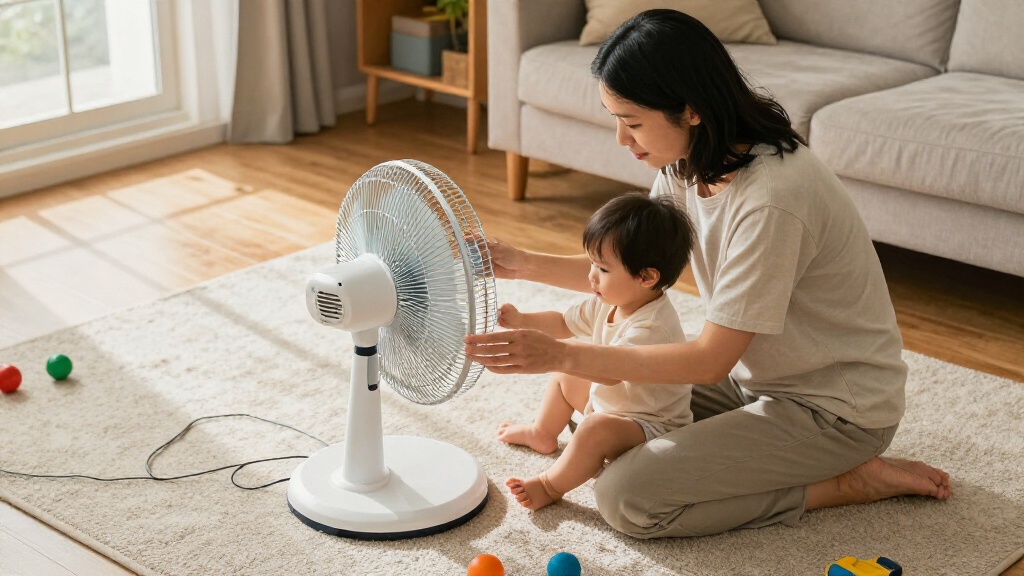
I ranked these five fans for toddler-household practicality, not as substitutes for childproofing. I looked at whether the fan’s blade or airflow design reduces access to moving parts, whether its size and mounting style make sensible placement possible, and how easily a caregiver can adjust it without inviting a child to handle it. A bladeless enclosure can lower direct contact with conventional exposed fan blades, but it does not remove risks from tipping, cords, outlets, or objects pushed into openings.
I also compared each model’s noise and speed options, intended scale of use, and control style. The DREO tower ranks first because it offers the broadest control range and a full-height form, while the Levoit earns a distinct role as a low-power, quiet personal fan. The DREO tabletop circulator ranks ahead of the smaller desk fans for room-spanning airflow claims, though its exposed three-blade design makes careful placement especially important. The compact bladeless models can be easier to keep on a high surface, but they may not cool a whole room. Manufacturer specifications and descriptions are the basis for this comparison; I am not claiming independent safety certification or hands-on testing.
| room fan safe for toddler | Power | Controls |
|---|---|---|
| DREO Smart Tower Fan for Bedro | Corded electric, 42 W | App, remote, touch, voice |
| Levoit Windi Mini Tower Fan fo | DC, 7.5 W | Remote control |
| DREO Fan for Bedroom | AC, 30 W | Knob control listed; no remote listed |
| DR.PREPARE Oscillating Tower F | Corded electric, 25 W | Dial switch; touch control also listed |
| KONSIDEN Bladeless Desk Fan | USB Type-C, 5 W | Touch |
Factors to Consider When Choosing Room Fan Safe For Toddlers
I would choose a fan by matching its airflow and placement to the room, then treating child access as a separate safety problem. A bladeless format can reduce access to conventional fan blades, but no option here is identified as childproof. The details below help separate a fan that suits your room from one that merely looks convenient.
Start With Placement, Not the Marketing Label
For a toddler household, the best fan is often the one that can sit securely out of reach without a cord dangling nearby. A tabletop fan may be small, but a low table can make it easier to pull down. A tall tower may put its outlet higher, yet it still needs a stable location and a cord that cannot be tugged. Keep fans away from beds, play areas, and places where a child can climb to reach controls or openings. Follow the manufacturer’s placement and cleaning instructions, and supervise children around powered appliances.
Choose Bladeless or Conventional Blades With Care
The DREO tower, Levoit Mini, DR.PREPARE, and KONSIDEN are described as bladeless; that means they do not use a conventional exposed fan blade, not that every opening or moving part is inaccessible. The DREO tabletop circulator lists three blades, so it calls for a more restrictive placement if toddler contact is a concern. I would favor an enclosed design for a room where children spend time, but I would still keep any fan away from small hands and avoid relying on its design as a substitute for supervision.
Match Airflow to the Room
The DREO tower and tabletop circulator are the stronger candidates when you want air to move beyond the immediate desk or bedside area. The tower lists 978 CFM; the tabletop model claims reach up to 60 feet and lists 800 CFM. These figures come from product specifications and are not directly comparable measurements of real-world room performance. The Levoit, DR.PREPARE, and KONSIDEN are more naturally suited to nearby personal airflow. If your room is large or has an awkward layout, consider the intended circulation pattern rather than relying on a single headline airflow number.
Think About Controls a Caregiver Can Reach
Remote or app controls can let an adult adjust a fan without moving close to it. The DREO tower offers remote, app, touch, and voice control, while the Levoit lists a remote. DR.PREPARE uses a dial-style control, and the DREO tabletop and KONSIDEN do not list a remote. More control options can be convenient, but they do not automatically make a unit safer; keep the fan itself and any controls that attract a child out of reach. If app access is undesirable, a basic switch may be easier to live with than a connected fan.
Use Noise and Power Figures as Comparisons, Not Guarantees
The listed noise figures range from 20 dB for the Levoit and DREO tabletop circulator to 40 dB for the DR.PREPARE. Noise can vary by speed and room conditions, so I would treat these figures as manufacturer specifications rather than a promise of silence. The Levoit’s 7.5-watt draw and KONSIDEN’s 5-watt figure distinguish them from the 30- to 42-watt DREO models, but lower wattage does not mean stronger airflow. Choose a setting that feels comfortable and keep airflow from blowing directly on a sleeping child for long periods.
Check the Cord, Base, and Cleaning Routine
Every fan in this list requires a power connection, including the USB-C KONSIDEN, so plan the outlet and cable route before deciding where it will sit. A short cable can restrict placement; a longer cord can create a reach or trip hazard if left exposed. Look for a stable, level surface and follow the maker’s directions for cleaning vents or the bladeless enclosure. Dust buildup can affect airflow, while cleaning a plugged-in device creates an avoidable hazard. Unplug it before cleaning and keep detachable parts away from children.
Frequently Asked Questions
Are bladeless fans safe to use around toddlers?
A bladeless design removes conventional exposed fan blades, which can reduce one kind of contact risk, but it does not make a fan childproof. A toddler could still pull a unit down, tug its cord, touch controls, or put an object into an opening. I would place any fan on a stable surface out of reach, manage its cable, follow the manufacturer’s instructions, and supervise children in the room.
Which fan in this comparison is quietest?
The Levoit Windi Mini and DREO 11-Inch Table Air Circulator both list a 20 dB noise level, the lowest figures among these five products. The KONSIDEN lists 30 dB, the DREO tower 25 dB, and the DR.PREPARE 40 dB. These are product specifications, and actual sound can vary with speed, placement, and room conditions.
Which option is best for a larger bedroom or shared room?
I would compare the DREO Smart Tower Fan and the DREO tabletop circulator first. The tower lists 978 CFM and eight speeds, while the tabletop model claims airflow reaching up to 60 feet and can tilt 120 degrees. The tabletop model has conventional blades, so it needs more restrictive placement around toddlers; the tower is the more balanced choice when an enclosed design and flexible controls matter.
Can I leave a room fan running while my toddler sleeps?
That depends on the fan’s instructions, the room setup, and your child’s access to the device. Use a stable placement with the fan and cord out of reach, choose a comfortable setting, and avoid aiming a strong breeze directly at the child for extended periods. A quiet specification can help with sleep comfort, but it does not replace safe placement or adult judgment.
Does a compact tabletop fan work for a whole room?
Usually, a compact desk fan is best at providing airflow nearby rather than evenly circulating a large room. The Levoit and KONSIDEN focus on personal-scale use, while the DR.PREPARE also remains a small tabletop option despite its oscillation. If broader circulation is the priority, the DREO tower or DREO tabletop circulator is a more suitable starting point, subject to safe placement.
Conclusion
My recommendation depends on where the fan will go and how much of the room it needs to serve. Choose the DREO Smart Tower Fan for the most versatile combination of bladeless design, multiple speeds, and adult-friendly controls. Pick the Levoit Windi Mini for quieter, low-power personal airflow on a secure elevated surface, or the DREO 11-Inch Table Air Circulator when directed room circulation matters more than an enclosed blade design. The DR.PREPARE suits buyers who want a simple oscillating desk fan, while the KONSIDEN makes sense for a very compact USB-C setup.
Whichever you choose, treat the fan as an electrical appliance rather than a child-safety product: keep it stable, route the power cable out of reach, and do not leave a toddler with access to its controls or openings. If no location keeps the unit secure and inaccessible, choose a different placement or wait until the room can be arranged safely.