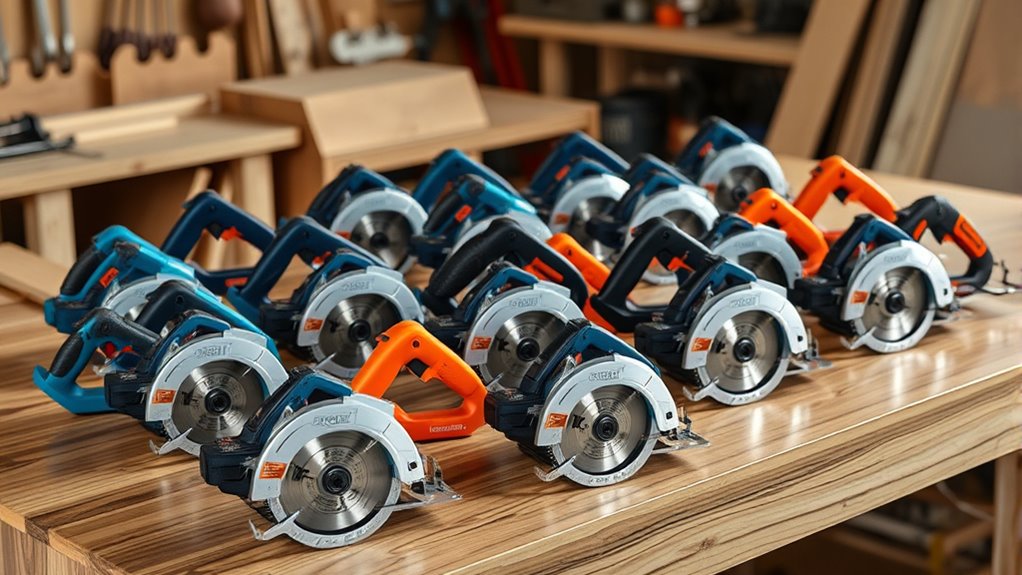

Compact circular saws trade the reach and capacity of a full-size saw for easier handling in tight spaces and on smaller projects. My best overall pick is the WORX WX439L, which pairs a compact 4-1/2-inch format with a familiar corded setup; the WEN 3625 stands out for bevel capability and a carrying case, while the WORKPRO 20V is a cordless choice with a larger included battery. The main tradeoffs are cutting depth, cord-free mobility, and how much guidance or control each saw provides. A compact model can suit sheet goods, trim, and occasional repairs, but it is not automatically a substitute for a full-size saw when cutting thick stock. Read on for the full comparison, ranking logic, and advice on matching a saw to your work.

Turn the school run and nap time into listening time
- Thousands of audiobooks, podcasts and originals
- Listen on your phone, tablet or Echo — also offline
- Cancel anytime
Complete the kit

Key Takeaways
- The WORX WX439L ranks first as a balanced corded compact option; it avoids relying on a laser guide or a bundle of accessories as the main reason to choose it.
- The WEN 3625 is the standout for bevel work, with beveling capability and a carrying case, though buyers should weigh those extras against their actual cutting needs.
- Cordless convenience comes with different compromises: the WORKPRO includes a 4.0Ah battery, while the GALAX PRO cordless listing specifies a 2.0Ah battery and KARTOP includes two batteries.
- Blade diameter separates compact use from broader capacity: most picks use blades around 4-1/2 inches, while the KARTOP’s 5-1/2-inch blade offers a different size tradeoff and the SKIL 5080-01 is a full-size 7-1/4-inch saw.
- Included guides, lasers, and extra blades vary widely, but they do not replace checking cutting depth, bevel range, blade availability, and whether the saw’s power source suits the worksite.


| compact circular saw | Power source | Voltage | Blade size | Weight |
|---|---|---|---|---|
| SEESII Mini Circular Saw | Corded electric | 120 V | 4-1/2 in | 4.7 lb |
| 4A Mini Circular Saw Corded wi | Corded electric | 120 V | 4-1/2 in | — |
| Mini Circular Saw by DEKOPRO | — | — | — | 2.1 kg |
| GALAX PRO Cordless Mini Circul | Battery powered | 20 V | 4.5 in | 4.6 lb (2.1 kg) |
| WEN 3625 5-Amp 4-1/2-Inch Beve | Corded electric, per product description | — | 4-1/2 in, per product title | — |
| TaskStar Mini Circular Saw wit | Corded electric | 120 V | 4.5 in | — |
| KARTOP Mini Circular Saw Cordl | Battery powered | — | 5.5 in | — |
| GALAX PRO Corded Mini Circular | Corded electric | 120 V | 4.5 in | 6 lb |
| WORX Electric Compact Circular | Corded electric | 120 V | 4.5 in | 4 lb |
| Skil 5080-01 13-Amp 7-1/4" Cir | Corded electric | 120 V | 7.25 in per title and description; listed spec says 4 in | 7 lb |
| Genesis GCS445SE 4.0A 4-1/2-In | — | — | 4-1/2 inches | — |
| Galax Pro 4-Amp 3500RPM Circul | Corded electric | 120 V | — | 6 pounds |
| 4.8A Power Circular Saw Corded | Corded electric | 120 V | — | 4.7 pounds |
| WORKPRO 20V 4-1/2" Cordless Mi | Cordless electric | 20 V | — | 9.6 pounds |
| DOVAMAN 4-1/2" Circular Saw wi | Corded electric | 220 V | 4.5 inches | 3.9 pounds |
More Details on Our Top Picks
SEESII Mini Circular Saw, 4.8A 4000RPM Corded 4-1/2″ with Laser Guide
The SEESII earns my Best Overall spot by balancing useful cutting capacity with a compact 4-1/2-inch format. Its 4.8A motor reaches 4000 RPM, and the stated 1-11/16-inch depth at 90 degrees suits many common sheet goods and trim jobs without moving to a full-size saw. Adjustable depth and bevel settings, plus a laser guide, give it more control than a bare-bones compact cutter. Compared with the WEN 3625, it lists a stronger motor and a similar blade size, while the WEN adds a carrying case. The SEESII’s main tradeoff is its cord: it needs an outlet, and its depth still falls short for thicker stock. Buyers should also plan on matching blades to the materials they cut.
Pros:- 4.8A motor and 4000 RPM provide strong output for a compact corded saw.
- Laser guide and adjustable depth and bevel settings support controlled cuts.
- 4-1/2-inch blade format keeps the tool more manageable than a full-size circular saw.
- Description specifies compatibility with blades for wood, metal, tile, and plastic.
Cons:- Corded operation limits use where an outlet is not readily available.
- 1-11/16-inch maximum depth at 90 degrees rules out thicker workpieces.
- Material-specific work may require buying additional blades.
Best for: Home DIYers who want a versatile corded compact saw for sheet goods, trim, and occasional material-specific cuts near an outlet.
Not ideal for: People making frequent cuts away from power or cutting thick lumber that exceeds its 1-11/16-inch stated depth.
- Power source:Corded electric
- Voltage:120 V
- No-load speed:4000 RPM
- Blade size:4-1/2 in
- Cutting depth at 90°:1-11/16 in
- Bevel capacity:45°
- Weight:4.7 lb
Our verdict“Choose the SEESII for a capable, adjustable compact saw used near an outlet, but skip it if cordless reach or deeper cuts matter most.”
4A Mini Circular Saw Corded with Laser Guide, 2 Saw Blades
This 4A mini saw is a sensible pick for DIYers who value a laser and rip guide for keeping everyday cuts on line. Its 3500 RPM motor and two included 4-1/2-inch, 24-tooth TCT blades are aimed at common home materials such as softwood, plywood, PVC, and drywall. The listed 1-1/8-inch depth at 45 degrees makes it suitable for modest bevel work, while the vacuum adapter can help contain dust during indoor jobs. Compared with the SEESII Mini Circular Saw, it runs at a lower stated speed but supplies a rip guide and dust adapter in the described kit. There is some listing uncertainty around weight and kit contents, so I would verify what arrives. Its cord and modest material focus make it less suited to mobile or heavy-duty cutting.
Pros:- Laser guide and rip guide help align both short cuts and longer straight runs.
- Two 4-1/2-inch, 24-tooth TCT blades are specified in the product description.
- Vacuum adapter connects to a stated standard 1-1/4-inch hose for dust collection.
- 45-degree bevel setting offers more flexibility than a fixed-angle compact saw.
Cons:- 3500 RPM is lower than the SEESII’s stated 4000 RPM.
- Corded power restricts mobility away from outlets.
- Product details conflict on weight and whether the saw body or blades are included, so package specifications should be checked.
Best for: Home renovators and first-time saw owners cutting plywood, drywall, PVC, or softwood who want a rip guide and shop-vac connection.
Not ideal for: Cordless-tool users, frequent heavy cutting, or buyers who need confirmed kit details and a clearly stated low tool weight.
- Power source:Corded electric
- Voltage:120 V
- No-load speed:3500 RPM
- Blade size:4-1/2 in
- Cutting depth at 90°:1-11/16 in
- Cutting depth at 45°:1-1/8 in
- Listed weight:6 lb in specifications; 5.5 lb in description
- Included accessories described:Two 24-tooth TCT blades, rip guide, vacuum adapter, and hex key
Our verdict“Pick this model for guided indoor DIY cuts and dust extraction, but look elsewhere if cordless convenience or dependable listing details are priorities.”
Mini Circular Saw by DEKOPRO, 5A 4500 RPM, 85mm Blade, Adjustable Depth, Includes 3 Blades and Guide
The DEKOPRO stands out for the highest stated no-load speed in this group: 4500 RPM from a 600W motor. That makes it the more compelling choice for buyers who want brisk cutting through wood, plastic, and soft metal while staying with an 85mm blade. Its adjustable depth reaches 27mm, and the kit description lists three blades and a guide, giving it a broader starting setup than the single-blade package described for the WEN 3625. The tradeoff is a lower stated cutting depth than several 4-1/2-inch competitors, including the SEESII, and the product data does not clarify whether it is corded or cordless. At 2.1kg, it is still portable, but buyers seeking confirmed power-source details or a saw for demanding materials should compare carefully.
Pros:- 600W motor and 4500 RPM are the highest stated power and speed figures in this batch.
- Three included blades and a guide provide a versatile starting kit.
- Adjustable cutting depth supports different thicknesses up to the stated limit.
- Dual safety switches and a dust port add practical control and cleanup features.
Cons:- Maximum adjustable depth of 27mm is shallower than the SEESII and several other 4-1/2-inch options.
- The supplied product data does not identify the power source.
- The listed material range excludes hard metals and other demanding cutting applications.
Best for: DIYers who prioritize a fast-running compact saw with several blade options for wood, plastic, and soft-metal projects.
Not ideal for: Buyers who need a clearly specified power source, deeper cuts, or a tool intended for hard metals and demanding professional workloads.
- Motor power:600 W
- No-load speed:4500 RPM
- Blade diameter:85 mm
- Bore size:10 mm
- Adjustable cutting depth:Up to 27 mm
- Weight:2.1 kg
- Included blades:3
- Listed materials:Wood, plastics, and soft metals
Our verdict“Choose the DEKOPRO for a high-speed compact saw and multi-blade kit, provided its unspecified power source and limited depth fit your work.”
GALAX PRO Cordless Mini Circular Saw 20V 2.0Ah with Laser Guide
The GALAX PRO is the clear choice here when cord-free movement matters more than maximum runtime. Its 20V battery platform and 4.6-pound listed weight suit quick cuts in tight spaces, overhead work, or repairs where dragging an extension cord would get in the way. A laser guide and rip fence help with alignment, and the package lists both 24T TCT and 60T HSS blades for different cutting needs. Compared with the corded SEESII, it sacrifices the SEESII’s higher stated speed of 4000 RPM for portability; both list a 1-11/16-inch depth at 90 degrees. The main limitation is the single 2.0Ah battery, which may interrupt longer jobs, and its compact blade still cannot match a full-size saw’s depth.
Pros:- 20V battery power avoids dependence on a nearby outlet.
- 4.6-pound listed weight and compact 4.5-inch blade support work in tight spaces.
- Laser guide and rip fence aid straight-line alignment.
- Two blade types and a vacuum adapter broaden the described setup.
Cons:- The included 2.0Ah battery may limit runtime on extended projects.
- 3400 RPM is lower than the corded SEESII’s stated 4000 RPM.
- Maximum depth remains limited to 1-11/16 inches at 90 degrees.
Best for: Homeowners and installers making short cuts in rooms, overhead, or away from outlets who value mobility over all-day runtime.
Not ideal for: Users tackling long production runs, those without time to recharge, or anyone needing full-size circular-saw cutting depth.
- Power source:Battery powered
- Voltage:20 V
- Battery capacity:2.0 Ah
- No-load speed:3400 RPM
- Blade size:4.5 in
- Cutting depth at 90°:1-11/16 in (42.8 mm)
- Cutting depth at 45°:1-1/8 in (28.6 mm)
- Weight:4.6 lb (2.1 kg)
- Included blades:24T TCT and 60T HSS
Our verdict“Choose the GALAX PRO when cordless reach is the deciding factor, but favor a corded model for sustained cutting near an outlet.”
WEN 3625 5-Amp 4-1/2-Inch Beveling Compact Circular Saw with Laser and Carrying Case
The WEN 3625’s strongest case is its ready-to-store package: the description lists a carrying case, dust extraction tube, carbide blade, and built-in laser. Its 5A motor and 3500 RPM sit between the SEESII’s higher stated speed and the 4A model’s lower motor rating, while the 4-1/2-inch format keeps it in compact-saw territory. A 0°–45° bevel range adds flexibility for angled trim cuts. Compared with the DEKOPRO, the WEN provides clearer corded operation and a case, while the DEKOPRO lists more blades and a higher speed. I would treat the WEN’s supplied specifications cautiously: details such as 0.27g weight, 2-inch blade length, and voltage do not align cleanly with the product description. Its listed cutting depth is also limited to just under 1-1/2 inches.
Pros:- Description includes a carrying case for storage and transport.
- Laser guide helps align cuts on workpieces.
- 0°–45° bevel capacity supports angled cuts.
- Dust extraction tube and carbide blade are listed in the package description.
Cons:- The supplied specifications contain apparent inconsistencies, including a 0.27g weight and 2-inch blade length.
- Listed maximum cutting depth is just under 1-1/2 inches, less than the SEESII’s stated 1-11/16 inches.
- Corded operation limits use away from outlets.
Best for: DIYers who want a corded compact saw with a case and basic accessories for occasional trim, drywall, or renovation cuts.
Not ideal for: Buyers who need a reliable stated weight or cutting-depth figure, deeper capacity, or a cordless tool for work away from outlets.
- Power source:Corded electric, per product description
- No-load speed:3500 RPM
- Blade size:4-1/2 in, per product title
- Bevel capacity:0°–45°
- Cutting depth:Just under 1-1/2 in, per supplied description
- Listed voltage:24 V; specification may be inconsistent with the corded description
- Included accessories described:24-tooth carbide blade, dust extraction tube, and carrying case
Our verdict“Pick the WEN if a case and bundled dust tube suit occasional corded work, but verify its specifications before buying for a depth- or weight-sensitive task.”
TaskStar Mini Circular Saw with Laser Guide, 4.8A, 4000RPM, 4-1/2 inch Corded Power Cutter with Rip Fence and 3 Blades
The TaskStar earns its place for DIYers who want a compact saw with more setup options than a basic wood cutter. Its 4,000-RPM motor, laser guide, depth adjustment, and 45-degree bevel setting suit small projects where a visible cut line and angle flexibility matter. The included three blades also give it a broader material range than the wood-focused WORX WX439L, though blade choice and cut demands still need to match the material.
The tradeoff is that this remains a 4-1/2-inch corded saw: it is easier to control in tight work than a full-size circular saw, but it cannot take on deeper cuts, and its cord limits reach. Reports of durability concerns make it a less reassuring pick for frequent, demanding use than a more established tool. I would choose it for occasional, varied home projects rather than a daily workhorse.
Pros:- Laser guide and adjustable depth help with controlled, repeatable cuts.
- 45-degree bevel setting adds angle-cut flexibility.
- Three included blades support more material options than a wood-only setup.
- Compact form and double safety switch suit controlled DIY work.
Cons:- 4-1/2-inch blade limits cutting depth and project scale.
- Cord restricts movement and requires access to an outlet.
- Durability concerns make it a less compelling choice for regular heavy use.
Best for: DIYers who want one compact corded saw for occasional wood, plastic, and other compatible light-material cuts, with bevel and depth adjustments.
Not ideal for: Frequent users or anyone making deep cuts, working far from an outlet, or needing a tool with a stronger durability track record.
- Power source:Corded electric
- Voltage:120 V
- Motor:4.8 A
- Speed:4,000 RPM
- Wattage:580 W
- Blade size:4.5 in
- Maximum cutting angle:45 degrees
- Included blades:3
Our verdict“Choose the TaskStar for occasional, varied DIY cuts and useful alignment features, but skip it if you need a proven saw for frequent or deep-cutting work.”
KARTOP Mini Circular Saw Cordless 5-1/2″ with 3 Blades & 2 Batteries
The KARTOP is the only cordless option in this group with a 5-1/2-inch blade, so it pairs freedom from an outlet with more cutting depth than the 4-1/2-inch TaskStar and WORX WX439L. Its brushless motor is rated at 7,000 RPM, and the two included batteries let a DIYer keep a spare ready while working around a room, yard, or remote job site. The 45-degree bevel setting also brings useful flexibility to trim and woodworking tasks.
That added reach comes with limits: the listed materials are wood, plastic, and soft metal, not demanding metalwork, and actual runtime will vary with the load. Compared with the corded WORX, KARTOP trades a simpler, lighter small-saw setup for battery convenience and a larger blade. I would pick it when mobility and cut depth matter more than a corded tool’s steady power supply.
Pros:- Cordless design makes it easier to move around a work area or take to remote projects.
- 5-1/2-inch blade offers more cutting depth than the 4-1/2-inch saws in this batch.
- Two included batteries provide a ready spare while the other pack is in use.
- Brushless motor and 45-degree bevel setting support versatile DIY cutting.
Cons:- Material guidance is limited to wood, plastic, and soft metal rather than heavy-duty metal cutting.
- Runtime depends on material and workload.
- Larger blade and body are less compact than the 4-1/2-inch alternatives.
Best for: DIYers working away from outlets who want cordless mobility, a larger-than-4-1/2-inch blade, and a spare battery for home projects.
Not ideal for: Users cutting heavy-gauge metal, needing predictable all-day runtime, or prioritizing the smallest and simplest compact saw.
- Power source:Battery powered
- Batteries included:2
- Battery capacity:2 × 21 V, 4,000 mAh
- Motor type:Brushless
- Speed:7,000 RPM
- Blade size:5.5 in
- Cutting depth at 90 degrees:2-3/16 in
- Cutting depth at 45 degrees:1-7/16 in
- Maximum bevel angle:45 degrees
Our verdict“Pick the KARTOP when cordless freedom and added blade reach outweigh the smaller footprint and steady outlet power of the WORX or TaskStar.”
GALAX PRO Corded Mini Circular Saw 4A with Laser Guide, 2 Saw Blades
This GALAX PRO makes the most sense for light construction and home projects in plywood, softwood, PVC, or drywall. Its 4-amp, 3,500-RPM motor and 4-1/2-inch blade keep it in the compact-saw category, while the laser and rip guide offer two ways to help follow a line. A vacuum adapter is also useful for connecting dust collection, a practical advantage over the TaskStar when cutting indoors.
It is less suited to demanding work than the WORX WX439L, which is lighter and lists a cutting depth of up to 2 inches. GALAX PRO lists 1-11/16 inches at 90 degrees, and its included components specify the body and two blades, so buyers should verify the package contents rather than assume a blade is already fitted. The cord also limits movement. I would choose this model for controlled, occasional cuts, not as a substitute for a full-size saw.
Pros:- Laser guide and rip guide help with alignment on straight cuts.
- Vacuum adapter supports dust collection during indoor work.
- Compact 4-1/2-inch blade suits smaller projects and tighter work areas.
- 45-degree cutting angle adds basic bevel versatility.
Cons:- Listed 90-degree cutting depth is shallower than the WORX WX439L’s stated maximum.
- Cord limits mobility around larger workpieces and sites.
- The package description can be confusing about blade inclusion; confirm contents before use.
Best for: Home DIYers cutting plywood, softwood, PVC, or drywall who value a rip guide and vacuum connection for indoor projects.
Not ideal for: Buyers needing deeper cuts, cordless mobility, or a saw intended for frequent heavy-duty construction.
- Power source:Corded electric
- Voltage:120 V
- Motor:4 A copper motor
- Wattage:480 W
- Speed:3,500 RPM
- Blade size:4.5 in
- Cutting depth at 90 degrees:1-11/16 in
- Cutting depth at 45 degrees:1-1/8 in
- Weight:6 lb
Our verdict“Choose this GALAX PRO for light indoor cuts where guides and dust collection help, but favor the WORX for greater listed depth or the KARTOP for cordless reach.”
WORX Electric Compact Circular Saw, 4.5 Amp, 4-1/2-Inch, WX439L
At 4 pounds, the WORX WX439L is the clearest choice here for buyers who put easy handling ahead of extra accessories or cordless freedom. Its one-handed design, adjustable depth up to 2 inches, and 45-degree bevel setting make it useful for quick wood cuts where a full-size saw feels cumbersome. A dust port helps manage debris, while the quick blade-change mechanism reduces interruption when maintenance or a blade swap is needed.
Compared with the GALAX PRO, the WORX weighs less and lists a greater maximum cutting depth, but it is described primarily for wood and does not include the same laser and rip-guide combination. The cord remains a constraint, and the 4-1/2-inch blade is no match for the reach of KARTOP’s 5-1/2-inch setup. Its listed dimensions are unusually large for a compact saw, so I would confirm fit if storage space is tight.
Pros:- Four-pound weight makes it the easiest option here to maneuver for short cuts.
- Adjustable depth reaches up to 2 inches, more than the GALAX PRO’s listed depth.
- Bevel adjustment supports cuts up to 45 degrees.
- Dust port and quick blade-change mechanism add convenience during work.
Cons:- Corded power limits movement away from an outlet.
- Best suited to wood, with less emphasis on other materials than the TaskStar.
- Listed dimensions are large for a compact saw and may complicate storage.
Best for: Homeowners and DIYers who want a light, manageable corded saw for quick wood cuts, bevels, and work where one-handed control helps.
Not ideal for: Buyers who need cordless operation, deeper cuts than the 4-1/2-inch format allows, or a saw optimized for cutting materials beyond wood.
- Power source:Corded electric
- Voltage:120 V
- Motor current:4.5 A
- Wattage:540 W
- Speed:4,100 RPM
- Blade size:4.5 in
- Maximum cutting depth:Up to 2 in
- Maximum cutting angle:45 degrees
- Weight:4 lb
Our verdict“Choose the WORX for a light, easy-to-handle corded saw for wood, but pick the KARTOP for cordless mobility or the TaskStar for broader material options.”
Skil 5080-01 13-Amp 7-1/4″ Circular Saw
The Skil 5080-01 stands apart from the compact picks: its 13-amp motor and 7-1/4-inch blade are aimed at more demanding woodworking, not tight-space maneuvering. That larger format can take on jobs beyond the 4-1/2-inch WORX WX439L or TaskStar, making it a better fit when a small saw’s depth becomes the limiting factor. Its bevel adjustment, spindle lock, on-tool storage, and dust blower add practical workshop features.
This is a deliberate exception to a compact-saw roundup, rather than a direct alternative for buyers who need a small, one-handed tool. At 7 pounds, it is heavier and less nimble than the WORX, and the supplied data conflicts: the title and description identify a 7-1/4-inch saw, while the listed blade length says 4 inches. I would verify the blade specification before buying. Choose it for workshop capacity, not compact portability.
Pros:- 13-amp motor is suited to more demanding cuts than the mini saws in this roundup.
- 7-1/4-inch blade size, as stated in the title and description, offers greater reach than 4-1/2-inch models.
- Bevel adjustment is listed up to 51 degrees, with positive stops noted in the product description.
- Spindle lock, on-tool storage, and dust blower add workshop utility.
Cons:- Larger format and 7-pound weight undermine the compact, one-handed use offered by the WORX.
- Product data conflicts on blade size; the listed 4-inch value does not match the title and description.
- Corded design limits mobility, and the basic feature set may not suit buyers seeking advanced safety features.
Best for: Home workshop users whose cuts exceed the capacity of a mini saw and who prefer corded power for larger woodworking tasks.
Not ideal for: Buyers seeking a genuinely compact, one-handed circular saw for tight spaces, quick small cuts, or easy portability.
- Power source:Corded electric
- Voltage:120 V
- Motor:13 A
- Wattage:1,800 W
- Blade size:7.25 in per title and description; listed spec says 4 in
- Maximum bevel angle:51 degrees per description
- Weight:7 lb
- Blade material:Carbide
- Tooth count:13
Our verdict“Pick the Skil only if cutting capacity matters more than compactness, and verify its blade size because the supplied specifications conflict.”
Genesis GCS445SE 4.0A 4-1/2-Inch Compact Circular Saw
The Genesis GCS445SE keeps the compact-saw format straightforward: its 4.0-amp motor and 4-1/2-inch blade are suited to common DIY cuts, including 2x material, without the bulk of a full-size circular saw. Its one-handed operation and quick blade changes are useful for occasional woodworking, while adjustable depth and a 45-degree bevel add flexibility for trim and angled cuts. Compared with the Galax Pro 4-Amp, Genesis offers a similar power class but does not list a laser guide or dust extraction, so it is a simpler choice rather than a precision-feature pick. The tradeoff is limited capacity: this small blade and modest motor are not intended for thick stock or sustained heavy cutting. I’d choose it for manageable home projects, not as a replacement for a larger saw.
Pros:- Lightweight format supports one-handed handling for controlled, smaller cuts.
- Adjustable depth and bevel settings cover more than straight crosscuts.
- Spindle lock supports quicker blade changes.
- Can cut through 2x material for common home-project tasks.
Cons:- The 4-1/2-inch blade limits cutting capacity compared with larger circular saws.
- The 4.0-amp motor is not suited to sustained heavy-duty cutting.
- No laser guide or dust-extraction feature is listed.
Best for: DIYers making occasional crosscuts, bevel cuts, and other light cuts in common lumber who value a manageable one-handed tool.
Not ideal for: Woodworkers regularly cutting thick stock or tackling extended, demanding jobs; the compact blade and 4.0-amp motor limit its range.
- Motor power:4.0 A
- Blade size:4-1/2 inches
- Speed:3,500 RPM
- Bevel capacity:45°
- Arbor size:3/8 inch
- Operation:One-handed
Our verdict“Choose the Genesis for light home projects where simple one-handed handling matters more than added guidance features or heavy-cutting capacity.”
Galax Pro 4-Amp 3500RPM Circular Saw with Laser Guide
The Galax Pro 4-Amp makes the most sense when a compact saw needs to help keep cuts on line. Its laser guide, scale, adjustable depth, and bevel setting add useful visual guidance for straight cuts and angled work, while dust extraction can help limit debris around the work area. The 4.5-inch blade and 3,500 RPM motor put it in a similar light-duty class to the Genesis GCS445SE, but the Galax Pro puts more emphasis on cut guidance and cleanup than one-handed simplicity. Its 1-11/16-inch maximum depth at 90 degrees is useful for many thinner materials, though not a substitute for a larger saw when stock gets thick. It is also corded, which means a nearby outlet is part of the setup. I’d favor it over Genesis when the added guide features matter more than cord-free movement.
Pros:- Laser guide and scale provide visual help for aligning straight cuts.
- Adjustable depth and bevel settings support varied cut types.
- Dust-extraction connection can help manage work-area debris.
- Listed for cutting wood, PVC, laminate, plastic, plasterboard, and MDF.
Cons:- Corded power restricts movement and requires access to an outlet.
- Maximum 90-degree cutting depth is 1-11/16 inches.
- At 6 pounds, it is heavier than some compact options in this roundup.
Best for: Home DIYers who make repeated straight cuts in wood, laminate, PVC, or MDF near an outlet and want laser guidance and dust extraction.
Not ideal for: People working far from power or cutting thick lumber; the cord limits mobility and the listed depth is modest.
- Power source:Corded electric
- Voltage:120 V
- Motor speed:3,500 RPM
- Blade diameter:4.5 inches
- Cutting depth at 90°:1-11/16 inches
- Cutting depth at 45°:1-1/8 inches
- Weight:6 pounds
- Bevel adjustment:Adjustable
Our verdict“Pick the Galax Pro if you want a corded compact saw with guidance and dust-management features for lighter, controlled cuts.”
4.8A Power Circular Saw Corded,4000RPM Laser Guide 45° Max Angle
This compact corded saw stands out for its three included blades: a TCT blade for wood, an HSS blade, and a diamond blade for dry cutting. That mix gives material-focused DIYers more starting options than the Genesis GCS445SE, which is presented as a simpler single-blade tool. Its listed 4.8-amp draw and 4,000 RPM are also higher than Genesis’s 4.0 amps and 3,500 RPM, while the 4.7-pound weight keeps it reasonably portable for a corded model. A laser, guide ruler, and dust pipe add practical support, but the stated cutting depth—1-11/16 inches at 90 degrees and 1-1/8 inches at 45 degrees—still defines it as a small-format saw. The product information gives limited detail about blade specifications and construction, so I’d treat the accessory range as the main differentiator, not a promise of heavy-duty performance.
Pros:- Includes three blade types for different material applications.
- 4.8-amp draw and 4,000 RPM offer higher listed output than the Genesis GCS445SE.
- Laser and guide ruler aid cut alignment.
- At 4.7 pounds, it remains manageable for many handheld tasks.
Cons:- Corded operation limits use away from an outlet.
- Cutting depth remains limited to 1-11/16 inches at 90 degrees.
- Product details provide limited information about blade specifications and long-term support.
Best for: DIYers who want one compact corded saw with supplied blades for wood, soft metal, plastic, and tile-related dry-cutting tasks.
Not ideal for: Buyers who need detailed blade compatibility guidance, cordless portability, or dependable capacity for thick and demanding cuts.
- Power source:Corded electric
- Voltage:120 V
- Current:4.8 A
- Wattage:580 W
- Speed:4,000 RPM
- Cutting depth at 90°:1-11/16 inches
- Cutting depth at 45°:1-1/8 inches
- Weight:4.7 pounds
- Included blades:3: HSS, TCT, and diamond dry-cutting
Our verdict“Choose this model if the included blade variety matters more than cordless mobility or a clearly documented heavy-duty cutting range.”
WORKPRO 20V 4-1/2″ Cordless Mini Circular Saw with 4.0Ah Battery
The WORKPRO 20V is the clearest fit here for jobs where a cord gets in the way: its included 4.0Ah battery lets you move around a workspace without tracking an extension lead. A listed 4,500 RPM, adjustable depth and angle, laser guide, dust extraction, and safety lock give it a broad feature set for DIY cuts. Compared with the corded Galax Pro 4-Amp, WORKPRO gains mobility and a higher listed speed, but gives up continuous plug-in operation; runtime becomes a factor on longer sessions. The supplied description calls it lightweight, yet the listed weight is 9.6 pounds, so it may not feel especially nimble for overhead or extended one-handed work. Multiple blades broaden material options, but the listed 80-watt figure and battery power suggest keeping expectations to home-use tasks rather than sustained heavy cutting.
Pros:- 20V cordless design avoids dependence on an outlet during a cut.
- Includes a 4.0Ah lithium-ion battery.
- Laser guide, dust extraction, and safety lock add practical support.
- Adjustable cutting depth and angle accommodate varied DIY tasks.
Cons:- Battery runtime can limit extended cutting sessions.
- Listed weight is 9.6 pounds, which may reduce comfort during prolonged handling.
- The 80-watt specification does not suggest a heavy-duty cutting class.
Best for: DIYers who cut in garages, yards, or rooms without convenient outlet access and want a battery and guidance features included.
Not ideal for: Users needing a particularly light saw for prolonged overhead work or continuous cutting without battery breaks; its listed weight and cordless runtime are constraints.
- Power source:Cordless electric
- Voltage:20 V
- Battery:4.0Ah lithium-ion, included
- Speed:4,500 RPM
- Cutting angle:0° to 45°
- Weight:9.6 pounds
- Wattage:80 W
- Additional features:Laser guide, dust extraction, safety lock
Our verdict“Choose WORKPRO for mobile DIY cutting with a battery included, but favor a corded model for long sessions or a lighter tool for extended overhead work.”
DOVAMAN 4-1/2″ Circular Saw with Laser & Auxiliary Handle, 5.8A
The DOVAMAN MCS01A pairs a compact 4.5-inch blade with an auxiliary handle, giving buyers a more supported grip than the one-handed Genesis GCS445SE. Its 5.8-amp, 710-watt motor is the strongest listed power figure among these five, and the laser plus six included blades make it a versatile option for a range of DIY materials. The stated depth is 1-11/16 inches at 90 degrees and 1-3/8 inches at 45 degrees; that angled capacity exceeds the Galax Pro’s listed 1-1/8 inches, though neither replaces a larger saw for thicker stock. The tradeoffs are corded operation and a 220-volt listing, which buyers should verify against their local power setup before choosing it. At 3.9 pounds, its listed weight is modest, but the auxiliary handle and blade bundle favor controlled versatility over the simplest, most portable setup.
Pros:- 5.8-amp motor and 710-watt rating are the highest listed power figures in this group.
- Auxiliary handle offers a more supported grip than one-handed compact designs.
- Includes six blades for varied DIY material tasks.
- Listed 45-degree cutting depth is 1-3/8 inches.
Cons:- Corded operation limits mobility around a worksite.
- The listed 220-volt supply may not suit every buyer’s power setup.
- Maximum depth remains limited for thick lumber and larger projects.
Best for: DIYers with compatible power access who want a compact corded saw, a second grip for steadier handling, and blades for varied materials.
Not ideal for: Buyers who need cordless mobility, cut thick stock, or cannot confirm compatibility with the listed 220-volt supply.
- Power source:Corded electric
- Voltage:220 V
- Current:5.8 A
- Wattage:710 W
- Speed:3,700 RPM
- Blade size:4.5 inches
- Cutting depth:1-11/16 inches at 90°; 1-3/8 inches at 45°
- Weight:3.9 pounds
- Included blades:6
Our verdict“Pick the DOVAMAN for supported, versatile cutting when its 220-volt requirement fits your setup and compact-saw capacity is enough.”

How We Picked
I compared these 15 saws against the needs that define this category: a manageable footprint, useful cutting capacity for smaller jobs, and control that helps a buyer make repeatable cuts. I gave weight to blade size, stated motor or battery details, depth and bevel adjustments, supplied guides, and practical inclusions such as batteries and cases. I also looked at whether each model’s format matches the compact-saw promise; the SKIL 5080-01 is included for comparison, but its 7-1/4-inch blade makes it a less direct fit than the smaller models.
The ranking favors useful balance over the longest accessory list. A saw with a clear role, relevant adjustments, and a practical power setup ranks ahead of a similar model whose listing mainly emphasizes a laser or extra blades. Cordless picks earn consideration for mobility, but battery capacity and kit contents matter; corded models can make more sense for sustained work near an outlet. Since product names and listed specifications do not establish real-world cut quality or durability, I avoid treating a higher amp figure or included accessory as proof of superior performance.
| compact circular saw | Power source |
|---|---|
| SEESII Mini Circular Saw | Corded electric |
| 4A Mini Circular Saw Corded wi | Corded electric |
| Mini Circular Saw by DEKOPRO | — |
| GALAX PRO Cordless Mini Circul | Battery powered |
| WEN 3625 5-Amp 4-1/2-Inch Beve | Corded electric, per product description |
| TaskStar Mini Circular Saw wit | Corded electric |
| KARTOP Mini Circular Saw Cordl | Battery powered |
| GALAX PRO Corded Mini Circular | Corded electric |
| WORX Electric Compact Circular | Corded electric |
| Skil 5080-01 13-Amp 7-1/4" Cir | Corded electric |
| Genesis GCS445SE 4.0A 4-1/2-In | — |
| Galax Pro 4-Amp 3500RPM Circul | Corded electric |
| 4.8A Power Circular Saw Corded | Corded electric |
| WORKPRO 20V 4-1/2" Cordless Mi | Cordless electric |
| DOVAMAN 4-1/2" Circular Saw wi | Corded electric |
Factors to Consider When Choosing Compact Circular Saws
Before choosing a compact circular saw, match the tool to the material, cut depth, and place where you plan to work. Small blade size alone does not tell you whether a saw can handle your project, and accessory bundles can distract from the specifications that shape actual use. These checks help separate a convenient compact tool from one that leaves you reaching for another saw.
Match Blade Size and Cutting Depth to Your Stock
Blade diameter is a starting point, not a complete measure of what a saw can cut. Check the manufacturer’s stated maximum depth at 90 degrees and at any bevel angle you expect to use, then compare that figure with the material’s true thickness. Beveling usually reduces available depth, so a saw that handles a straight cut may not clear the same stock at an angle. Avoid assuming that a larger blade automatically suits every job: body size, adjustment range, and intended use matter too. If your projects regularly involve thick framing lumber, a full-size saw such as the SKIL 5080-01 may fit better, though it gives up the compact handling most of this lineup prioritizes.
Choose Corded or Cordless Based on Where You Cut
Think about access to outlets and how long a typical cutting session lasts before choosing a power source. A corded saw avoids battery run time and charging breaks, which can suit a fixed workshop or repeated cuts near a power outlet. Cordless models make it easier to move around a room, yard, or jobsite, but the kit’s battery capacity and whether a spare is included shape how convenient that freedom is. A listed battery size is useful for comparing kits, but real run time also depends on material, blade condition, and cutting pace. Do not choose cordless solely for portability if most of your work happens at a bench with reliable power.
Treat Laser Guides as Aids, Not Cut Accuracy Guarantees
A laser can help indicate a cut path, but it does not replace a stable base, a correctly aligned blade, or a marked workpiece. Its usefulness depends on visibility in the work area and whether the line corresponds closely to the blade’s actual path. For repeat cuts, a rip fence or straightedge may offer more dependable guidance than a laser alone. Check how the saw supports the work and whether you can keep the base flat through the cut. A common mistake is paying extra attention to guide features while overlooking blade visibility, safe hand placement, and a reliable way to secure the material.
Check Bevel Adjustments and Depth Controls Before You Need Them
Depth and bevel adjustments affect both the range of projects a saw can handle and the time needed to set up a cut. If you only make square cuts, a bevel feature may add little value; if you regularly cut trim or angled joints, it can make a compact saw more versatile. Look for clear markings and locking controls that allow the base to stay where you set it. Confirm the available bevel range from the product specifications rather than inferring it from a model name. Also remember that angled cuts reduce effective cutting depth, which can make a compact blade less suitable for thicker material.
Compare the Whole Kit, Not the Accessory Count
Extra blades, a carrying case, and a fence can make a kit more useful, but only when they fit your intended work. Confirm blade diameter, arbor compatibility, and the types of material a blade is designed to cut before treating included blades as a meaningful advantage. A case matters more if you transport the saw than if it stays in a workshop, while a fence can help with straight rip cuts when set up correctly. Look for replacement-blade availability and clear instructions for changing blades, since a bundled accessory is less helpful if suitable replacements are difficult to source. Prioritize the saw’s core controls and capacity over a long feature list.
Know When a Compact Saw Is the Wrong Tool
Compact saws are most at home with smaller boards, sheet goods, and jobs where easy handling matters more than maximum depth. They can be a poor fit for frequent cuts through thick lumber, demanding framing work, or projects that call for a larger blade and greater capacity. A smaller tool can feel easier to control, but it still needs a firm work surface, a secured workpiece, and safe operating practices. If your workload spans both light DIY cuts and heavy construction, consider whether a compact saw will complement a full-size saw rather than replace it. The 7-1/4-inch SKIL in this group illustrates that distinction: it offers a conventional full-size format, not the same handling priorities as the other picks.
Frequently Asked Questions
Can a compact circular saw replace a 7-1/4-inch saw?
It can replace one for some smaller projects, but not as a blanket substitute. Compact models are aimed at easier handling and lighter cutting tasks, while a 7-1/4-inch saw typically offers more capacity for thick stock. Compare the listed cut depth with the material you cut most often, including at bevel angles. If you regularly cut framing lumber or need a full-size blade, the SKIL 5080-01 is the more direct fit in this lineup. Buyers who mostly cut sheet goods or make occasional repairs may prefer a compact model’s smaller format.
Should I choose a cordless compact saw if I already own batteries for another tool?
Only if the saw uses the same battery platform and the manufacturer confirms compatibility. Similar voltage labels do not guarantee that packs fit or work across brands or product lines. Check whether the saw kit includes a battery and charger, since a tool-only purchase can change the total setup you need. If you work for long stretches, also think about whether you have a spare pack ready to use. When compatibility is unclear, a corded model avoids adding a new battery system to your workshop.
Is a laser guide more useful than a rip fence?
They solve different problems, so the better choice depends on the cut. A laser can make a marked line easier to follow, while a rip fence can help guide repeated cuts parallel to an edge when it is adjusted and held properly. Neither feature guarantees a straight cut if the workpiece moves or the saw base wanders. For repeatable ripping, a fence or a securely clamped straightedge is often the more practical reference. For occasional freehand cuts, a visible laser may be convenient, but it should not replace careful layout and support.
What should I check before buying a compact saw for plywood?
Check the saw’s supported blade type, maximum cut depth, and whether a suitable blade for plywood is included or available. A blade intended for a different material may leave a rougher edge or make the cut less suitable for finish work. Consider how the base will ride over a large sheet and plan supports that keep the offcut from pinching the blade. A guide or straightedge can help keep long cuts on line, but confirm that the saw’s base can track it safely. If you need consistently clean cabinet-grade cuts, a compact circular saw may not be the best finishing tool on its own.
Does a higher amp rating mean a compact saw will cut faster?
Not by itself. Amp ratings describe electrical input information, but they do not account for blade design, motor behavior under load, material, or the condition of the blade. A higher number in a product name is not a dependable shortcut for comparing finished cut quality or speed. Compare blade size, stated capacity, adjustment features, and the power setup alongside the rating. For cordless saws, battery details also matter, so do not compare an amp figure on a corded model directly with a battery pack’s amp-hour rating.
Conclusion
For most buyers seeking a compact corded saw, I recommend the WORX WX439L as the best overall because it is a straightforward fit for the category without leaning on accessories as its main distinction. The best value-style choice is the DEKOPRO Mini Circular Saw for shoppers who want a stated 5A motor, adjustable depth, and three included blades, provided those included items match the work. For a more feature-focused compact option, the WEN 3625 is my premium pick for buyers who will use its beveling capability and case. Beginners who want a familiar corded setup and included guidance can look at the TaskStar, while buyers who need portability should compare the WORKPRO 20V and its 4.0Ah battery with the other cordless kits. Choose the SKIL 5080-01 only if your work needs a full-size 7-1/4-inch saw; it is the outlier rather than the compact-category match. Match the tool to your regular material and work area, and the right pick becomes clearer than any single feature label.