For most 1-year-olds, I’d start with the VTech Magic Star Learning Table as the best overall pick: its familiar, interactive play format makes it an approachable first activity table. The Baby Einstein Curiosity Table stands out for varied hands-on activities, while the wooden 10-in-1 sensory center suits families who prefer tactile, less electronic play. The main tradeoff is between sound-and-light features that invite button pressing and simpler activity stations that encourage manipulation, alongside differences in footprint, materials, and assembly. A table’s age label alone does not tell you whether its height, stability, or play pieces fit your child. Continue reading for the full breakdown and guidance on choosing a table that suits your home and your 1-year-old’s play style.

Turn the school run and nap time into listening time
- Thousands of audiobooks, podcasts and originals
- Listen on your phone, tablet or Echo — also offline
- Cancel anytime
Complete the kit


Key Takeaways
- The VTech Magic Star Learning Table leads for an approachable first pick: it offers an interactive format without requiring families to choose a complex wooden activity layout.
- The Baby Einstein Curiosity Table is the strongest alternative for varied hands-on play: its play-station approach differs from the more music-led VTech options.
- Wooden models make a distinct choice, not an automatic upgrade: the 10-in-1, Vanplay 8-in-1, and 13-in-1 tables emphasize tactile activities, but greater feature counts can mean more parts and a busier surface.
- Music-focused picks serve a narrower preference: the Basytodio DJ table, VEVOR spacecraft table, and Fisher-Price DJ table suit households seeking sound and light, but may be less appealing when quiet play is a priority.
- Age range and format matter more than the number of activities: products labeled for older toddlers, such as the Vanplay table, may be less suited to a child just turning one than a simpler, accessible station.


| baby activity table for 1 year old | Age range | Material |
|---|---|---|
| VTech Magic Star Learning Tabl | 6 months–3 years | — |
| Baby Einstein Curiosity Table | 12–36 months | Plastic |
| VTech Magic Star Learning Tabl | 6 months–3 years | Plastic |
| Activity Table for 1 Year Old | — | Wood |
| Basytodio Baby DJ Table Musica | 18 months–3 years | — |
| VEVOR Baby Spacecraft Musical | 6–18 months | ABS and PP |
| Vanplay 8 in 1 Wooden Activity | 18 months to 5 years | Wood |
| Weilim Montessori Activity Tab | 12 months to 3 years | Solid hardwood |
| VTech Buzz and Learn Activity | 9 months to 3 years | Plastic |
| Fisher-Price Laugh & Learn Mix | 6 months to 3 years | Plastic |
| VTech Little CEO Learning Desk | 9 months–3 years | Plastic |
| Wooden Activity Table Baby Act | 6 months–3 years | Wood |
| Montessori Toys for 1 Year Old | 12 months–5 years | Natural wood |
More Details on Our Top Picks
VTech Magic Star Learning Table (Frustration Free Packaging), Yellow
For a one-year-old who is drawn to buttons, sounds, and familiar play routines, this six-activity table offers a straightforward introduction to interactive play. Its English and Spanish activities add language exposure alongside color, sound, and motor-skill exploration, while the removable legs let it work as a floor toy when standing play is not yet a fit. Compared with the larger Baby Einstein Curiosity Table, the VTech has a simpler activity set and a smaller learning scope, which may suit families who want less to explore at once. That simplicity is also its main limitation: children who quickly master repeated buttons and songs may want more variety. It needs two AA batteries, and the listed batteries are for demonstration use, so plan on replacing them.
Pros:- English and Spanish activities introduce two languages during everyday play.
- Buttons, steering, page flipping, and other controls invite fine-motor practice.
- Convertible design supports both table-height and floor play.
- Age range starts at 6 months, making it suitable for younger babies as well as toddlers.
Cons:- Two AA batteries are required, and the included batteries are for demonstration use.
- Its six activities may feel repetitive sooner than the Baby Einstein Curiosity Table’s broader set of play modes.
Best for: Families with a one-year-old who enjoys buttons and songs and whose caregivers want English- and Spanish-language play in a convertible format.
Not ideal for: Caregivers seeking a broad, growing STEAM activity center or a toy that stays challenging after a toddler has learned its repeated activities.
- Brand:VTech
- Age range:6 months–3 years
- Activities:Six bilingual activities
- Languages:English and Spanish
- Battery requirement:2 AA batteries; included batteries are for demonstration use
- Play formats:Table or floor play
- Model number:80-181501
- Warranty:90-day warranty against manufacturer defects
Our verdict“Choose this VTech if bilingual songs and approachable controls matter more than a large range of activities.”
Baby Einstein Curiosity Table Activity Play Station, Montessori Floor Toy and Interactive Workbench
The Baby Einstein Curiosity Table is the strongest fit here for a one-year-old ready to move among different kinds of hands-on play. Its art, science, and music modes, removable parts, and reported collection of more than 65 melodies and sounds give caregivers more ways to refresh play than the simpler VTech Magic Star Learning Table. Removable legs also let the station shift between floor and standing play, a useful option as a child’s play posture changes. The tradeoff is a larger footprint—23.5 by 17.5 inches—and a more involved setup, so it needs more room and caregiver time than the compact VTech. It also relies on three AA batteries that are not included, and its many electronic features may be too stimulating for families seeking quieter, more open-ended play.
Pros:- Art, science, and music modes offer more variety than the VTech Magic Star Learning Table.
- Removable legs allow floor play as well as standing-height play.
- Removable parts support hands-on exploration beyond pressing electronic controls.
- Designed for ages 12–36 months, aligning with the target age and early toddler years.
Cons:- Its 23.5 x 17.5-inch footprint takes more floor space than the VTech Magic Star Learning Table.
- Requires three AA batteries, which are not included.
- Assembly may take more caregiver effort, and the electronic features may overwhelm some children.
Best for: Families with a one-year-old who enjoys switching between music, sensory activities, and hands-on exploration, and who have room for a larger play station.
Not ideal for: Households short on floor space, caregivers who prefer quiet or mostly non-electronic toys, or anyone wanting a simple setup with batteries included.
- Age range:12–36 months
- Dimensions:23.5 x 17.5 x 27.6 inches
- Weight:5.1 pounds
- Material:Plastic
- Battery requirement:3 AA batteries
- Power source:Battery powered
- Play modes:Art, science, and music
- Educational objectives:Cognitive development, early learning, motor skills, and sensory stimulation
Our verdict“Pick the Curiosity Table if you want broader play modes and have the space for a larger, battery-powered station.”
VTech Magic Star Learning Table (Frustration Free Packaging), Pink
This pink Magic Star is a practical choice for a one-year-old who wants electronic activities without a large activity station taking over the play area. At 14.92 x 19.76 x 16.81 inches and 4.1 pounds, it is more manageable to move than the Baby Einstein Curiosity Table, while still offering English and Spanish play through songs, a pretend phone, steering, and gears. The option to remove the legs also gives it a floor-play role for children who are not ready to stand at a table. Its six activities make the experience more focused than Baby Einstein’s art, science, and music modes; that can be an advantage for a young toddler, but children seeking frequent novelty may outgrow the repeated interactions. Two AA batteries power the features.
Pros:- English and Spanish content combines early language exposure with songs and interactive controls.
- Removable legs allow floor play as well as table play.
- At 4.1 pounds, it is easier to move than the 5.1-pound Baby Einstein Curiosity Table.
- Activities touch on colors, shapes, letters, numbers, and nursery rhymes.
Cons:- Six activities offer less variety than the Baby Einstein Curiosity Table’s multiple play modes.
- Requires two AA batteries, which may need replacement.
- Repeated songs and interactions may become less engaging as a child’s skills advance.
Best for: Caregivers who want a relatively lightweight bilingual activity table that can move between floor and standing play.
Not ideal for: Families wanting extensive activity variety, a non-electronic toy, or a table that will hold a more advanced toddler’s interest for a long time.
- Brand:VTech
- Age range:6 months–3 years
- Dimensions:14.92 x 19.76 x 16.81 inches
- Weight:4.1 pounds
- Material:Plastic
- Battery requirement:2 AA batteries
- Play formats:Learning table and interactive floor play
- Educational objectives:Color, shape, letter, and number recognition; nursery rhymes and early development
- Color:Pink
Our verdict“Choose the pink VTech for movable bilingual electronic play, but opt for Baby Einstein if activity variety matters more.”
Activity Table for 1 Year Old – Montessori Educational Learning Toys for Toddlers 12-18 Months, 10-in-1 Wooden Bead Maze Sensory Center Toys
For caregivers who would rather offer tactile puzzles than lights and songs, this 10-activity wooden set brings together a bead maze, animal matching, a shape sorter, and other hands-on play. That makes it a different proposition from both VTech Magic Star tables: it emphasizes moving and matching pieces instead of bilingual electronic prompts. The stated wood construction and water-based paints may appeal to families looking for a non-plastic alternative, while the included train set adds another play element. The main caution is scale: the listed dimensions are only 10 x 6 x 4 inches, which may feel small for an active one-year-old using it as a standing table. The age range extends to 10 years, but some activities may remain too simple for older children.
Pros:- Ten activities offer varied tactile play, including a bead maze, animal matching, and shape sorting.
- Wood construction and water-based paints provide a non-plastic alternative to the VTech and Baby Einstein tables.
- Includes an activity table, bead maze, and wooden train set.
- Designed for children from 12 months, matching the target age.
Cons:- The listed 10 x 6 x 4-inch size may be small for active toddlers or standing play.
- Lacks the lights, sounds, and bilingual prompts found on the VTech Magic Star tables.
- Some activities may be too simple for older children despite the listed age range extending to 10 years.
Best for: Families seeking a compact, hands-on wooden toy with several simple activities for a one-year-old who enjoys moving and sorting pieces.
Not ideal for: Caregivers wanting a full-size standing activity table, electronic music and lights, or activities that stay challenging through later childhood.
- Material:Wood
- Dimensions:10 x 6 x 4 inches
- Listed age range:12 months–10 years
- Number of activities:10
- Included components:Activity table, bead maze, wooden train set
- Example activities:Bead maze, animal matching, shape sorter
- Paint:Water-based
Our verdict“Choose this wooden option for compact, tactile play, but skip it if your one-year-old needs a larger standing station.”
Basytodio Baby DJ Table Musical Piano Toys for Toddlers with Music & Light
The Basytodio DJ table is the most music-centered option in this group, with a light-up turntable, piano keys, and multiple instrument sounds. It makes more sense for an older toddler who is ready to press keys and explore sound modes than for a newly one-year-old: its stated age range begins at 18 months. Compared with the VTech Magic Star Learning Table, it gives musical interaction more of the spotlight, but the supplied details do not describe bilingual learning or the broader early-recognition topics featured by VTech. Legs need assembly for standing use, and sound effects may become repetitive, so it is less suitable for families seeking quieter, open-ended activities. Its stated age range also makes it a later-starting choice than the Baby Einstein table.
Pros:- Light-up turntable and piano keys give music play a clear focus.
- Multiple instrument sounds and modes offer more sound exploration than the VTech Magic Star Learning Table.
- Can be set up for floor or table play.
- Stated age range covers toddlers from 18 months through 3 years.
Cons:- The 18-month minimum makes it a less suitable match for younger one-year-olds than the VTech and Baby Einstein options.
- Legs require assembly for standing play.
- Sound effects may become repetitive, and the product description does not specify a battery requirement.
Best for: Families with a toddler approaching or past 18 months who is especially interested in piano keys, turntables, lights, and sound play.
Not ideal for: Caregivers shopping for a newly one-year-old, wanting a broad language-learning table, or trying to limit electronic sounds.
- Brand:Basytodio
- Age range:18 months–3 years
- Instruments:DJ turntable and piano
- Features:Lights, music, and multiple interactive modes
- Play formats:Floor or table play
- Included components:Toys
- Model number:2308
- Warranty and support:Amazon.com Return Policy, 30-day return guarantee
Our verdict“Choose the Basytodio for a music-loving toddler aged 18 months or older, not as a first activity table for a younger one-year-old.”
VEVOR Baby Spacecraft Musical Activity Table for Toddlers 6-18 Months
For a 1-year-old drawn to light, sound, and tactile play, the VEVOR spacecraft table offers a more sensory-led experience than the wooden stations on the Weilim Montessori Activity Table. Its lights, music, textures, and star projector give a young toddler several ways to explore cause and effect, while tummy-time, seated, and standing modes suit changing play positions. The compact footprint and anti-slip feet are practical for indoor floor play, though the 2.3-pound table is still a lightweight toy rather than a surface for pulling up on.
The tradeoff is its reliance on three AA batteries, sold separately, and its more stimulating feature set may be a lot for babies who prefer quieter toys. Choose it over the Vanplay wooden table if electronic sensory effects matter more than battery-free, hands-on activities; skip it if you want a simple, quiet play station.
Pros:- Combines lights, music, textures, and a star projector for varied sensory play.
- Offers tummy-time, sit-and-play, and stand-and-play modes.
- Anti-slip feet help keep the table in place during floor play.
- Compact size is suited to indoor play areas.
Cons:- Requires three AA batteries that are not included.
- The lights and sounds may be overstimulating for some young children.
- Indoor-only use limits where it can be played.
Best for: Caregivers of 12-month-olds who enjoy lights and music and want a table with floor, seated, and standing play options.
Not ideal for: Families seeking a quiet, battery-free wooden toy, or caregivers who need an activity table for outdoor play.
- Age range:6–18 months
- Material:ABS and PP
- Size:13.8 × 13.8 × 7.87 inches
- Weight:2.3 pounds
- Power:3 AA batteries, not included
- Color:Blue and white
- Included components:Learning table, star projector, sound sources
Our verdict“Choose the VEVOR if your 1-year-old responds to electronic sensory features and you do not mind supplying batteries.”
Vanplay 8 in 1 Wooden Activity Table, Montessori Toys for 2 Year Old Gift
The Vanplay takes a quieter, hands-on approach than the VEVOR spacecraft table: its eight manual activities include a bead maze, fishing game, shape sorter, and music box, with no batteries to replace or electronic effects to manage. That can suit a 1-year-old who is beginning to practice grasping, sorting, and cause-and-effect play, though its listed age range begins at 18 months, so it is a less age-aligned choice for a newly turned 1-year-old than the Weilim table, which is specified from 12 months.
Removable legs and a storage net make it easier to put away or carry than a fixed activity center. The compact wooden format also trades broad electronic stimulation for focused manual play. Assembly may take time, and indoor-only use limits flexibility. I’d choose this over the VTech Buzz and Learn if battery-free play matters more than lights, sounds, and electronic learning prompts.
Pros:- Eight manual activities offer variety without electronic features.
- No batteries are required.
- Removable legs and an included storage net support storage and portability.
- Wooden construction has smooth edges, according to the product description.
Cons:- The stated age range starts at 18 months, which is a mismatch for some 1-year-olds.
- Assembly may take time.
- Designed for indoor use only.
Best for: Families with an older 1-year-old nearing 18 months who want a portable, battery-free wooden table with several hands-on activities.
Not ideal for: Caregivers looking for a product explicitly rated for 12 months, or children who need lights, music, and electronic prompts to stay engaged.
- Age range:18 months to 5 years
- Activities:8
- Material:Wood
- Size:13 × 9.4 × 2.3 inches
- Weight:0.82 kg
- Players:1
- Operation:Manual; no batteries required
- Use:Indoor
Our verdict“Pick the Vanplay for a near-18-month-old who is ready for battery-free, hands-on play and a table that stores away easily.”
Weilim Montessori Activity Table for 1 Year Old, Wooden Farm Toddler Toy
The Weilim is the clearest age match here for a 1-year-old: it is listed for 12 months to 3 years and puts eight hands-on stations on a wooden table, including a bead maze, shape sorter, train track, and spinning gears. Compared with the electronic VTech Buzz and Learn, it swaps lights and sounds for tactile activities that invite repeated grasping, moving, and sorting. Its solid hardwood construction and water-based paint also make it the more natural fit for families choosing a non-electronic play surface.
Four detachable legs make setup and storage more flexible, and the included figures and blocks add play pieces beyond the built-in stations. The tradeoff is that assembly may take more than a few minutes, and this is an indoor toy. Compared with Vanplay, Weilim has the stronger age fit for a newly 1-year-old, though both favor manual play over electronic teaching.
Pros:- Age range begins at 12 months, making it a direct fit for many 1-year-olds.
- Eight activity stations support varied hands-on play.
- Solid hardwood construction with non-toxic water-based paint.
- Detachable legs and included pieces allow flexible setup and play.
Cons:- Assembly may take longer than five minutes.
- Indoor use only.
- Manual activities may be less engaging for children who prefer lights and sound.
Best for: Caregivers seeking a wooden activity table specifically rated for 12-month-olds, with multiple tactile stations and included play pieces.
Not ideal for: Families who want lights, music, or spoken learning prompts, or anyone needing an activity table for outdoor use.
- Age range:12 months to 3 years
- Material:Solid hardwood
- Number of stations:8
- Included components:Activity table, 4 detachable legs, farm animal figures, fruit pieces, shape blocks, assembly tool, instruction card
- Paint:Non-toxic water-based paint
- Certifications:CPSIA and ASTM F963
- Use:Indoor
Our verdict“Choose Weilim if you want an age-matched wooden table with varied tactile activities rather than electronic effects.”
VTech Buzz and Learn Activity Table with Seven Interactive Play Zones, Pink
The VTech Buzz and Learn is a better fit than the Weilim wooden table for families who want a 1-year-old’s play to include colors, numbers, and animal prompts alongside moving parts. Its seven zones combine buttons, shape sorting, lights, and sounds, giving a child several ways to trigger a response. The table also starts at 9 months and is described for floor-to-standing play, so it can suit a child who is still exploring different play positions.
That electronic format has a clear tradeoff: regular use requires fresh batteries, and the included batteries are for demonstration. Compared with the Fisher-Price Mix & Learn DJ Table, the VTech foregrounds broader early-learning topics, while Fisher-Price leans more heavily into music and songs. Choose VTech for interactive learning cues; skip it if you prefer a battery-free, quieter wooden center.
Pros:- Seven play zones combine interactive features and hands-on activities.
- Age range begins at 9 months and extends through toddlerhood.
- Lights and sounds add responsive feedback to play.
- Includes four legs and activity components for assembly.
Cons:- Demo batteries are not intended to replace regular-use batteries.
- Indoor use only.
- Electronic lights and sounds may not suit families seeking quieter play.
Best for: Caregivers who want an electronic table for a 1-year-old that pairs buttons and moving activities with early colors, numbers, and animal concepts.
Not ideal for: Families who prefer battery-free play, want outdoor use, or are looking for a quiet wooden activity table.
- Age range:9 months to 3 years
- Play zones:7
- Material:Plastic
- Batteries:2 AA included for demo
- Assembly:Includes 4 legs and activity components
- Color:Pink
- Features:Lights, sounds, buttons, shape sorters, and moving parts
Our verdict“Choose the VTech if you want a battery-powered activity table that introduces early learning concepts through interactive play.”
Fisher-Price Laugh & Learn Mix & Learn DJ Table
For a 1-year-old who gravitates toward songs and sound, the Fisher-Price DJ Table makes a more music-centered choice than the VTech Buzz and Learn. Its eight keys and more than 100 songs, sounds, and phrases give the child plenty of sound-based feedback, while learning content covers colors, shapes, numbers, language, and opposites, including Spanish. Sit-at and stand-up play modes with detachable legs help it serve children at different points in early toddlerhood.
The large selection of audio is also the main tradeoff: it needs three AA batteries, not included, and may be too sound-heavy for families seeking calmer play. Compared with the VEVOR spacecraft table, this one emphasizes songs and language rather than a star projector and broader sensory effects. Its stated size and 4.5-pound weight also make it less appealing where floor space or easy moving is a priority.
Pros:- Offers more than 100 songs, sounds, and phrases.
- Learning topics include colors, shapes, numbers, language, and opposites.
- Detachable legs support sit-at and stand-up play.
- Age range spans infancy through age 3.
Cons:- Requires three AA batteries, which are not included.
- Audio-heavy play may not suit quieter households or sound-sensitive children.
- The stated size and weight may be inconvenient in a small play area.
Best for: Families whose 1-year-old enjoys musical toys and who want a table with songs, spoken phrases, and sit-at or stand-up play.
Not ideal for: Caregivers seeking a compact, quiet, battery-free table or working with a small play area.
- Age range:6 months to 3 years
- Material:Plastic
- Size:12 × 6.5 × 0.1 inches, as listed
- Weight:4.5 pounds
- Batteries:3 AA required
- Keys:8
- Learning objectives:Colors, shapes, numbers, language, and opposites
- Play modes:Sit-at and stand-up with detachable legs
Our verdict“Pick the Fisher-Price DJ Table if music and spoken learning prompts are the main features you want for your 1-year-old.”
VTech Little CEO Learning Desk Toddler Activity Center
The Little CEO Learning Desk suits a 1-year-old who is drawn to buttons, songs, and copying adult routines. Its pretend typing, phone calls, and page-flipping give little hands clear actions to repeat, while letters, counting, and first-word activities add simple learning prompts. At 14 by 12.4 inches, it takes less room than the larger wooden play centers in this roundup. Compared with the 13-in-1 Wooden Activity Table, though, it offers fewer kinds of hands-on exploration and leans more on electronic responses than open-ended play. The included batteries let play start without a separate battery purchase, but ongoing use depends on replacing them. I’d choose it for a young toddler who enjoys music and pretend office play; families seeking a quieter, mostly tactile table may prefer a wooden option.
Pros:- Pretend phone calls and typing give toddlers familiar actions to imitate.
- Songs and interactive prompts add variety to early play.
- Activities introduce letters, counting, number recognition, and first words.
- Compact footprint suits homes with limited play space.
Cons:- Electronic play requires three AA batteries, which need replacement over time.
- The office-play theme and activity range may lose appeal as a child gets older.
- The product is described for indoor use, limiting where it can be played.
Best for: Families with a 9- to 18-month-old who enjoys music, buttons, and imitating everyday adult activities, especially in a small play area.
Not ideal for: Buyers seeking a quiet, battery-free activity table or a broad range of tactile games that can hold an older preschooler’s interest.
- Brand:VTech
- Age range:9 months–3 years
- Material:Plastic
- Dimensions:14 × 12.4 × 8.7 inches
- Weight:3 pounds
- Batteries:3 AA batteries required; included
- Learning activities:Counting, first words, letters, number recognition, motor skills, and sing-along songs
- Play style:Pretend office activities, including typing, taking calls, and flipping pages
Our verdict“Choose this compact desk for a young toddler who likes music and pretend play, but pick a wooden table for more varied hands-on activities.”
Wooden Activity Table Baby Activity Center Montessori Toys for 1 Year Old
This 6-in-1 wooden table is a straightforward pick for families who want several tactile activities without an electronic play focus. A shape sorter, spinning gears, and animal action game give a newly mobile toddler different ways to grasp, turn, and match pieces. Its standalone or tabletop setup also lets caregivers use it on a floor or another stable surface, unlike the VTech Little CEO Learning Desk, which is built around its own interactive desk format. The tradeoff is a smaller activity selection than the 13-in-1 Wooden Activity Table, so it may offer less variety as a child’s interests grow. The listing describes water-based, non-toxic paint and tool-free assembly, but reports mention unclear assembly instructions; buyers who want a highly guided setup may find that frustrating. I’d favor it as a simpler wooden introduction, not the most expandable play center.
Pros:- Six activities offer varied opportunities for sorting, spinning, and interaction.
- Wood construction provides a tactile alternative to electronic plastic tables.
- Can be used as a freestanding table or placed on a tabletop.
- Described as using non-toxic, water-based paint and requiring no tools for assembly.
Cons:- Assembly instructions may be unclear, making setup less straightforward than advertised.
- Six games provide less variety than the 13-in-1 wooden activity center.
- Product data does not provide dimensions or weight to help judge fit and portability.
Best for: Caregivers seeking a compact, non-electronic wooden activity table with a handful of tactile games for a toddler around 1 to 3 years old.
Not ideal for: Families wanting the widest activity range, a fully specified set of dimensions, or especially clear assembly guidance.
- Manufacturer:ranqibo
- Age range:6 months–3 years
- Activities:6-in-1, including shape sorter, spinning gears, and animal action game
- Material:Wood
- Finish:Non-toxic, water-based paint, according to product description
- Included components:1 wooden activity table
- Model number:RA-004
- Setup and use:Tool-free assembly; suitable as a standalone or tabletop play station
Our verdict“Pick this as a simple wooden starter for a toddler who benefits from a few hands-on games, rather than a larger activity assortment.”
Montessori Toys for 1 Year Old – Wooden Activity Table for Toddlers 1-3, 13-in-1 Sensory Play Center with Bead Maze, Fishing Game, Shape Sorter & Xylophone
For families who want one table to offer several kinds of hands-on play, this 13-in-1 wooden center has the broadest stated activity mix in this three-product group. Its bead maze, fishing game, shape sorter, clock, and xylophone invite different motions and types of exploration, while the natural-wood construction keeps play screen-free. Compared with the 6-in-1 Wooden Activity Table, it gives a toddler more activities to move between; compared with the VTech Little CEO Learning Desk, it trades songs and electronic prompts for tactile play. The added variety takes space and setup: assembly is required, and the listed height is 13 inches. Detachable legs and a removable bead maze help with storage, but reports of some instability on uneven surfaces make a flat play area a better fit. It suits caregivers prioritizing variety, not a fuss-free setup.
Pros:- The stated 13-in-1 activity range offers more variety than the other wooden table in this batch.
- Bead maze, fishing game, shape sorter, and xylophone encourage different kinds of hand use.
- Natural wood supports a screen-free, tactile play experience.
- Detachable legs and a removable bead maze help with storage and portability.
Cons:- Assembly is required and may take time.
- Some reports mention stability problems on uneven surfaces.
- The many activities may be more than families seeking a simple, low-clutter table need.
Best for: Families, nurseries, or daycare rooms seeking a screen-free wooden center with varied activities for toddlers who are ready to explore different hands-on tasks.
Not ideal for: Buyers who need a ready-to-play table with no assembly, or whose play area has uneven flooring that could affect stability.
- Age range:12 months–5 years
- Activity count:13-in-1
- Material:Natural wood
- Height:13 inches
- Included activities:Bead maze, rainbow spinning gear, shape sorter, learning clock, shape matching, fishing game, and pulling radishes
- Included components:Bead maze, fishing game, shape sorter, and xylophone are named in the product title
- Storage features:Detachable legs and removable bead maze
- Pack count:1
- Warranty or return information:30-day return policy
Our verdict“Choose this for a flat play area and a toddler who benefits from varied, screen-free activities; skip it if easy setup and stability on uneven floors matter most.”
How We Picked
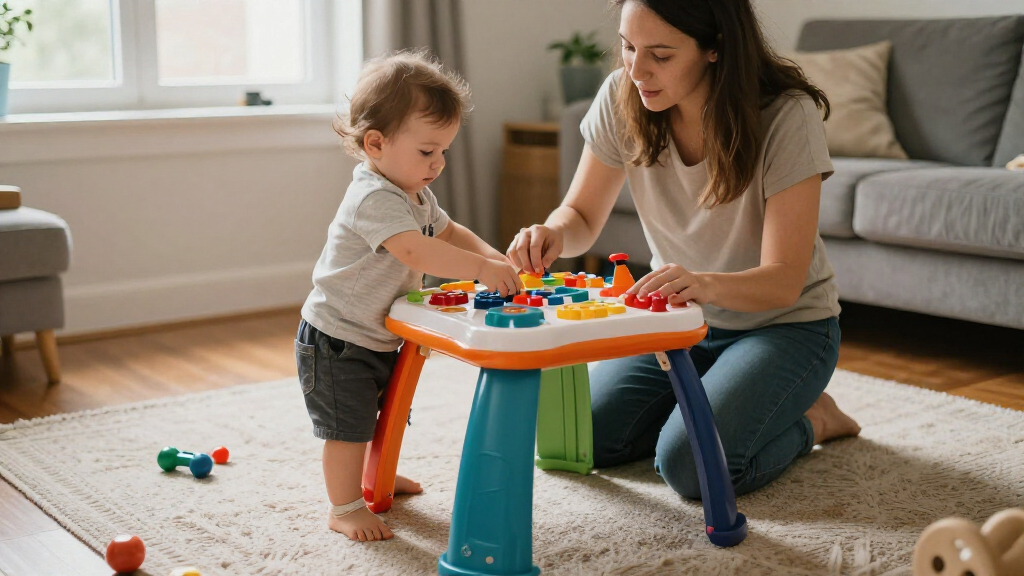
I ranked these tables for the needs of a 1-year-old, prioritizing accessible play, a useful mix of activities, and a format that makes sense for early toddler use. I also compared the kinds of play they invite: music and buttons, themed interactive zones, or hands-on wooden activities such as bead mazes and sorters. A table with many listed functions did not automatically outrank a simpler design; I gave more weight to whether the format seemed manageable and relevant for this age.
The order also reflects practical tradeoffs buyers face: age fit, play variety, materials, and likely household fit. Electronic tables rank higher for families who want immediate sound-and-light feedback, while wooden centers appeal to those seeking tactile play. Where product names suggest an older age range or a more specialized theme, I treated that as a narrower fit rather than a universal advantage. I considered assembly, maintenance, and the space a multi-activity surface may require as buying factors, while avoiding claims not supported by the product details.
| baby activity table for 1 year old | Material |
|---|---|
| VTech Magic Star Learning Tabl | — |
| Baby Einstein Curiosity Table | Plastic |
| VTech Magic Star Learning Tabl | Plastic |
| Activity Table for 1 Year Old | Wood |
| Basytodio Baby DJ Table Musica | — |
| VEVOR Baby Spacecraft Musical | ABS and PP |
| Vanplay 8 in 1 Wooden Activity | Wood |
| Weilim Montessori Activity Tab | Solid hardwood |
| VTech Buzz and Learn Activity | Plastic |
| Fisher-Price Laugh & Learn Mix | Plastic |
| VTech Little CEO Learning Desk | Plastic |
| Wooden Activity Table Baby Act | Wood |
| Montessori Toys for 1 Year Old | Natural wood |
Factors to Consider When Choosing Baby Activity Table For 1 Year Old
A baby activity table can be a first play station, but the right choice depends on how your child uses toys and where the table will live. I’d look past activity counts and ask whether the table’s height, play style, and setup suit your household.
Match the Play Style to Your Child
At one year, children can be drawn to very different kinds of interaction: pressing a button, turning a page, moving a bead, or repeating a tune. A musical table can make cause and effect clear, while a wooden sensory center offers more opportunities to handle and move pieces. Think about what already holds your child’s attention rather than assuming more features will hold it longer. A common mistake is choosing the busiest design because it appears to offer more value. If sound tends to overwhelm your child or your household, a quieter tactile format may see more use. If your child enjoys songs and lights, an electronic model can provide a more immediate response to exploration.
Check Height, Stability, and How Your Child Plays
A table that works for a seated child may not suit a child who pulls up or leans while standing. Check the product’s dimensions and the maker’s age and use guidance, then compare the height with your child’s posture and reach. Stability matters because toddlers may press down or use the edge for support, even when a play table is not intended to serve as a standing aid. Do not treat an activity table as a substitute for a walker or a support rail. When possible, look for clear information about the base and assembly, and place the table on a level surface. The right fit is the one your child can reach comfortably while you can supervise play.
Choose a Feature Count You Can Live With
Many tables advertise multiple play zones, but activity counts do not show how easy the surface is to use. A compact set of familiar actions may be more inviting than a crowded board with several small components. Before buying, consider whether your child can focus on one area at a time and whether loose accessories are easy to keep track of. More moving parts can also mean more assembly, storage, or cleaning work for adults. A higher feature count makes sense when the activities are distinct and match your child’s interests. Otherwise, prioritize a clear layout over the longest list of functions.
Weigh Electronic Play Against Wooden Materials
Electronic tables tend to offer songs, lights, and responsive buttons; wooden tables usually emphasize physical actions such as sorting, sliding, and turning. Neither format is automatically better for development, and a child can enjoy both. Consider whether you want batteries and sound in the play area, or prefer a simpler material and activity mix. Wooden designs can still include many attached components, so inspect care guidance and check for loose or damaged parts during normal use. Electronic models may need battery replacement and can be harder to clean around controls. Choose based on the kind of interaction you want to encourage and the maintenance you are comfortable with.
Plan for Space, Storage, and Shared Use
A multi-sided table needs room not only for its base but also for a child to reach around it. Measure the intended play area and account for nearby furniture before choosing a larger station. If floor space is limited, consider whether the table can be moved or stored without repeated disassembly. Families with more than one young child may value activities accessible from several sides, while a single-user tabletop can work well in a smaller corner. Check whether toys are attached or removable, since that affects cleanup and storage. A table that fits into your daily routine is more likely to stay available for play.
Treat Age Labels as a Starting Point
Product age ranges can cover broad stages, so a label that includes toddlers up to age three does not guarantee a close fit for a newly turned one-year-old. Look at the actual activities and whether they seem reachable and understandable for your child now. Be especially thoughtful when a product is presented mainly as a gift for a 2-year-old or older toddler. A more advanced assortment may become useful later, but it can feel less accessible at the start of the age range. Avoid buying for a future stage if the table will be frustrating today. Compare the manufacturer’s guidance with your child’s abilities and supervise play, particularly around small or movable pieces.
Frequently Asked Questions
Is a musical activity table a good choice for a 1-year-old who is easily distracted by sound?
It can be, but sound should be a deciding factor rather than a bonus. Look for product information about volume controls or quieter play modes before choosing an electronic table. If those details are not available, a wooden activity center may be a better starting point for a sound-sensitive child. You can also think about where the table will be used and whether music would disrupt naps or shared living spaces. Whichever format you choose, watch how your child responds and keep other play options available.
Should I buy a table with many activities or a simpler one for a first birthday?
A large activity count is not a reliable measure of how well a table will suit a newly one-year-old. Younger toddlers may get more from a few clear actions they can repeat than from a surface crowded with different features. A simpler design may also be easier to assemble, clean, and keep organized. Choose a broader activity mix if your child already enjoys switching between different toys and can explore the table without becoming frustrated. Check age guidance and the nature of any movable pieces before deciding.
Can a baby activity table help my child stand or walk?
An activity table can give a child something to explore while standing, but it should not be treated as a device for teaching walking or as a guaranteed support for pulling up. Stability and intended use depend on the specific design, assembly, and floor surface. Follow the maker’s instructions, keep the table on level flooring, and supervise closely. If your child leans heavily on furniture or is just beginning to stand, discuss suitable play setups with your child’s health professional if you have concerns. Choose a table for its play activities, not as a mobility aid.
How do I choose between a wooden activity center and an electronic table?
Start with the kind of play you want the table to invite. Wooden centers generally emphasize moving, sorting, and handling pieces, while electronic options offer sound, lights, and button-based feedback. Think about noise tolerance, battery upkeep, cleaning, and how many loose or attached components you want in the play area. A child who enjoys music may respond quickly to an electronic station, while one who likes manipulating objects may prefer a tactile layout. Product materials alone do not determine quality, so check care instructions, construction details, and age guidance for the specific model.
What should I check before buying an activity table for a small home?
Measure the floor space where your child will play, including room to stand or reach around the table. Compare the table’s listed dimensions and find out whether it can be moved or stored without taking it apart. Consider whether a large multi-sided station would obstruct a walkway or whether a more compact tabletop would fit your routine better. Also check how accessories are stored and whether the surface is easy to clean. A smaller table with activities your child will use can be a better fit than a feature-heavy center that is difficult to place.
Conclusion
For most families, I’d choose the VTech Magic Star Learning Table as the best overall starting point because it offers an approachable interactive format for a 1-year-old. For best value, I’d compare the simpler VTech and Fisher-Price options against your child’s interest in music and buttons rather than paying for a high activity count. The Baby Einstein Curiosity Table is my pick for buyers who want a broader hands-on station, while the wooden 10-in-1 center is better for families who prioritize tactile play. For beginners, start with a clear, accessible layout; for a sound-loving child, consider the DJ or spacecraft-themed tables. If you want a particular wooden feature mix, compare the Vanplay, Weilim, and 13-in-1 designs closely, and check age fit before choosing one aimed at older toddlers.
Cold & flu season Picks
humidifiers
As an affiliate, we earn on qualifying purchases.