The best baby sleep training clocks make it easier for a child to understand when to stay in bed and when the day can begin. I name the LittleHippo Mella my best overall pick for its clear visual cues paired with a night light and sound machine; the Hatch Baby stands out for app-based routine control, while the I·Code Sun & Moon Rise offers a straightforward visual approach. The main tradeoffs are simplicity versus customization, a dedicated wake cue versus an all-in-one sound machine, and app control versus hands-on buttons. A clock can support a routine, but it cannot replace one or guarantee a child will follow it. Read on for how all 14 options differ and which type of household each suits.

Turn the school run and nap time into listening time
- Thousands of audiobooks, podcasts and originals
- Listen on your phone, tablet or Echo — also offline
- Cancel anytime
Complete the kit


Key Takeaways
- Mella is the clearest all-around fit for families who want a recognizable wake cue alongside a night light and sound machine, rather than a wake clock alone.
- Hatch models prioritize routine control through an app and routine builder; that added flexibility may not suit parents who want a device controlled entirely at the bedside.
- Several picks combine sleep cues with sound and light, including BUTTING, MooLarm, Frida, and the Bluetooth-equipped option, but more functions can mean more settings to manage.
- Dinosaur designs set ANALOI and H-chin apart visually, while the Stay-in-Bed clock and I·Code Sun & Moon Rise lean toward recognizable stay-or-rise cues.
- The two Hatch color versions are functionally similar choices; color preference alone should not outweigh whether app control and routine features fit your household.
| ANALOI Dinosaur Sleep Training Alarm Clock for Kids |  | Best All-in-One Bedtime Routine | Display: Digital | Design: Dinosaur | Lighting options: 10 | VIEW ON AMAZON | See Our Full Breakdown |
| BUTTING Kids Sleep Training Alarm Clock with Sound Machine and Night Light |  | Best for Nap-Time Routines | Display type: Digital | Power source: Corded electric | Dimensions: 5 in W × 6 in H | VIEW ON AMAZON | See Our Full Breakdown |
| ANNNGUL Kids OK-to-Wake Alarm Clock with Night Light |  | Best for Simple Wake Cues | Model: YF400 | Display type: Analog | Power source: Corded electric | VIEW ON AMAZON | See Our Full Breakdown |
| Dreamegg Baby Sound Machine with Night Light and App Control |  | Best for App-Based Routine Control | Sounds: 34 | Sound types: 11 nature, 7 ambient, 6 white noise, and 10 melodies | Night-light modes: Solid Color, Sunlight, and Dynamic | VIEW ON AMAZON | See Our Full Breakdown |
| Kids’ Sleep Trainer and OK-to-Wake Alarm Clock with Night Light, Sound Machine, and Bluetooth Speaker |  | Best for Stories and Music | Display type: Digital | Power source: Battery powered; one lithium-polymer battery included | Connectivity: Bluetooth | VIEW ON AMAZON | See Our Full Breakdown |
| Frida 3-in-1 Alarm Clock, Sound Machine, and Nightlight with Bluetooth |  | Best All-in-One Routine Station | Functions: Alarm clock, sound machine, nightlight, sleep trainer | Sleep-trainer colors: Red for bedtime, yellow 15 minutes before wake time, green for wake time | Built-in sounds: White noise, pink noise, heartbeat, lullaby, bird, waves, wind | VIEW ON AMAZON | See Our Full Breakdown |
| Stay-in-Bed Clock for Kids with Night Light and Alarm |  | Best for Reward-Based Beginners | Brand: Learn & Climb | Display: Digital | Power: USB adapter with battery backup; batteries not included | VIEW ON AMAZON | See Our Full Breakdown |
| LittleHippo Mella Kids Sleep Trainer Alarm Clock with Night Light and Sound Machine, Arctic Blue |  | Best for Expression-Based Cues | Display: LCD | Power: Corded; must be plugged in with adapter | Mounting: Tabletop | VIEW ON AMAZON | See Our Full Breakdown |
| DINVEL Kids OK-to-Wake Sleep Training Alarm Clock |  | Best Compact, Simple Cue Clock | Model: YF400 | Display: Digital | Light signals: Red and green | VIEW ON AMAZON | See Our Full Breakdown |
| MooLarm Kids Sleep Training Alarm Clock with Night Light and Sound Machine |  | Best for Sound and Light Variety | Model: YF300 | Display: Digital | Power: Corded electric | VIEW ON AMAZON | See Our Full Breakdown |
| H-chin Dinosaur Sleep Training Alarm Clock for Kids |  | Best for Flexible Night-Light and Nap Settings | Brand and model: H-chin YF100 | Display: Digital, dimmable | Power: Corded electric | VIEW ON AMAZON | See Our Full Breakdown |
| Hatch Baby Sound Machine and Night Light with Routine Builder (Putty) |  | Best for App-Based Bedtime Routines | Product type: Sound machine and night light | Color: Putty | Controls: Hatch Sleep app, large button, and volume control | VIEW ON AMAZON | See Our Full Breakdown |
| I·Code Sun & Moon Rise Kids Alarm Clock and Sleep Trainer |  | Best for Clear Sleep-and-Wake Cues | Display: Digital | Light: Nine colors; warm light is dimmable | Sounds: Six soothing sounds | VIEW ON AMAZON | See Our Full Breakdown |
| Hatch Baby Sound Machine and Night Light with Routine Builder, Mint | 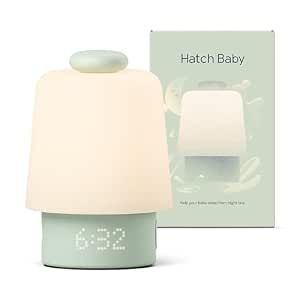 | Best for App-and-Button Flexibility | Product type: Sound machine and night light | Color: Mint | App control: Hatch Sleep app | VIEW ON AMAZON | See Our Full Breakdown |
| baby sleep training clock | Display | Dimensions |
|---|---|---|
| ANALOI Dinosaur Sleep Training | Digital | 4.6 × 4.6 inches |
| BUTTING Kids Sleep Training Al | — | 5 in W × 6 in H |
| ANNNGUL Kids OK-to-Wake Alarm | — | — |
| Dreamegg Baby Sound Machine wi | — | — |
| Kids’ Sleep Trainer and OK-to- | — | 7.5 × 7.5 × 4.0 inches |
| Frida 3-in-1 Alarm Clock | — | — |
| Stay-in-Bed Clock for Kids wit | Digital | 5 x 5 inches |
| LittleHippo Mella Kids Sleep T | LCD | 4.25 in W × 4.5 in H |
| DINVEL Kids OK-to-Wake Sleep T | Digital | 4.1 × 3.9 in (W × H) |
| MooLarm Kids Sleep Training Al | Digital | 4.5 in W × 5.5 in H |
| H-chin Dinosaur Sleep Training | Digital, dimmable | — |
| Hatch Baby Sound Machine and N | — | — |
| I·Code Sun & Moon Rise Kids Al | Digital | — |
| Hatch Baby Sound Machine and N | — | — |
More Details on Our Top Picks
ANALOI Dinosaur Sleep Training Alarm Clock for Kids
The ANALOI pairs sun-and-moon sleep cues with a digital clock, night light, alarm, and seven white-noise options, making it a strong fit for families who want one bedside device to support several parts of a routine. Its 15-, 30-, or 60-minute timer can shut off sound and light after bedtime, so parents need not rely on them running through the night. Compared with the simpler ANNNGUL, it offers sound choices and a bedtime timer; the ANNNGUL is smaller and centers on a straightforward red-to-green cue. The tradeoff is a more feature-heavy setup, and the included details do not specify a power adapter. Its dinosaur styling and plastic-and-silicone build are aimed squarely at children’s rooms.
Pros:- Combines sun-and-moon cues, digital time, alarm, and night light
- Seven white-noise options support a more settled bedtime routine
- Timer choices shut off bedtime sound and light after 15, 30, or 60 minutes
- Rechargeable USB-C power avoids requiring a cord at the bedside during use
Cons:- Adapter details are not specified, so charging setup may require checking the package
- Multiple light, sound, and timer settings may be more than families need for basic wake cues
Best for: Families who want sleep cues, a night light, and timed white noise in one rechargeable bedside clock.
Not ideal for: Caregivers seeking a minimalist red/green wake cue or clear confirmation of the included wall adapter.
- Display:Digital
- Design:Dinosaur
- Lighting options:10
- Brightness levels:3
- White-noise options:7
- Countdown timer:15, 30, or 60 minutes
- Power:Rechargeable; USB-C connectivity
- Dimensions:4.6 × 4.6 inches
Our verdict“Choose the ANALOI if you want an all-in-one children’s clock with timed sound and light, rather than the simpler cue-focused ANNNGUL.”
BUTTING Kids Sleep Training Alarm Clock with Sound Machine and Night Light
The BUTTING’s most useful distinction is its two-hour nap timer, which gives families a defined daytime sleep setting alongside sun, moon, star, and color cues for overnight routines. Its 17 sound options and adjustable-volume night light offer more variety than the focused red-and-green signaling on the ANNNGUL, while the child lock and settings memory can help keep a chosen routine from being changed by curious hands. Compared with the rechargeable ANALOI, this model stays tied to a tabletop outlet, so it is less flexible to place and cannot be used away from power. Its plastic body is practical but not a premium-feeling choice. Pick it for its nap feature and controls, not for portability or a pared-back interface.
Pros:- Two-hour nap timer adds a dedicated daytime routine feature
- Seventeen sound choices cover white noise, music, and nature sounds
- Child lock and settings memory help preserve parent-selected settings
- Multiple night-light colors with automatic dimming support a less bright sleep space
Cons:- Corded power limits placement and use during travel
- Plastic construction is less suited to buyers seeking a more substantial-feeling device
- The range of sounds and visual cues may take time to configure
Best for: Families who want one tabletop clock for wake cues and a timed two-hour nap routine, with child-resistant settings.
Not ideal for: Parents who need a rechargeable clock, a travel-friendly option, or a device that can sit away from an outlet.
- Display type:Digital
- Power source:Corded electric
- Dimensions:5 in W × 6 in H
- Weight:15.2 oz
- Sound options:17: 2 white noise, 9 soothing music, and 6 nature sounds
- Nap timer:2 hours
- Mounting type:Tabletop
- Material:Plastic with ABS frame
Our verdict“Pick the BUTTING for its nap timer and lockable settings if a permanently plugged-in bedside clock suits your setup.”
ANNNGUL Kids OK-to-Wake Alarm Clock with Night Light
The ANNNGUL keeps sleep training centered on an easy-to-read red-and-green signal: red indicates staying in bed, while green marks get-up time. That focused approach can suit toddlers who do not need a sound machine or a long list of routine settings. It is also notably compact at 4 × 4 inches, unlike the larger Bluetooth-equipped trainer in this lineup. The night light adds ten color choices and five brightness levels, and the included adapter and cord make the power setup clear. The tradeoff is that it must remain plugged in; the rechargeable ANALOI offers more placement flexibility and adds white noise and timers. This is a purpose-built cue clock, not a multifunction sleep station.
Pros:- Straightforward red and green cues focus on the core stay-in-bed lesson
- Ten night-light colors and five brightness levels allow light adjustment
- Compact 4 × 4-inch tabletop design takes up little bedside space
- Adapter and cord are included, and settings are preserved
Cons:- Continuous corded power rules out battery-powered placement
- No sound machine or bedtime countdown timer is listed
- The analog display may be less useful to children who rely on digital time
Best for: Caregivers introducing a toddler to a clear red-means-wait, green-means-wake routine in a small bedside footprint.
Not ideal for: Families who need battery operation, built-in sound options, or a clock that can be moved freely around the room.
- Model:YF400
- Display type:Analog
- Power source:Corded electric
- Night-light colors:10
- Brightness levels:5
- Time format:12- or 24-hour
- Snooze:9 minutes
- Dimensions and weight:4 × 4 inches; 8 oz
- Included:Adapter and cord
Our verdict“Choose the ANNNGUL for compact, uncomplicated red-and-green wake cues, but opt for the ANALOI if sound and timer functions matter.”
Dreamegg Baby Sound Machine with Night Light and App Control
The Dreamegg stands apart from the simpler tabletop clocks here by letting caregivers adjust sleep schedules, sounds, and lighting through an app. Its 34 sounds and several night-light modes give parents room to shape a bedtime environment, while the okay-to-wake clock, alarm, timer, and child lock keep it relevant to sleep training rather than just soothing. Compared with the ANNNGUL, it offers far more sound and lighting control, but that extra flexibility comes with more setup and dependence on app-based controls. The product details do not specify power source, dimensions, or sound-control methods outside the app, which makes those practical points harder to judge. This is best for caregivers who want remote routine adjustments, not those seeking the simplest possible wake cue.
Pros:- App control allows remote changes to sleep schedules and settings
- Thirty-four sounds span nature, ambient audio, white noise, and melodies
- Okay-to-wake clock, timer, and alarm support routine building
- Multiple night-light modes include changing, fading, and breathing effects
Cons:- App-based control may feel unnecessarily involved for a basic wake-cue routine
- Power source and physical dimensions are not specified in the provided details
- The product information does not describe how much can be controlled directly on the device
Best for: Caregivers who want to adjust an okay-to-wake routine, lighting, and a broad sound selection from an app.
Not ideal for: Families who prefer direct, simple controls or want confirmed power and physical-control details before choosing.
- Sounds:34
- Sound types:11 nature, 7 ambient, 6 white noise, and 10 melodies
- Night-light modes:Solid Color, Sunlight, and Dynamic
- Dynamic lighting:Color Changing, Color Fading, and Sunlight Breathing
- Controls:App control
- Sleep-training feature:Okay-to-wake clock
- Other features:Timer, alarm clock, child lock, and display brightness control
Our verdict“Choose the Dreamegg if app-based routine adjustments and sound variety matter more than a simple, self-contained clock like the ANNNGUL.”
Kids’ Sleep Trainer and OK-to-Wake Alarm Clock with Night Light, Sound Machine, and Bluetooth Speaker
This sleep trainer combines color-and-face wake cues with a sound machine and Bluetooth speaker, so it can support a routine that includes stories or music as well as a visual signal. The nine light colors, dual alarms, and adjustable brightness give families more schedule flexibility than the simpler ANNNGUL, while nine sleep sounds and five alarm tones provide built-in audio without needing Bluetooth. The tradeoff is size: at 7.5 inches square, it takes up more bedside room than the compact ANNNGUL. Its included lithium-polymer battery avoids a corded-only setup, though replacement may be less convenient than using standard batteries. The product details also flag text-heavy setup instructions, so this is better for caregivers willing to consult the manual than those seeking a fast, minimal setup.
Pros:- Color and facial cues give children a visual signal for bedtime and wake-up
- Bluetooth playback lets caregivers use stories or music as part of a routine
- Dual alarms and snooze can accommodate different schedules
- Nine sleep sounds, five alarm tones, and nine light colors offer multiple routine choices
Cons:- The 7.5-inch-square footprint is larger than compact options such as the ANNNGUL
- The included lithium-polymer battery may be less convenient to replace than standard batteries
- Setting the time and alarms may require working through text-heavy instructions
Best for: Families who want visual sleep cues plus Bluetooth playback for bedtime stories or music and need dual alarms.
Not ideal for: Buyers with limited bedside space or caregivers who prefer standard replaceable batteries and especially simple setup instructions.
- Display type:Digital
- Power source:Battery powered; one lithium-polymer battery included
- Connectivity:Bluetooth
- Dimensions:7.5 × 7.5 × 4.0 inches
- Weight:10.56 oz
- Night-light colors:9
- Sleep sounds:9
- Alarms:Dual alarms; snooze function
- Other audio and timer features:5 alarm tones; auto-off timer
Our verdict“Choose this model if Bluetooth stories, dual alarms, and expressive wake cues justify its larger footprint and more involved setup.”
Frida 3-in-1 Alarm Clock, Sound Machine, and Nightlight with Bluetooth
The Frida is a strong fit for families who want a sleep-training clock plus bedtime audio and light in one tabletop unit. Its red, yellow, and green cues break the routine into clear stages: bedtime, a short warning before wake-up, and the go-ahead to get up. Compared with the Learn & Climb Stay-in-Bed Clock, it offers more sound choices and Bluetooth audio playback; the Learn & Climb instead includes a storybook and reward chart for families who want extra routine tools.
Seven built-in sounds, three shut-off timers, and adjustable warm light make the Frida flexible at bedtime, while blackout mode suits children who prefer a dark room overnight. Its tradeoff is less remote control than some app-based options: Bluetooth can set the time and play phone audio, but there is no app or phone-based scheduling. Buyers may also need to consult the manual or packaging for power and setup details.
Pros:- Combines sleep-training cues, an alarm clock, sound machine, and nightlight
- Red, yellow, and green lights mark bedtime, an approaching wake time, and morning
- Seven built-in sounds and 15-, 30-, or 60-minute shut-off timers
- Three warm-light levels plus blackout mode
Cons:- No app or phone-based scheduling
- Setup and power details require checking the manual or packaging
Best for: Families seeking one device for color-coded sleep cues, bedtime sounds, and a warm adjustable nightlight without needing an app.
Not ideal for: Parents who want to build or adjust sleep schedules from a phone, or who need clearly stated setup and power details before buying.
- Functions:Alarm clock, sound machine, nightlight, sleep trainer
- Sleep-trainer colors:Red for bedtime, yellow 15 minutes before wake time, green for wake time
- Built-in sounds:White noise, pink noise, heartbeat, lullaby, bird, waves, wind
- Sound timer:15, 30, or 60 minutes
- Nightlight:Three warm glow levels and blackout mode
- Bluetooth:Sets clock time and plays audio from a phone
- App required:No
Our verdict“Choose the Frida if you want a versatile clock with sound and light built in, but skip it if remote scheduling is a priority.”
Stay-in-Bed Clock for Kids with Night Light and Alarm
The Learn & Climb makes sense for parents introducing a sleep clock alongside a simple, repeatable routine. Red, yellow, and green lights give children an easy visual rule for staying in bed and getting up, while the included storybook and eight-week reward chart give parents ways to reinforce that rule. Compared with the Frida 3-in-1, this model has fewer listed sound features, but its child-oriented learning extras make it more than a clock-only cue system.
A nap countdown, alarm, night light, and two sound levels cover basic bedroom needs, and the battery backup preserves saved settings during a power outage. The limitation is that backup batteries are not included, and the clock still needs its USB adapter for operation. Its 5-by-5-inch tabletop footprint is straightforward, but families seeking a larger range of sounds or lighting control may prefer the MooLarm or Frida.
Pros:- Red, yellow, and green signals make stay-in-bed and wake-up cues easy to explain
- Includes a storybook and eight-week reward chart for routine practice
- Nap countdown, alarm, night light, and two sound levels cover basic needs
- Battery backup preserves settings during power outages
Cons:- Backup batteries are not included
- Requires electrical power for operation
- Fewer sound and lighting options are specified than on the Frida or MooLarm
Best for: Parents starting sleep training with a young child who may respond to a storybook, reward chart, and clear color-coded cues.
Not ideal for: Families seeking a battery-powered clock, extensive sound choices, or more detailed nightlight settings.
- Brand:Learn & Climb
- Display:Digital
- Power:USB adapter with battery backup; batteries not included
- Light colors:Red, yellow, green
- Additional features:Alarm, night light, nap countdown, two sound levels
- Connectivity:USB
- Dimensions:5 x 5 inches
- Mounting:Tabletop
Our verdict“Pick the Learn & Climb for a beginner-friendly routine supported by a storybook and reward chart, rather than for broad sound customization.”
LittleHippo Mella Kids Sleep Trainer Alarm Clock with Night Light and Sound Machine, Arctic Blue
Mella gives children more than a color to read: its facial expressions change with the sleep routine, pairing a visual character with cues for bedtime, the approaching wake time, and getting up. That extra layer may suit families whose child responds better to expressive signals than to a plain light. Compared with the DINVEL OK-to-Wake Clock, Mella adds a face-based cue system and a stated mix of sleep sounds, alarm sounds, and nightlight colors; DINVEL emphasizes color and brightness customization in a compact design.
Three sleep sounds, five light colors, three alarm sounds, and alarm and silent countdown modes give Mella flexibility without crowding the routine with extensive settings. Its small 4.25-by-4.5-inch tabletop format is easy to place near a bed, though it must stay plugged in. That corded power requirement limits placement and makes it less suitable for families wanting a portable or battery-operated clock.
Pros:- Uses facial expressions alongside colors to communicate sleep and wake stages
- Combines sleep training, alarm, nightlight, and sound machine functions
- Offers three sleep sounds, five nightlight colors, and three alarm sounds
- Compact tabletop size and child-safe ABS and silicone construction
Cons:- Must remain plugged in with its adapter
- Designed for indoor tabletop use rather than portable placement
Best for: Families whose child may understand a friendly face-and-color cue more readily than lights alone.
Not ideal for: Parents who need a cordless clock or want extensive sound and light customization beyond the listed options.
- Display:LCD
- Power:Corded; must be plugged in with adapter
- Mounting:Tabletop
- Dimensions:4.25 in W × 4.5 in H
- Weight:8 oz
- Materials:ABS plastic and silicone
- Sleep sounds:3
- Nightlight colors:5
- Alarm sounds:3
Our verdict“Choose Mella if expressive face cues could help your child follow the routine and a corded bedside setup works for your room.”
DINVEL Kids OK-to-Wake Sleep Training Alarm Clock
DINVEL is the most focused pick here for families who want a small clock with straightforward red-and-green wake cues. Its star-shaped tabletop body measures 4.1 by 3.9 inches, making it a tidy choice where bedside space is limited. Compared with Mella, it does not use facial expressions, but DINVEL offers more listed color and brightness adjustments, along with five sounds and six volume settings. That makes it a better match for buyers who want to tune the room’s light and audio rather than rely on a character-led signal.
The controls are described as simple, and the range of settings lets parents adjust the clock to a child’s room and preferences. Still, the supplied data does not describe a nap timer, alarm features, or backup power, so it is less fully specified than the Learn & Climb, which includes a nap countdown and battery backup for saved settings. DINVEL also runs on a CR2032 battery; buyers should check the product details for how that affects ongoing use.
Pros:- Compact 4.1-by-3.9-inch tabletop design
- Red and green signals support a simple stay-in-bed and wake-up routine
- Ten color options and five brightness levels allow light adjustment
- Five soothing sounds with six volume settings
Cons:- Uses a CR2032 battery, with no alternate power or backup details supplied
- No warranty details are provided in the supplied product information
- Nap timer and alarm functions are not specified
Best for: Families with limited bedside space who want adjustable light and sound settings around basic red-and-green wake cues.
Not ideal for: Parents who want a clearly specified nap timer, alarm, or power-outage backup as part of the sleep-training setup.
- Model:YF400
- Display:Digital
- Light signals:Red and green
- Color options:10
- Brightness levels:5
- Sounds and volume:5 sounds; 6 volume settings
- Dimensions:4.1 × 3.9 in (W × H)
- Weight:3.68 oz
- Battery:1 CR2032 battery, included
Our verdict“DINVEL suits space-conscious families who want customizable light and sound, but not buyers who need clearly documented timer or backup features.”
MooLarm Kids Sleep Training Alarm Clock with Night Light and Sound Machine
MooLarm stands out for families who want a large selection of bedtime audio and adjustable lighting alongside sleep-training cues. Its 17 sound options span white noise, soothing music, and nature sounds, while 10 nightlight colors and four brightness levels offer more ways to tailor the room than the Learn & Climb Stay-in-Bed Clock. Sun, moon, and star symbols pair with colored lights to make the sleep and wake routine more visual than a color signal alone.
The nap timer is another practical distinction: it runs for 30, 60, 90, or 120 minutes without changing the wake-up alarm, which helps keep daytime rest separate from the morning routine. Compared with the Frida, MooLarm offers more listed sound choices and color options, but the Frida includes a blackout mode and Bluetooth playback. MooLarm requires corded power, and the supplied details do not specify backup or battery operation.
Pros:- Seventeen sound options include white noise, music, and nature sounds
- Ten nightlight colors and four brightness levels allow flexible room lighting
- Nap timer offers 30-, 60-, 90-, or 120-minute durations independently of the wake-up alarm
- Sun, moon, and star symbols reinforce the sleep-training cues
Cons:- Requires corded electric power
- No backup power or battery operation is specified
- Does not list the blackout mode or Bluetooth playback offered by the Frida
Best for: Families who want a nap countdown plus broad choices in sound, light color, and brightness for a child’s sleep space.
Not ideal for: Parents who need a cordless clock, power-outage backup, or a dark-room blackout mode.
- Model:YF300
- Display:Digital
- Power:Corded electric
- Dimensions:4.5 in W × 5.5 in H
- Weight:11.2 oz
- Nap timer:30, 60, 90, or 120 minutes
- Sound options:17: 2 white noise, 9 soothing music, 6 nature sounds
- Nightlight:10 colors and 4 brightness levels
Our verdict“Choose MooLarm for extensive sound and light choices with a separate nap timer, provided a corded setup suits your room.”
H-chin Dinosaur Sleep Training Alarm Clock for Kids
The H-chin Dinosaur makes its sleep-training cues easy to pair with bedtime comfort: colors and facial expressions help children distinguish sleep time from wake time, while the nine-color night light offers more atmosphere choices than the I·Code Sun & Moon Rise. Its 0–120-minute nap timer also gives it an advantage for families who want one device for naps as well as nighttime routines. Seventeen sound options cover white noise, lullabies, and nature sounds, and the child lock helps keep little hands from changing settings. The tradeoff is power: this clock must stay plugged in, so it is less flexible to move than a battery-powered option. It also lacks the Hatch models’ app-based routine controls, making it a better fit for families who prefer settings directly on the device.
Pros:- Colors and facial expressions give children clear visual sleep and wake cues.
- Nine light colors and 17 sound options support a range of bedtime preferences.
- A 0–120-minute nap timer adds use beyond overnight sleep.
- Dimmable display, snooze, and child lock offer practical control.
Cons:- Corded operation limits placement and means it cannot run unplugged.
- No app control for setting routines remotely.
Best for: Parents who want a child-friendly sleep cue, a broad choice of light and sound, and a timer for naps.
Not ideal for: Families who need a clock they can move around without access to an outlet or want app-controlled routines.
- Brand and model:H-chin YF100
- Display:Digital, dimmable
- Power:Corded electric
- Light:Nine colors and five white-light brightness levels
- Sounds:17: 3 white noise, 4 lullabies, and 10 nature sounds
- Nap timer:0–120 minutes
- Materials:ABS and silicone
- Dimensions and weight:5 × 4.5 inches; 0.35 kg
Our verdict“Choose the H-chin if you want varied light and sound plus a nap timer, and do not need app control or portable power.”
Hatch Baby Sound Machine and Night Light with Routine Builder (Putty)
For families who want bedtime settings to follow a routine rather than rely on a simple wake cue, the Hatch Baby in Putty is the most app-centered option in this group. The Hatch Sleep app lets parents customize lights, sounds, stories, and songs, then build routines that can be controlled remotely. That makes it more flexible for adult setup than the H-chin Dinosaur, which offers more listed sound categories and a dedicated nap timer but relies on device-level controls. A large button and physical volume control give caregivers a way to make quick adjustments without opening the app. This is a sound machine and night light, though, not a clock with clearly described sun, moon, or color-based wake cues like the I·Code. Hatch+ content is included for three months; ongoing access is optional, and some features require the app.
Pros:- App supports remote control and customized sleep routines.
- Combines a night light with pink noise, heartbeat audio, stories, and songs.
- Large button and physical volume control allow quick on-device adjustments.
- Includes three months of Hatch+ guides, consultant chat, and premium content.
Cons:- Some controls and features rely on the Hatch Sleep app.
- Hatch+ access is limited to three months unless renewed separately.
- The supplied description does not specify a dedicated visual wake-up cue or clock display.
Best for: Caregivers who want to customize lights and audio from a phone and build repeatable bedtime routines.
Not ideal for: Families seeking a dedicated visual OK-to-wake clock or those who prefer to avoid app-dependent features and optional subscription content.
- Product type:Sound machine and night light
- Color:Putty
- Controls:Hatch Sleep app, large button, and volume control
- Audio and content:Pink noise, heartbeat, stories, and songs
- Included Hatch+ access:Three months
- Hatch+ after included period:Optional; does not auto-renew
- Included accessories:Power adapter and instructions
- Available colors:Mint, Peach, Putty, Greige, and Beechwood
Our verdict“Pick the Putty Hatch if app-built routines matter more to you than a dedicated sun-and-moon wake cue.”
I·Code Sun & Moon Rise Kids Alarm Clock and Sleep Trainer
The I·Code Sun & Moon Rise puts the training signal front and center: separate sleep and wake alarms use familiar sun and moon icons to help children understand when to stay in bed and when it is time to get up. That makes its purpose clearer than the Hatch Baby sound machines, whose strengths are customizable audio, lighting, and app routines rather than a described sun-and-moon cue. It also works as a night light and sound machine, with nine light colors, six soothing sounds, adjustable timers, and a child lock. Compared with the H-chin Dinosaur, it offers explicit sleep and wake alarms, while the H-chin supplies more sound options and a nap timer. The I·Code must stay plugged in, and its description gives conflicting battery information, so I would not choose it for battery-powered use.
Pros:- Sun and moon icons make sleep and wake cues straightforward for children.
- Separate sleep and wake alarms focus the device on sleep training.
- Nine light colors, six sounds, and adjustable timers combine several bedtime functions.
- Child lock, snooze, and adjustable volume add practical controls.
Cons:- Corded operation limits placement and portability.
- Product information conflicts about battery requirements, creating uncertainty about backup power.
- Six sound options are fewer than the H-chin Dinosaur’s listed 17.
Best for: Families who want separate bedtime and wake cues that a young child can recognize through sun and moon symbols.
Not ideal for: Parents who need battery-powered operation, a large sound library, or app-based routine controls.
- Display:Digital
- Light:Nine colors; warm light is dimmable
- Sounds:Six soothing sounds
- Light timer:15, 30, 60, 90, or 120 minutes
- Sound timer:30, 60, 90, or 120 minutes, or continuous playback
- Time format:12- or 24-hour
- Power:Corded electric; 5V 1A AC adapter included
- Dimensions and weight:4.7 × 4.7 inches; 0.4 kg
- Warranty:Limited, one year
Our verdict“Choose the I·Code if recognizable sun-and-moon cues matter most and a permanently plugged-in clock suits your room.”
Hatch Baby Sound Machine and Night Light with Routine Builder, Mint
The Mint Hatch Baby shares its core routine-building features with the Putty version, so color is the main listed distinction rather than a different sleep-training approach. I’d choose it for families who want app scheduling but still value a Big Button and physical volume control for quick adjustments at the device. That two-way control is a useful contrast with the H-chin Dinosaur, which has direct controls and a nap timer but no listed app routines. The Hatch combines customizable light and audio—including pink noise, heartbeat, stories, and songs—and includes three months of Hatch+ content. Its limitation as a sleep-training clock is that the provided details do not describe a dedicated wake-time display or sun-and-moon cue like the I·Code. Some controls and content depend on a compatible phone, and Hatch+ access becomes optional after the included period.
Pros:- App control supports remote adjustments and routine scheduling.
- Big Button and physical volume control provide an alternative to phone controls.
- Customizable light and audio include pink noise, heartbeat, stories, and songs.
- Three months of Hatch+ content and support are included.
Cons:- Some app controls and content require a compatible phone.
- Hatch+ access is optional after three months and may require separate renewal.
- The supplied product details do not specify a clear visual wake-time cue.
Best for: Families who want app schedules with a physical control for quick changes, and prefer the Mint color option.
Not ideal for: Buyers whose priority is a dedicated OK-to-wake clock face or who want all features available without a compatible phone.
- Product type:Sound machine and night light
- Color:Mint
- App control:Hatch Sleep app
- Device controls:Big Button and volume control
- Audio options:Pink noise, heartbeat, stories, and songs
- Included Hatch+ access:Three months
- Hatch+ after included period:Optional; does not auto-renew
- Included accessories:Power adapter and instructions
- Available colors:Mint, Peach, Putty, Greige, and Beechwood
Our verdict“Choose the Mint Hatch for app routines plus convenient on-device controls, but select a dedicated trainer if wake cues are your main need.”
How We Picked
I ranked these baby sleep training clocks by how directly they support the core task: helping a child recognize a consistent stay-in-bed or wake-up cue. I gave more weight to clear visual signals and usable controls than to extra features that do not directly support that cue. I also compared whether each model adds a night light, sound machine, alarm, or routine tool, since those features can reduce the number of devices a family needs but may add setup complexity.
The order reflects clarity, ease of everyday use, and fit for different households, not a claim that every family needs the same feature set. Models with broader sound-and-light functions rank well when they still serve the sleep-training purpose; simpler clocks can be a better choice for parents who value fewer settings. App control, Bluetooth, and decorative designs are treated as meaningful differences, not automatic advantages. The product names and stated features provide a basis for comparison, but they do not establish unlisted details such as battery life, exact sound libraries, or long-term durability.
Factors to Consider When Choosing Baby Sleep Training Clocks
Before choosing a clock, decide what you want it to change in your routine: the child’s understanding of morning, the sleep environment, or both. The right feature mix depends on who will operate the device and how much visual and sound input your child responds to.
Choose a cue your child can understand
A wake clock works only if its signal is easy for your child to learn and remember. Think about whether a color, face, sun-and-moon image, or other visual change is more intuitive than a spoken instruction. A very young child may need an adult to explain and practice the signal repeatedly, so avoid expecting the device to teach the rule by itself. Keep the chosen cue consistent, including on weekends, rather than changing its meaning from day to day. If your child tends to ignore lights, a model with a clear visual design may still need support from a simple family routine.
Decide whether sound and light belong in the same device
An all-in-one clock can reduce bedside clutter and give parents a single place to manage a light, sound, and wake cue. That convenience is useful when the device’s extra functions match what your family already needs. It can also create more controls to learn, and a child who only needs a morning signal may be better served by a simpler model. Check whether you want a night light to remain on overnight, whether sound is part of your existing sleep routine, and whether those functions can be adjusted separately. Avoid buying extra features on the assumption that more stimulation automatically means better sleep.
Match the controls to the person who will use them
App control can make routine changes easier for a parent who already manages household devices by phone, but it adds a setup step and makes the phone part of the process. Physical controls may be easier for caregivers who prefer direct adjustments or do not want to rely on an app. Consider who will change the schedule, how often it is likely to change, and whether another caregiver needs to operate the clock without instructions. Bluetooth features can serve a different purpose from a wake cue, so decide whether that added function is genuinely useful. A less feature-heavy clock may be the calmer choice if you want a predictable, simple bedtime routine.
Plan for the child’s age and level of independence
A child must be old enough to connect the clock’s signal with the household rule for it to help with staying in bed. Parents still need to set expectations in child-friendly language and reinforce them consistently. A clock with several modes may suit a family that wants to adjust routines over time, while a simpler cue can be easier to introduce at the start. Consider where the device will sit and whether the child can see it without being able to change settings. Do not treat a sleep-training clock as a substitute for age-appropriate supervision or a safe sleep space.
Separate useful customization from setup burden
Schedules and routine tools can be valuable when wake times need to change across weekdays, weekends, or caregivers. They can also turn a simple purchase into another system to configure and maintain. Before choosing a more customizable device, identify the specific schedule or routine problem you want it to solve. If the answer is only “we need a clear morning cue,” extra programming may not add much. If your family frequently adjusts light, sound, or routine timing, broader controls may earn their place.
Check the practical details before relying on it
Product names and headline features do not tell the whole story of everyday use. Before buying, check the current listing or manufacturer information for power requirements, controls, dimensions, cleaning guidance, and any app or connectivity requirements. These details matter if the clock will sit in a small room, travel between homes, or be operated by several caregivers. Also confirm how the alarm or wake cue is set so you know whether it supports your planned routine. When a listing leaves an important detail unclear, do not assume the feature works in a particular way.
Frequently Asked Questions
Should I choose a sleep training clock or a sound machine with a wake cue?
Choose based on the job you need the device to do most. If your child mainly needs a clear signal for when it is time to get up, prioritize an easy-to-understand visual cue and simple controls. A sound-machine combination makes more sense when sound or a night light already plays a regular role in the sleep routine. Combining functions can save space, but it may add settings you do not use. Compare the core cue first, then treat sound and light as useful extras only if they fit your household.
Is an app-controlled clock a better choice than one with physical controls?
Neither control style is universally better; the difference is who will adjust the routine and how often. App control can make scheduled changes convenient for parents who are comfortable managing a device from a phone. Physical controls can be easier for caregivers who want direct access or prefer not to rely on an app. If multiple adults handle bedtime, think about which method they can all use consistently. Check the product’s current requirements before buying, since connectivity and setup details can shape daily convenience.
Can a sleep training clock help a toddler who wakes before the scheduled time?
It can provide a consistent visual reminder of the family’s wake-up rule, but it cannot make a child follow that rule on its own. Choose a cue the child can recognize, explain what it means, and practice the response during the day. Keep your response consistent when the child wakes early, so the clock’s message does not conflict with what happens next. A clock is one part of a routine, not a promise of later mornings. If early waking is tied to discomfort, sleep changes, or another concern, a clock may not address the cause.
Are two versions of the same clock worth comparing if they differ mainly by color?
When the stated distinction is color, treat them as one feature set for the purpose of choosing a sleep-training tool. Decide whether the model’s control style and routine functions suit you before choosing a finish. Color may matter for a child’s room or personal preference, but it does not by itself make a wake cue clearer or a routine easier to maintain. Verify the current listing to confirm that the versions share the functions you expect. In this roundup, the Putty and Mint Hatch listings are best separated by color preference rather than an assumed difference in capability.
Do I need Bluetooth or a routine builder for sleep training?
No. These features can add convenience, but the central need is a cue your child understands and a routine the adults can follow. A routine builder may appeal to families who want to coordinate several parts of bedtime, while Bluetooth may matter if its audio function fits your plans. Extra controls can also make setup and everyday operation less simple. Identify the problem you want to solve before paying attention to feature count, and skip functions that would add complexity without changing your routine.
Conclusion
For the broadest mix of a recognizable sleep cue, light, and sound, I recommend the LittleHippo Mella as best overall. Families who want more routine control should look at the Hatch Baby Sound Machine in Putty or Mint; those are my premium-style picks for app-led flexibility, with color as the main stated difference between them. For best value, compare the simpler options such as the ANNNGUL or DINVEL against the functions you truly need, since the product information here does not establish a price winner. Parents starting with a wake cue for the first time may prefer the I·Code Sun & Moon Rise or Stay-in-Bed Clock for their direct visual framing. If a child is drawn to playful designs, the ANALOI and H-chin dinosaur clocks offer a more themed option; if you need sound, light, and extra playback features together, compare the BUTTING, Frida, and Bluetooth-equipped models. Pick the simplest device that supports a routine your family can keep using.
Cold & flu season Picks
humidifiers
As an affiliate, we earn on qualifying purchases.