Energy-efficient window ACs can lower the electricity needed to cool a room, but the right choice depends on room size, unit design, and how you use it. My best overall pick is the Midea 10,000 BTU U-Shaped Smart Inverter, which pairs inverter operation with a window design that leaves more of the window open. The GE Profile ClearView 6,100 BTU stands out for its clear-view design, while the Frigidaire 5,000 BTU suits smaller rooms where a simpler, lower-capacity unit may be enough. The main tradeoffs are upfront features versus simple controls, cooling capacity versus room fit, and smart operation versus installation needs. Read on for the full comparison and guidance on choosing an efficient unit for your space.

Turn the school run and nap time into listening time
- Thousands of audiobooks, podcasts and originals
- Listen on your phone, tablet or Echo — also offline
- Cancel anytime
Complete the kit


Key Takeaways
- The Midea 10,000 BTU U-Shaped Smart Inverter ranks first because it combines inverter operation with a design that preserves more of the window opening; buyers should still check window compatibility and installation requirements.
- The two Midea 10,000 BTU U-shaped models are not interchangeable: the smart inverter version emphasizes efficiency and connected control, while the standard U-shaped model may suit shoppers who want the form factor without the same smart feature set.
- GE Profile ClearView models prioritize window visibility in a way conventional window units do not, but their higher-capacity 6,100 BTU format may be more than a very small room needs.
- Small-room choices span very different feature levels: the Frigidaire and renewed Midea are straightforward 5,000 BTU options, while the 6,000 BTU LG, DELLA, and GE models add different control and connectivity approaches.
- Capacity and special features do not automatically mean lower energy use: the 8,000- and 10,000-BTU units, including the TCL and heater-equipped ROVSUN, make the most sense when room size or multi-season use justifies the extra capability.
| LG 6,000 BTU Smart Window Air Conditioner, Wi-Fi, Remote Control, White (LW6024RSMX) |  | Best Small-Room Smart Pick | Cooling capacity: 6,000 BTU | Coverage: Up to 250 sq. ft. | Power: 540 W | VIEW ON AMAZON | See Our Full Breakdown |
| GE 10,000 BTU Smart Window Air Conditioner |  | Best for Larger Rooms | Cooling capacity: 10,000 BTU | Coverage: Up to 450 sq. ft. | Wattage: 870 W | VIEW ON AMAZON | See Our Full Breakdown |
| GE Profile ClearView 6,100 BTU Wi-Fi Window Air Conditioner |  | Best for Quiet, View-Preserving Cooling | Cooling capacity: 6,100 BTU | Coverage: Up to 250 sq. ft. | Wattage: 510 W | VIEW ON AMAZON | See Our Full Breakdown |
| DELLA 6,000 BTU Wi-Fi Window Air Conditioner |  | Best Efficiency-Data Pick | Cooling capacity: 6,000 BTU | Coverage: Up to 250 sq. ft. | Efficiency: CEER 11.0 | VIEW ON AMAZON | See Our Full Breakdown |
| GE 6,000 BTU Window Air Conditioner with Remote, Cools up to 250 sq. ft. |  | Best Non-Smart Efficiency Pick | Cooling capacity: 6,000 BTU | Coverage: Up to 250 sq. ft. | Efficiency: 11 SEER; 12.1 CEER | VIEW ON AMAZON | See Our Full Breakdown |
| Frigidaire 5,000 BTU Window Air Conditioner |  | Best for Simple, Small-Room Cooling | Cooling capacity: 5,000 BTU | Coverage area: Up to 150 sq. ft. | Voltage: 115 V | VIEW ON AMAZON | See Our Full Breakdown |
| ROVSUN 8000 BTU Window Air Conditioner with Heater and Inverter |  | Best for Inverter Heating and Cooling | Cooling capacity: 8,000 BTU | Heating capacity: 8,400 BTU | Coverage: Up to 350 sq. ft. | VIEW ON AMAZON | See Our Full Breakdown |
| Midea 10,000 BTU U-Shaped Smart Inverter Window Air Conditioner | 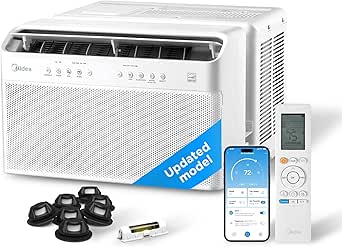 | Best for Quiet, Energy-Conscious Larger Rooms | Cooling capacity: 10,000 BTU | Coverage area: 450 sq. ft. | Noise level: As low as 32 dBA | VIEW ON AMAZON | See Our Full Breakdown |
| Windmill 5,000 BTU Lite Window Air Conditioner |  | Best Smart Pick for Compact Rooms | Cooling power: 5,000 BTU | Coverage: Up to 150 sq. ft. | Noise level: Starting at 51 dB | VIEW ON AMAZON | See Our Full Breakdown |
| TCL 10,000 BTU Smart Window Air Conditioner with Fan and Dehumidifier |  | Best for Multi-Function Room Cooling | Cooling capacity: 10,000 BTU | Coverage area: Up to 450 sq. ft. | Functions: Air conditioner, fan, and dehumidifier | VIEW ON AMAZON | See Our Full Breakdown |
| GE Profile ClearView 6,100 BTU Window Air Conditioner with WiFi, White (Renewed) | 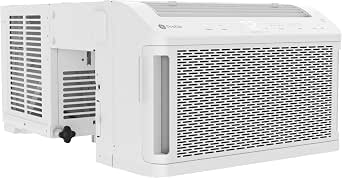 | Best for Small Rooms with Smart Control | Cooling capacity: 6,100 BTU | Recommended room size: Up to 250 sq. ft. | Wattage: 510 W | VIEW ON AMAZON | See Our Full Breakdown |
| Midea 5,000 BTU Mechanical Window Air Conditioner, 150 sq. ft., Black (Renewed) | 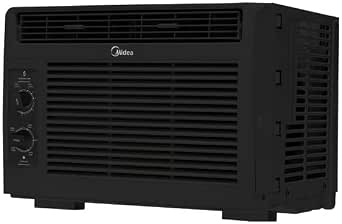 | Best Compact Mechanical Pick | Cooling capacity: 5,000 BTU | Coverage: Up to 150 sq. ft. | Wattage: 450 W | VIEW ON AMAZON | See Our Full Breakdown |
| GE 8,000 BTU Smart Window Air Conditioner |  | Best for App-Based Room Cooling | Cooling capacity: 8,000 BTU | Recommended room size: Up to 350 sq. ft. | Wattage: 650 W | VIEW ON AMAZON | See Our Full Breakdown |
| Midea 10,000 BTU U-Shaped Window Air Conditioner |  | Best Energy-Saving Premium Pick | Cooling capacity: 10,000 BTU | Coverage: Up to 450 sq. ft. | Energy features: Inverter; ENERGY STAR certified; reported savings over 37% versus traditional units | VIEW ON AMAZON | See Our Full Breakdown |
| energyefficient window ac | Cooling capacity | Noise level | Wattage | Coverage |
|---|---|---|---|---|
| LG 6,000 BTU Smart Window Air | 6,000 BTU | 52 dB | — | Up to 250 sq. ft. |
| GE 10,000 BTU Smart Window Air | 10,000 BTU | 59 dB | 870 W | Up to 450 sq. ft. |
| GE Profile ClearView 6,100 BTU | 6,100 BTU | As low as 41 dB | 510 W | Up to 250 sq. ft. |
| DELLA 6,000 BTU Wi-Fi Window A | 6,000 BTU | As low as 51 dB | 550 W | Up to 250 sq. ft. |
| GE 6,000 BTU Window Air Condit | 6,000 BTU | 52 dBA low; 56 dBA high | 530 W | Up to 250 sq. ft. |
| Frigidaire 5,000 BTU Window Ai | 5,000 BTU | 52 dBA | 450 W | — |
| ROVSUN 8000 BTU Window Air Con | 8,000 BTU | — | — | Up to 350 sq. ft. |
| Midea 10,000 BTU U-Shaped Smar | 10,000 BTU | As low as 32 dBA | — | — |
| Windmill 5,000 BTU Lite Window | — | Starting at 51 dB | — | Up to 150 sq. ft. |
| TCL 10,000 BTU Smart Window Ai | 10,000 BTU | 54 dB | 870 W | — |
| GE Profile ClearView 6,100 BTU | 6,100 BTU | — | 510 W | — |
| Midea 5,000 BTU Mechanical Win | 5,000 BTU | 51 dB | 450 W | Up to 150 sq. ft. |
| GE 8,000 BTU Smart Window Air | 8,000 BTU | 52 dB | 650 W | — |
| Midea 10,000 BTU U-Shaped Wind | 10,000 BTU | As low as 32 dBA | 890 W | Up to 450 sq. ft. |
More Details on Our Top Picks
LG 6,000 BTU Smart Window Air Conditioner, Wi-Fi, Remote Control, White (LW6024RSMX)
For a bedroom or home office up to 250 square feet, the LG pairs modest capacity with convenient app and voice control. Its 540-watt draw is lower than the larger GE 10,000 BTU Smart Window Air Conditioner’s 870 watts, though the LG is intended for a much smaller area, so that comparison is about scale rather than a direct efficiency ranking. The 24-hour timer, auto-restart, and washable filter make routine operation easier, while R-32 refrigerant is specified in the product data. The tradeoff is a simpler setup of two cooling and fan speeds, rather than the broader mode selection on the DELLA 6,000 BTU. Choose it for smart scheduling in a small room; skip it if you need more capacity or your window is not compatible.
Pros:- Wi-Fi control through LG ThinQ, with Alexa and Google Assistant compatibility
- 24-hour timer and auto-restart support scheduled, low-effort operation
- Washable filter and cleaning reminder simplify upkeep
- 540 W power draw paired with 6,000 BTU capacity for small-room use
Cons:- Two cooling and fan speeds offer fewer adjustments than the DELLA 6,000 BTU’s three fan speeds and four modes
- Capacity is limited to rooms up to 250 square feet
- Requires a compatible double-hung window
Best for: People cooling a bedroom or small office up to 250 square feet who want Wi-Fi scheduling and voice-assistant control.
Not ideal for: Buyers cooling larger open rooms, or anyone without a compatible double-hung window.
- Cooling capacity:6,000 BTU
- Coverage:Up to 250 sq. ft.
- Power:540 W
- Noise level:52 dB
- Connectivity:Wi-Fi; LG ThinQ, Amazon Alexa, and Google Assistant
- Timer:24-hour digital on/off timer
- Refrigerant:R-32
- Dimensions:12.83 in D × 17.32 in W × 11.14 in H
Our verdict“Choose the LG for smart, scheduled cooling in a small room, but pick the GE 10,000 BTU if you need to cover substantially more space.”
GE 10,000 BTU Smart Window Air Conditioner
The GE 10,000 BTU model is the room-coverage choice here: its stated capacity reaches up to 450 square feet, compared with 250 square feet for the LG 6,000 BTU and the other small-room picks. That extra reach suits a larger bedroom or living area, but the listed 870 W draw is higher, and the product data does not establish that it uses less energy per square foot than the smaller units. Eco Mode offers an energy-conscious operating setting, while three cooling modes and three fan speeds give more adjustment than the LG’s two-speed setup. App and voice control add convenience, but operation is rated at 59 dB, a meaningful drawback for light sleepers. Its installation fit is also specific: double-hung windows 25–36 inches wide.
Pros:- 10,000 BTU capacity covers a larger stated area than the 6,000 BTU models
- Eco Mode provides an energy-saving operating option
- Three cooling modes and three fan speeds allow more adjustment than the LG 6,000 BTU
- Wi-Fi app and Alexa or Google Assistant compatibility, plus a remote
Cons:- 870 W listed wattage is higher than the small-room models in this group
- 59 dB noise level may be disruptive in quiet rooms
- Requires a compatible double-hung window 25–36 inches wide
Best for: Households cooling a larger room, up to 450 square feet, that want app control and multiple operating settings.
Not ideal for: Light sleepers seeking quieter operation, or buyers with a small room who do not need its higher capacity and power draw.
- Cooling capacity:10,000 BTU
- Coverage:Up to 450 sq. ft.
- Wattage:870 W
- Noise level:59 dB
- Cooling modes:3
- Fan speeds:3
- Window fit:25–36 in. wide; 14.56 in. minimum height
- Refrigerant:R-32
Our verdict“Pick the GE when room coverage matters more than low listed wattage or quiet operation; for a small bedroom, the LG 6,000 BTU is a more fitting scale.”
GE Profile ClearView 6,100 BTU Wi-Fi Window Air Conditioner
The GE Profile ClearView makes a different compromise from the LG 6,000 BTU: it keeps the same small-room class while placing the unit below the windowsill, helping preserve the view and allowing the window to open and close. Its noise rating as low as 41 dB is the lowest stated in this five-product group, and its 510 W draw is below the LG’s 540 W and DELLA’s 550 W. Those figures may appeal to buyers prioritizing quieter, lower-wattage operation, but they do not by themselves prove lower seasonal energy use. The ClearView also offers four cooling modes and app, voice, remote, and touch controls. Its 61-pound weight and specialized window design make installation more involved than the lighter LG or DELLA; check the fit carefully before choosing it.
Pros:- Noise level rated as low as 41 dB, quieter on paper than the other listed models
- Below-sill design preserves the view and allows the window to open and close
- 510 W listed wattage is below the LG and DELLA 6,000 BTU models
- Four cooling modes with app, voice, remote, and touch controls
Cons:- At 61 lb, installation may require assistance
- Specialized fit requires a double-hung window with a 13-inch minimum opening
- Covers up to 250 square feet, so it is not suited to larger rooms
Best for: People with a compatible double-hung window who want small-room cooling, a preserved view, and the quietest stated operation in this group.
Not ideal for: Anyone who needs a lighter, simpler installation, has a window outside the listed fit range, or prioritizes a conventional compact unit.
- Cooling capacity:6,100 BTU
- Coverage:Up to 250 sq. ft.
- Wattage:510 W
- Noise level:As low as 41 dB
- Cooling modes:4
- Window fit:20–40 in. wide; 13 in. minimum opening height
- Wall thickness fit:4.5–13.75 in.
- Weight:61 lb
Our verdict“Choose the ClearView for quieter small-room cooling and a less obstructed window, provided its heavier, specialized installation fits your home.”
DELLA 6,000 BTU Wi-Fi Window Air Conditioner
Among these small-room models, DELLA is the clearest choice for shoppers comparing a stated efficiency metric: its product data lists a CEER of 11.0. That gives buyers a reference point the LG 6,000 BTU and GE Profile ClearView listings do not provide, although it should not be read as proof that DELLA will use less electricity in every home. It covers the same stated 250-square-foot area and adds four modes, including Dry, plus three fan speeds and an energy-saving mode. The LG has broader named voice-assistant support, while DELLA specifies Alexa compatibility and a 550 W draw. Its 51 dB minimum noise rating is not as low as the ClearView’s 41 dB, and its window requires at least 23 inches of width and 14.5 inches of height.
Pros:- Published CEER rating of 11.0 provides an efficiency figure for comparison
- Energy-saving mode plus four operating modes, including Dry
- Wi-Fi app control, Alexa compatibility, remote, and LED panel
- Three fan speeds and coverage up to 250 sq. ft.
Cons:- 550 W listed draw is higher than the LG 6,000 BTU and GE Profile ClearView
- Noise level is rated as low as 51 dB, above the ClearView’s 41 dB
- Requires a window at least 23 inches wide and 14.5 inches high
Best for: Efficiency-minded buyers cooling a room up to 250 square feet who want a published CEER figure, Wi-Fi control, and a Dry mode.
Not ideal for: Buyers who need the quietest stated operation, broader voice-assistant compatibility, or a smaller minimum window opening.
- Cooling capacity:6,000 BTU
- Coverage:Up to 250 sq. ft.
- Efficiency:CEER 11.0
- Wattage:550 W
- Noise level:As low as 51 dB
- Modes:Auto, Cool, Fan, Dry
- Window fit:23–34 in. wide; 14.5 in. minimum height
- Refrigerant:R-32
Our verdict“Choose DELLA if a published CEER rating and flexible modes matter most; choose the ClearView instead if quiet operation is your priority.”
GE 6,000 BTU Window Air Conditioner with Remote, Cools up to 250 sq. ft.
The GE 6,000 BTU is the practical choice for buyers who want efficiency-related controls without adding Wi-Fi. Its listed 12.1 CEER is higher than DELLA’s 11.0, though ratings from product listings should be compared as stated rather than treated as a guarantee of household energy savings. Eco Mode, a 24-hour timer, and auto-restart support less hands-on operation; the washable filter is reusable. At 530 W, its listed draw sits between the LG’s 540 W and GE Profile ClearView’s 510 W. Unlike those smart models, it has no app or voice control, and its window fit starts at 27.125 inches wide—more restrictive than the LG’s stated dimensions. For buyers who prefer straightforward remote and touch controls, that simplicity may be a benefit; smart-home users should look at LG or DELLA instead.
Pros:- 12.1 CEER rating is the highest published efficiency figure among these five products
- Eco Mode, 24-hour timer, and auto-restart support convenient operation
- 530 W listed wattage for 6,000 BTU capacity
- Reusable washable filter and included installation kit
Cons:- No Wi-Fi or smart-home compatibility, unlike the LG and DELLA
- Window width requirement begins at 27.125 inches
- Noise ranges from 52 dBA on low to 56 dBA on high
Best for: Buyers cooling a room up to 250 square feet who want a published CEER rating, Eco Mode, and timer controls without Wi-Fi.
Not ideal for: Smart-home users who expect app or voice control, and owners of narrower windows that do not meet the 27.125-inch minimum width.
- Cooling capacity:6,000 BTU
- Coverage:Up to 250 sq. ft.
- Efficiency:11 SEER; 12.1 CEER
- Wattage:530 W
- Noise level:52 dBA low; 56 dBA high
- Window fit:27.125–36 in. wide; 13.375 in. minimum height
- Temperature range:64°F–86°F
- Filter:Washable, reusable
Our verdict“Choose this GE for remote-controlled small-room cooling with the strongest listed CEER here, but pick the LG or DELLA if app control is a must.”
Frigidaire 5,000 BTU Window Air Conditioner
I’d choose this Frigidaire for a bedroom or office up to 150 square feet where straightforward cooling matters more than smart controls. Its 450-watt draw and modest capacity suit a small space, while the washable filter keeps routine upkeep simple. Auto restart brings back the previous settings after a power interruption, a practical touch for a basic unit. Compared with the Windmill 5,000 BTU Lite, the Frigidaire gives up app and voice control but offers a lower stated noise level of 52 dBA versus Windmill’s starting figure of 51 dB, so neither is a clear quiet-room winner on those numbers alone. The main tradeoff is its limited reach: it has no inverter and is not suited to larger rooms or buyers seeking connected energy controls.
Pros:- Sized for rooms up to 150 square feet
- 450-watt power rating
- Washable dust filter simplifies routine maintenance
- Auto restart restores the prior settings after a power interruption
Cons:- Small-room capacity limits where it can be used
- No inverter technology
- Does not include app or voice control
Best for: People cooling a small bedroom, home office, or studio who want uncomplicated controls, a washable filter, and auto restart.
Not ideal for: Buyers cooling more than 150 square feet or seeking inverter operation, app control, or voice commands.
- Cooling capacity:5,000 BTU
- Coverage area:Up to 150 sq. ft.
- Voltage:115 V
- Wattage:450 W
- Noise level:52 dBA
- Fan speeds:2
- Filter:Washable
- Refrigerant:R-32
- Auto restart:Yes
Our verdict“Choose the Frigidaire for basic, small-room cooling and skip it if you want smart controls or inverter efficiency.”
ROVSUN 8000 BTU Window Air Conditioner with Heater and Inverter
This ROVSUN makes the most sense for someone who wants one window unit to handle both summer cooling and supplemental heating. Its inverter technology, ECO mode, and stated CEER of 13.2 give it a stronger efficiency case than the fixed-speed Frigidaire 5,000 BTU, while the 8,400 BTU heating function adds year-round utility. App, remote, touch, and voice controls offer flexibility, and sleep mode is rated at 40 dB. Compared with the Midea 10,000 BTU U-Shaped, the ROVSUN covers a smaller area but adds heating; the Midea instead emphasizes very quiet operation and a window-opening design. The ROVSUN’s limits are its 350-square-foot coverage and specified window fit, plus operating-temperature restrictions that can make it unsuitable for very cold conditions.
Pros:- Inverter technology, ECO mode, and a stated CEER of 13.2
- Provides 8,000 BTU cooling and 8,400 BTU heating
- App, remote, touch, and voice control options
- Sleep mode noise is rated at 40 dB
Cons:- Operating-temperature limits restrict use in very cold conditions
- Fits only windows 24.5–36 inches wide and at least 14.5 inches high
- Coverage is less than the 450-square-foot Midea and TCL models
Best for: Households with a room up to 350 square feet that want inverter-based cooling, app control, and supplemental heat from one window unit.
Not ideal for: People with very cold winters, windows outside the stated dimensions, or rooms larger than 350 square feet.
- Cooling capacity:8,000 BTU
- Heating capacity:8,400 BTU
- Coverage:Up to 350 sq. ft.
- Power:870 W
- CEER:13.2
- Annual energy consumption:360 kWh/year
- Sleep-mode noise:40 dB
- Window fit:24.5–36 in wide; minimum 14.5 in high
- Controls:App, remote, voice, and touch
Our verdict“Pick the ROVSUN if you want inverter cooling and supplemental heat in a compatible, mid-sized room.”
Midea 10,000 BTU U-Shaped Smart Inverter Window Air Conditioner
For a larger room where noise and energy use both matter, I’d put this Midea ahead of the TCL 10,000 BTU Smart Window Air Conditioner. It pairs inverter operation with ENERGY STAR certification and claimed energy savings over 35%, while its stated 32 dBA minimum is quieter than the TCL’s 54 dB rating. The U-shaped design also lets the window open while the unit stays installed, a useful difference for fresh air and access compared with conventional window units. Wi-Fi and Alexa or Google Assistant support add convenient scheduling and control. Its tradeoffs are substantial physical demands: at 56.9 pounds, it may take two people to position, and it needs a window within its stated dimensions. This is a more efficiency-focused choice than the TCL, but not the simplest install.
Pros:- Inverter technology and ENERGY STAR certification
- Stated noise level as low as 32 dBA
- U-shaped design allows the window to open while installed
- Wi-Fi, app, Alexa, and Google Assistant control
Cons:- 56.9-pound weight makes installation more demanding
- Requires a window 22–36 inches wide and at least 13.75 inches high
- The energy-savings figure is a claim, not a guarantee of household results
Best for: People cooling a room up to 450 square feet who value low stated operating noise, inverter efficiency, and the ability to open the window.
Not ideal for: Solo installers, buyers with windows outside the specified fit, or shoppers who prefer a lighter, simpler conventional unit.
- Cooling capacity:10,000 BTU
- Coverage area:450 sq. ft.
- Noise level:As low as 32 dBA
- Power:890 W
- Voltage:115 V
- Refrigerant:R-32
- Dimensions:19.17 × 21.97 × 13.46 in (D × W × H)
- Weight:56.9 lb
- Window fit:22–36 in wide; minimum 13.75 in high
Our verdict“Choose the Midea over the noisier TCL if quiet, inverter-based cooling and an operable window outweigh installation weight.”
Windmill 5,000 BTU Lite Window Air Conditioner
The Windmill Lite brings connected controls to small-room cooling without stepping up in capacity. For spaces up to 150 square feet, its app and compatible voice controls make scheduling easier than on the basic Frigidaire 5,000 BTU, and three cooling modes plus three fan speeds give more adjustment than that Frigidaire’s two speeds. A washable filter keeps maintenance familiar, and the included installation kit is useful for standard single- and double-hung windows. The efficiency caveat is important: despite its Eco mode, this model has no inverter, so buyers focused on inverter operation should look instead at the ROVSUN or Midea options. It also remains a small-room unit, and its window-fit requirements rule it out for openings outside the specified range.
Pros:- App and compatible voice controls
- Three fan speeds and cool, eco, and fan modes
- Washable filter
- Installation kit included for standard single- and double-hung windows
Cons:- No inverter technology
- Cooling capacity is limited to rooms up to 150 square feet
- Fits only openings 23–34 inches wide and at least 14.5 inches high
Best for: Smart-home users cooling a bedroom or office up to 150 square feet who want app or compatible voice control.
Not ideal for: Buyers seeking inverter technology, larger-room coverage, or a unit for windows outside the stated dimensions.
- Cooling power:5,000 BTU
- Coverage:Up to 150 sq. ft.
- Noise level:Starting at 51 dB
- Refrigerant:R-32
- Inverter:No
- Window fit:23–34 in wide; minimum 14.5 in high
- Dimensions:14.8 × 17.8 × 15.1 in (D × W × H)
- Controls:App and compatible voice control
- Modes and fan speeds:Cool, eco, and fan; 3 fan speeds
Our verdict“Pick the Windmill Lite over the basic Frigidaire if smart controls matter, but choose an inverter model for a stronger efficiency focus.”
TCL 10,000 BTU Smart Window Air Conditioner with Fan and Dehumidifier
The TCL is a practical choice when a large room needs cooling plus help managing humidity, rather than the quietest or most efficiency-focused unit available. Its 10,000 BTU capacity is rated for up to 450 square feet, matching the Midea U-Shaped model’s coverage, and it adds fan and dehumidifier functions. Wi-Fi, app, remote, and voice control make operation flexible, while Sleep and Eco modes provide settings aimed at reducing energy use. The key distinction from the Midea is efficiency and noise: the TCL lists a 54 dB noise level and SEER of 10.9, while the Midea offers inverter operation, ENERGY STAR certification, and a much lower stated minimum noise figure. The TCL’s advantage is its multi-function setup; its tradeoff is that energy-saving modes do not make it an inverter unit.
Pros:- 10,000 BTU capacity for areas up to 450 square feet
- Combines air conditioning, fan, and dehumidifier functions
- App, remote, and compatible voice control
- Sleep and Eco modes plus a washable, reusable filter
Cons:- 54 dB noise rating is higher than the Midea U-Shaped model’s stated minimum
- SEER is 10.9, and inverter technology is not listed
- Requires window installation
Best for: People cooling a room up to 450 square feet who also want a fan and dehumidifier, with app or voice control.
Not ideal for: Noise-sensitive households or buyers prioritizing inverter technology and the quieter operation stated for the Midea U-Shaped model.
- Cooling capacity:10,000 BTU
- Coverage area:Up to 450 sq. ft.
- Functions:Air conditioner, fan, and dehumidifier
- Connectivity:Wi-Fi
- Controls:App, remote, and voice
- Noise level:54 dB
- SEER:10.9
- Wattage:870 W
- Filter:Washable and reusable
Our verdict“Choose the TCL for broad-room cooling and dehumidifying functions, but favor the Midea if low noise and inverter efficiency lead your priorities.”
GE Profile ClearView 6,100 BTU Window Air Conditioner with WiFi, White (Renewed)
For a small room where Wi-Fi control matters, this renewed GE Profile ClearView offers a useful middle ground: its 6,100 BTU capacity is rated for spaces up to 250 square feet, while the 510-watt draw is lower than the larger GE 8,000 BTU Smart Window Air Conditioner’s 650 watts. That comparison favors the ClearView when the room is smaller and avoiding excess cooling capacity is the priority, though wattage alone does not establish which unit uses less energy for a given space. The listed 41 dB noise level is another potential advantage over the GE model’s 52 dB rating. Wi-Fi and a remote add flexible control, and an installation kit is included. The tradeoff is the 90-day limited warranty and renewed condition; buyers seeking a longer coverage period or a new unit should look elsewhere.
Pros:- 6,100 BTU capacity is intended for rooms up to 250 square feet
- Wi-Fi and remote control offer convenient adjustment
- Listed noise level is 41 dB
- Installation kit is included
Cons:- Renewed condition may not suit buyers who prefer new appliances
- Limited warranty lasts only 90 days
- Listed SEER of 2.6 provides little basis for choosing it as a high-efficiency model
Best for: Buyers cooling a bedroom or home office of up to 250 square feet who want Wi-Fi control and a quieter listed noise level than the larger GE smart model.
Not ideal for: Buyers who want a new air conditioner, longer warranty coverage, or a unit with documented high-efficiency certification.
- Cooling capacity:6,100 BTU
- Recommended room size:Up to 250 sq. ft.
- Wattage:510 W
- Listed noise level:41 dB
- Controls:Wi-Fi and remote control
- Refrigerant:R-410A
- Warranty:90-day limited warranty
Our verdict“Choose this renewed ClearView for a small room where Wi-Fi and its relatively low listed noise level matter more than warranty length.”
Midea 5,000 BTU Mechanical Window Air Conditioner, 150 sq. ft., Black (Renewed)
This compact Midea is the straightforward choice for a small room, with 5,000 BTU cooling for spaces up to 150 square feet and mechanical controls instead of app features. Its 450-watt rating is below the GE Profile ClearView’s 510 watts, but that comparison is only useful alongside room size: the Midea is designed for a smaller area, and wattage by itself does not prove lower operating costs. Two cooling modes, two fan speeds, and seven temperature settings give buyers some adjustment without smart controls or an inverter. Compared with the ClearView, this unit is lighter at 33.1 pounds and has a smaller capacity, making it a more modest fit for a compact bedroom. The tradeoffs are a 51 dB noise rating, a short warranty, and renewed condition; its listed data does not identify an energy-efficiency certification.
Pros:- 5,000 BTU capacity is sized for rooms up to 150 square feet
- Compact 33.1-pound unit
- Two cooling modes, two fan speeds, and seven temperature settings
- 450-watt listed draw
Cons:- No inverter or smart controls
- 51 dB listed noise level is higher than the GE Profile ClearView’s 41 dB
- Renewed condition and 90-day warranty offer limited reassurance
Best for: Buyers with a small bedroom, dorm room, or office up to 150 square feet who prefer basic controls and have a compatible window.
Not ideal for: Buyers cooling a larger room, seeking smart scheduling or inverter operation, or unwilling to purchase a renewed unit with a 90-day warranty.
- Cooling capacity:5,000 BTU
- Coverage:Up to 150 sq. ft.
- Wattage:450 W
- Noise level:51 dB
- Window fit:23–36 in. wide; minimum height 13 in.
- Controls and settings:2 cooling modes, 2 fan speeds, 7 temperature settings
- Warranty:90 days from original purchase date; authorized purchases only
Our verdict“Pick this Midea for a compact room and uncomplicated mechanical operation, not for smart features or documented energy-saving technology.”
GE 8,000 BTU Smart Window Air Conditioner
The GE 8,000 BTU model is the more flexible smart pick for rooms up to 350 square feet: SmartHQ app, voice assistant, and remote controls make it easier to adjust cooling without being beside the unit, while Eco Mode and a 24-hour timer offer tools for managing operation. Against the smaller GE Profile ClearView, it covers a larger area but draws 650 watts rather than 510, so it is a better fit for a bigger room—not a default upgrade for every buyer. The washable slide-out filter helps keep routine maintenance simple, though it still needs regular cleaning to maintain airflow. Its 52 dB rating is also higher than the ClearView’s listed 41 dB. This is a practical smart feature set, but the provided specs do not list an efficiency certification, and window compatibility is limited to specified double-hung dimensions.
Pros:- Cools rooms up to 350 square feet
- App, voice assistant, and remote control options
- Eco Mode and 24-hour timer provide operating controls
- Washable slide-out filter and included installation kit
Cons:- 52 dB listed noise level is higher than the GE Profile ClearView’s 41 dB
- Requires a double-hung window within specified dimensions
- 650-watt draw is higher than the smaller GE Profile ClearView’s 510 watts
Best for: Households cooling a room up to 350 square feet that want app or voice control, a timer, and an Eco Mode.
Not ideal for: Buyers with non-compatible windows, those cooling only a very small room, or shoppers prioritizing a lower listed noise level.
- Cooling capacity:8,000 BTU
- Recommended room size:Up to 350 sq. ft.
- Wattage:650 W
- Noise level:52 dB
- Controls:App, voice assistants, and remote
- Window fit:24.5–36 in. wide × 13.375 in. high; double-hung window
- Energy and maintenance features:Eco Mode, 24-hour timer, washable filter
Our verdict“Choose this GE when app and voice control plus coverage for a medium-sized room outweigh its higher listed wattage and window-fit limits.”
Midea 10,000 BTU U-Shaped Window Air Conditioner
Among these four, this Midea has the clearest energy-saving credentials: it uses an inverter, carries ENERGY STAR certification, and reports energy savings of over 37% compared with traditional units. Those claims make it a stronger efficiency-focused choice than the GE 8,000 BTU Smart Window Air Conditioner, whose listed features include Eco Mode but no stated certification. The Midea also cools up to 450 square feet and operates as quietly as 32 dBA; its U-shaped design leaves room for the window to open and helps block outside noise. Wi-Fi and voice control add convenience, while the included bracket supports installation. The tradeoffs are its higher 890-watt rating, which should be read alongside its larger capacity, and fit requirements that need checking: the product information gives conflicting minimum window dimensions. It also has a one-year limited warranty.
Pros:- Inverter operation and ENERGY STAR certification
- Reports over 37% energy savings compared with traditional units
- Quiet operation listed as low as 32 dBA
- U-shaped design, Wi-Fi control, and voice assistant compatibility
Cons:- 890-watt rating is the highest among these four units, though it also has the largest capacity
- Product information lists conflicting minimum window dimensions
- One-year limited warranty
Best for: Buyers cooling a larger room up to 450 square feet who want inverter operation, ENERGY STAR certification, quiet performance, and smart controls.
Not ideal for: Buyers with small rooms, incompatible windows, or anyone who needs unambiguous minimum window dimensions before choosing a unit.
- Cooling capacity:10,000 BTU
- Coverage:Up to 450 sq. ft.
- Energy features:Inverter; ENERGY STAR certified; reported savings over 37% versus traditional units
- Noise level:As low as 32 dBA
- Wattage:890 W
- Smart controls:Wi-Fi, SmartHome app, Alexa, and Google Assistant
- Window compatibility:22–36 in. wide; minimum height is inconsistent in product information
- Warranty:One limited year
Our verdict“Choose this Midea for a large room when inverter efficiency and quiet operation lead your priorities, after confirming your window measurements.”

How We Picked
I compared the 14 listed models by the factors that shape real energy use and day-to-day fit: cooling capacity relative to room size, whether the product identifies inverter operation, control options, installation style, and extra functions such as heating or dehumidification. I also separated conventional window units from U-shaped and clear-view designs, since those designs affect window access, installation, and the tradeoffs a buyer must accept.
The ranking favors models with a clear efficiency-related advantage and a useful match for common rooms, rather than treating smart controls or larger BTU ratings as proof of lower consumption. Standard models remain strong picks when their simpler setup, capacity, or controls better fit the room and household. Renewed products rank lower because condition and included accessories can vary; buyers should verify the seller’s renewal details and return terms before choosing them.
| energyefficient window ac | Coverage | Refrigerant |
|---|---|---|
| LG 6,000 BTU Smart Window Air | Up to 250 sq. ft. | R-32 |
| GE 10,000 BTU Smart Window Air | Up to 450 sq. ft. | R-32 |
| GE Profile ClearView 6,100 BTU | Up to 250 sq. ft. | — |
| DELLA 6,000 BTU Wi-Fi Window A | Up to 250 sq. ft. | R-32 |
| GE 6,000 BTU Window Air Condit | Up to 250 sq. ft. | — |
| Frigidaire 5,000 BTU Window Ai | — | R-32 |
| ROVSUN 8000 BTU Window Air Con | Up to 350 sq. ft. | — |
| Midea 10,000 BTU U-Shaped Smar | — | R-32 |
| Windmill 5,000 BTU Lite Window | Up to 150 sq. ft. | R-32 |
| TCL 10,000 BTU Smart Window Ai | — | — |
| GE Profile ClearView 6,100 BTU | — | R-410A |
| Midea 5,000 BTU Mechanical Win | Up to 150 sq. ft. | — |
| GE 8,000 BTU Smart Window Air | — | — |
| Midea 10,000 BTU U-Shaped Wind | Up to 450 sq. ft. | — |
Factors to Consider When Choosing Energyefficient Window Acs
Choosing an efficient window AC starts before comparing app features or appearance. I would first match cooling capacity to the room and climate, then check how the unit operates, whether your window can support its design, and which convenience features you will actually use.
Match Cooling Capacity to the Room
BTU capacity needs to fit the room, not simply exceed it. An undersized unit can run for long stretches without reaching the set temperature, while an oversized model may cool quickly and shut off before managing humidity well. Room area is only a starting point: strong sun, high ceilings, frequent cooking, and several occupants can raise the cooling load. Check the manufacturer’s room-size guidance, then account for those conditions rather than choosing by BTU alone. This is why a 5,000- or 6,000-BTU option may be a sensible fit for a small bedroom, while a 10,000-BTU model is better reserved for a larger or harder-to-cool space.
Understand Inverter Operation and Energy Labels
Inverter compressors can vary their output instead of relying only on repeated full-power starts and stops. That can help maintain a steadier temperature, especially when an AC runs for long periods, but the benefit depends on correct sizing and use. Do not assume that a smart model, a higher BTU number, or a product described as energy-efficient will always use less electricity. Compare the current energy label and published efficiency figures for the exact model and capacity, since similarly named versions can differ. For occasional short use, a simpler model may make more sense than paying for an operating feature whose advantage matters most during extended cooling.
Check Window Fit Before Choosing a Design
Window AC styles can change both installation and how much of the window remains usable. U-shaped models place the window sash between sections of the unit, while clear-view designs aim to leave more of the glass visible; neither style fits every opening or installation preference. Measure window width, height, sill depth, and sash movement before ordering, then compare those measurements with the manufacturer’s requirements. Also check whether the installation calls for a particular sill shape, outlet location, or additional support. A conventional unit may be easier to match to a familiar setup, while a distinctive design can be worth the extra planning if window access matters to you.
Choose Controls You Will Actually Use
Wi-Fi control can help you adjust settings before arriving home or change a schedule without reaching the unit, but it does not by itself improve the compressor’s efficiency. A remote is useful for everyday changes from across a room, while mechanical controls can suit buyers who prefer a straightforward setup with fewer connected features. Think about whether you need app access, scheduling, or voice-assistant support before paying for smart functions. Check whether the app requires an account, a specific wireless network, or continued internet access for remote control. If those features are unlikely to become part of your routine, prioritize fit, capacity, and operating performance instead.
Weigh Extra Functions Against Your Main Need
Heating, dehumidification, and fan modes can make a window unit more useful across changing conditions, but each added function should solve a real problem in your home. A heater-equipped model may reduce the need for a separate seasonal appliance, yet its heating method, capacity, and electrical draw should be checked for the room and local climate. A dehumidifier setting can improve comfort in muggy weather, though it is not a substitute for selecting a suitable cooling capacity. Extra modes can also make controls more involved. Choose the simplest unit that covers your regular needs, and treat secondary functions as a bonus rather than a reason to overlook installation or energy information.
Compare New and Renewed Units Carefully
A renewed AC can appeal to buyers seeking a basic unit, but its condition and package contents may differ from those of a new product. Before choosing one, confirm the renewal standard, warranty coverage, return window, and whether mounting hardware or a remote is included. These details matter because missing parts or a difficult return can erase the appeal of a lower-cost option. Also compare the exact model number rather than relying on a shared product family name; controls and design details can vary between versions. For a unit expected to run daily through a long cooling season, dependable support and clear warranty terms may matter as much as the initial purchase decision.
Frequently Asked Questions
Is an inverter window AC worth choosing if I only cool a room for a few hours a day?
It depends on how often and how long the unit runs, rather than on the inverter label alone. Variable-speed operation can be more useful during long cooling periods, when maintaining a steady temperature matters. If you switch the AC on only briefly, correct room sizing and sensible thermostat settings may have more influence on your overall electricity use. Compare the exact model’s energy information with a conventional alternative before deciding. A higher-feature unit is not automatically the better fit for occasional cooling.
Can I use a 10,000 BTU window AC in a small bedroom to cool it faster?
A larger unit is not always a better shortcut for a small room. If capacity is far above the room’s needs, the AC may cool the air quickly without running long enough to manage humidity comfortably. The result can feel cool but clammy, and the unit may cycle in a way that does not suit the space. Check the manufacturer’s room-size range and account for sun exposure, ceiling height, and heat from occupants or equipment. A properly matched 5,000- or 6,000-BTU model may be a better choice for a compact bedroom.
Will a smart window AC use less electricity than a model with a remote?
Smart controls do not inherently reduce electricity use; they change how you manage the AC. Scheduling or remote adjustments can help avoid cooling an empty room, but those savings depend on using the features and setting a reasonable schedule. The compressor design, sizing, operating conditions, and published efficiency figures are more direct comparison points. For example, Wi-Fi is a convenience feature, while inverter operation relates to how compressor output is managed. Choose smart controls when remote access or scheduling will be useful to you, not as a stand-in for efficiency data.
What should I measure before buying a U-shaped or clear-view window AC?
Measure the opening’s width and height, plus the sill depth and the way the sash moves. Compare every measurement with the specific model’s installation instructions, since U-shaped and clear-view designs can have different fit requirements from conventional units. Check whether your window type, frame material, and available support are permitted by the manufacturer. Confirm the unit will not block a handle or prevent the window from opening as intended. If the opening is unusual or the installation instructions do not clearly cover it, ask the manufacturer or a qualified installer before ordering.
Should I buy a renewed window AC for a room I use every day?
A renewed model can be reasonable when the product’s condition, included parts, and support terms are clearly stated. For everyday use, verify warranty coverage, return conditions, and whether the unit includes its remote and required mounting hardware. Ask how the cooling system and electrical components were checked, rather than assuming that renewed means equivalent to new. Compare the exact model’s features with current new alternatives, since a familiar product name may cover different versions. If dependable long-season operation is your main concern, clearer warranty terms may justify choosing a new unit.
Conclusion
For most buyers who want an efficiency-focused feature set and a distinctive installation design, my best overall choice is the Midea 10,000 BTU U-Shaped Smart Inverter, provided the window and room suit it. The best value for a small room is the Frigidaire 5,000 BTU for shoppers who prefer a straightforward unit, while the best premium design is the GE Profile ClearView 6,100 BTU for buyers who want more of the window visible. Beginners who want a familiar format can start with a conventional GE or LG unit matched to their room, then decide whether Wi-Fi features are useful. For specific needs, choose the ROVSUN if its heating function fits your seasonal use, or the Midea U-shaped model if window access matters; skip either if its extra features or installation demands do not serve your space. My final advice is to confirm room fit, window measurements, and the exact model’s energy information before choosing between these options.