
Wireless subwoofer soundbar combos pair a TV-ready soundbar with a separate bass unit, but they differ sharply in surround coverage, connectivity, and setup demands. My best overall pick is the JBL Bar 500MK2 for its 5.1-channel design, Dolby Atmos support, and wireless subwoofer. The LG S40TR stands out for buyers who want physical rear speakers, while the Samsung HW-B550F is a simpler 2.1-channel choice with dialogue and bass features. The main tradeoff is between straightforward, compact systems and larger setups that offer a more enveloping presentation but require more space and configuration. Read on for the full breakdown and a guide to choosing the right combo for your room and TV.

Turn the school run and nap time into listening time
- Thousands of audiobooks, podcasts and originals
- Listen on your phone, tablet or Echo — also offline
- Cancel anytime
Complete the kit


Key Takeaways
- The JBL Bar 500MK2 leads the lineup with a 5.1-channel design and Dolby Atmos support, making it the strongest fit for buyers who want a more cinematic system without separate rear speakers.
- The LG S40TR takes a different route to surround sound: its included rear speakers add physical placement around the room, but require more setup space than the simpler 2.1 systems.
- Channel count and format support are not the same thing. Models such as the TCL S55H list Dolby Atmos and DTS:X, while their 2.1-channel layouts still rely on virtualized surround rather than rear speakers.
- The JBL Bar 2.1 Deep Bass prioritizes bass impact over a multi-channel layout, while the Samsung HW-B550F adds voice-enhancement and adaptive sound features for everyday TV listening.
- Several lower-complexity options suit basic TV upgrades, including the Hisense HS2100, Polk Audio Signa S2, and ULTIMEA 2.1 system; check connection types and control options before choosing among them.




| wireless subwoofer soundbar combo | Channels | Connectivity |
|---|---|---|
| Samsung HW-B550F B-Series 2.1 | 2.1 | — |
| LG S40TR 4.1 Channel Home Thea | 4.1 | — |
| TCL S55H 2.1 Sound Bar with Wi | 2.1 | — |
| JBL Bar 500MK2 5.1 Channel Sou | 5.1 | HDMI eARC, Bluetooth, Wi-Fi |
| Hisense HS2100 2.1ch Soundbar | 2.1 | HDMI ARC, Bluetooth 5.3 |
| Home Theater Sound Bar Subwoof | 2.1 | HDMI ARC, Bluetooth 5.3, optical, coaxial, AUX, USB |
| TCL S65K S Series 5.1 Channel | 5.1 | Bluetooth, USB, Wi-Fi, HDMI, wireless |
| 2.1CH Sound Bar with Subwoofer | 2.1 | Bluetooth 5.3, HDMI ARC, optical, AUX |
| JBL Bar 2.1 Deep Bass | 2.1 | HDMI, optical, Bluetooth |
| ULTIMEA Sound Bar with Wireles | 2.1 | — |
| Polk Audio Signa S2 Ultra-Slim | — | — |
More Details on Our Top Picks
Samsung HW-B550F B-Series 2.1 Channel Soundbar with Subwoofer (2025 Model), DTS Virtual:X, Voice Enhance, Bass Boost, Adaptive Sound
The Samsung HW-B550F suits TV viewers who want a wireless subwoofer and clearer speech without adding rear speakers. Its Voice Enhance and Adaptive Sound modes can help dialogue stay audible as content changes, while Bass Boost lets movie and music playback lean harder into low frequencies. Compared with the LG S40TR, it has a simpler 2.1-channel layout, so it avoids the added rear-speaker setup but cannot provide the same physical surround placement. It also offers DTS Virtual:X for a wider spatial effect from the front of the room. The tradeoff is its listed 33.81-inch width and limited expansion path: rear speakers require a compatible 2025 setup and wired links between the rear units. Choose it for a straightforward, dialogue-focused TV upgrade, not a compact or true multi-speaker system.
Pros:- Voice Enhance and Adaptive Sound can make speech easier to follow across different content
- Wireless subwoofer adds low-frequency impact without a cable running from the soundbar
- DTS Virtual:X creates a broader surround impression without rear speakers
- Bass Boost gives listeners a direct way to emphasize low-end sound
Cons:- The listed 33.81-inch width may be awkward for compact TV setups
- Rear-speaker expansion requires a compatible 2025 model and wired connections between rear units
Best for: TV viewers who often miss dialogue and want a wireless subwoofer with simple sound modes rather than separate rear speakers
Not ideal for: Buyers with narrow TV stands or those who want physical rear-channel surround without compatibility limits
- Channels:2.1
- Maximum output power:300 watts
- Audio mode:Surround
- Virtual surround:DTS Virtual:X
- Soundbar width:33.81 inches
- Weight:15 pounds
- Mounting type:Wall mount
- Control method:Remote
Our verdict“Choose the Samsung HW-B550F if clearer dialogue and virtual surround matter more than physical rear speakers or a small footprint.”
LG S40TR 4.1 Channel Home Theater Soundbar with Wireless Subwoofer and Rear Speakers
The LG S40TR is the pick here for listeners who want surround sound from speakers placed behind them, not only virtual processing from a front bar. Its 4.1-channel layout includes a wireless subwoofer and wireless rear speakers, giving it a more enveloping room arrangement than the Samsung HW-B550F or TCL S55H. Wireless describes the connection to the main system, though: the rear speakers still need wired connections, which can limit placement and create cable runs across the room. Dolby Audio and DTS Digital support cover common TV and movie formats, while the LG app and WOW Interface add control options. The 28.4-inch bar is shorter than the Samsung’s listed width, but the extra speakers make setup more involved. Pick this for a dedicated surround layout; skip it if you want a minimal, cable-light installation.
Pros:- Rear speakers create physical surround placement beyond front-only virtual effects
- Wireless subwoofer avoids a direct audio cable between it and the soundbar
- Dolby Audio and DTS Digital support common movie and television formats
- LG app and WOW Interface provide additional control and customization
Cons:- Rear speakers require wired connections, which can restrict where they can be placed
- The multi-speaker setup takes more work and room than the TCL S55H or Samsung HW-B550F
Best for: Movie watchers with space for rear speakers who want a more physical surround field than a 2.1 soundbar can provide
Not ideal for: Apartment dwellers or minimalist setups where rear-speaker wires and multiple components would be inconvenient
- Channels:4.1
- Wireless subwoofer:Yes
- Rear surround speakers:Wireless; wired connections required for rear units
- Dolby Audio:Supported
- DTS Digital:Supported
- Soundbar dimensions:28.4 x 2.5 x 3.4 inches
- Subwoofer dimensions:6.7 x 12.6 x 9.9 inches
- Inputs:Optical and USB
Our verdict“Choose the LG S40TR if real rear-speaker surround is your priority and you can accommodate its extra wiring and setup.”
TCL S55H 2.1 Sound Bar with Wireless Subwoofer for Smart TV, Dolby Atmos, DTS:X, 220W, App & Remote Control
The TCL S55H makes sense for a small or medium room where a low-profile bar, wireless bass, and height-oriented audio formats matter more than adding rear speakers. Its Dolby Atmos and DTS Virtual:X processing aims to widen the presentation from a 2.1 setup, unlike the LG S40TR, which builds surround around separate rear speakers. At 31.89 inches wide and 2.36 inches high, the TCL is a comparatively unobtrusive fit beneath many TVs, and its listed 220W output provides a clear step up from TV speakers without the larger-system emphasis of the JBL Bar 500MK2. The tradeoff is that virtual effects cannot reproduce the same behind-the-listener placement as the LG’s rear units. The product data also lists corded power and a basic remote, so this is a home-TV system rather than a portable speaker.
Pros:- Dolby Atmos and DTS Virtual:X add spatial processing without separate rear speakers
- Low-profile 31.89-inch-wide bar can fit beneath many television screens
- Wireless subwoofer adds bass without an audio cable to the soundbar
- Remote control and app support offer more than one control route
Cons:- Virtual surround does not place sound behind listeners like the LG S40TR’s rear speakers
- Requires corded power and is not a portable or outdoor setup
- The remote may feel basic to buyers seeking extensive direct controls
Best for: Small- to medium-room TV owners seeking an unobtrusive 2.1 bar with Atmos processing and a wireless subwoofer
Not ideal for: Buyers who want physical rear speakers, battery-powered portability, or the stronger system scale of the JBL Bar 500MK2
- Channels:2.1
- Maximum output power:220 watts
- Audio modes:Dolby Atmos, DTS Virtual:X, surround sound
- Soundbar dimensions:31.89 x 3.86 x 2.36 inches
- Woofer diameter:5.5 inches
- Bluetooth range:10 meters
- Power source:Corded electric
- Control method:Remote
Our verdict“Choose the TCL S55H for a space-conscious 2.1 setup with virtual Atmos effects, but pick the LG S40TR for physical rear surround.”
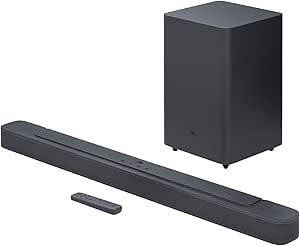
JBL Bar 500MK2 5.1 Channel Soundbar System with Dolby Atmos, Wireless Subwoofer, and Voice Assistant Compatibility (Black)
The JBL Bar 500MK2 is the most ambitious system in this group for buyers seeking high output, 5.1-channel processing, and a large wireless subwoofer. Its listed 750W power and 10-inch woofer set it apart from the 220W TCL S55H and 240W Hisense HS2100, making it the stronger fit for a larger room or listeners who want weightier low frequencies. Dolby Atmos, smart sound calibration, and Wi-Fi streaming support give it broader home-entertainment duties than a basic TV bar. AirPlay, Google Cast, Spotify Connect, and other listed services also make it more versatile for music playback. That capacity comes with a footprint and setup burden: the bar and subwoofer need room, and the feature set may be more than a casual TV viewer wants. It is not waterproof, so it belongs indoors.
Pros:- Listed 750W output and 10-inch subwoofer offer more scale than the 2.1 systems here
- 5.1-channel design with Dolby Atmos supports an immersive home-cinema presentation
- Wi-Fi streaming includes AirPlay, Google Cast, and Spotify Connect
- Smart sound calibration and app control support room setup and playback adjustment
Cons:- The large subwoofer and soundbar need more placement space than the TCL S55H or Hisense HS2100
- Its advanced features and setup may be excessive for buyers who only want clearer TV audio
- Not waterproof and unsuitable for outdoor use
Best for: Home-cinema listeners with a larger room who want high output, a large subwoofer, Atmos, and built-in streaming options
Not ideal for: Small-room buyers seeking a simple, compact TV upgrade or anyone needing equipment for outdoor use
- Channels:5.1
- Power output:750 watts
- Subwoofer diameter:10 inches
- Audio format:Dolby Atmos
- Connectivity:HDMI eARC, Bluetooth, Wi-Fi
- Supported streaming:AirPlay, Google Cast, Spotify Connect, Tidal Connect, Roon Ready
- Frequency response:20 Hz
- Waterproof:No
Our verdict“Choose the JBL Bar 500MK2 if you want the most powerful, feature-rich indoor system here and have room for its larger components.”
Hisense HS2100 2.1ch Soundbar with Wireless Subwoofer, Dolby Audio, DTS Virtual:X, HDMI ARC, Bluetooth 5.3, Remote Control, 6 EQ Modes
The Hisense HS2100 is a straightforward choice for buyers who want a wireless subwoofer, TV-friendly HDMI ARC, and useful sound presets without the larger feature set of the JBL Bar 500MK2. Its 240W output, Dolby Audio, and DTS Virtual:X give it a fuller, more spatial presentation than a television’s built-in speakers, while six EQ modes make it easy to adjust for different programs. Bluetooth 5.3 also lets it handle casual music playback. Compared with the TCL S55H, the Hisense emphasizes simple connections and preset listening modes rather than Dolby Atmos branding; compared with the Samsung HW-B550F, its listed 31.5-inch width is a more compact fit. The tradeoff is a 2.1-channel front-focused layout, not the physical surround offered by the LG S40TR. It also needs mains power and is not weather-resistant.
Pros:- HDMI ARC simplifies connection to compatible TVs
- Six EQ presets make sound adjustments accessible without complex tuning
- Bluetooth 5.3 supports wireless music playback from compatible devices
- 31.5-inch width is a relatively compact fit compared with the Samsung HW-B550F listing
Cons:- Its 2.1-channel layout cannot match the LG S40TR’s physical rear surround
- It lacks the listed Dolby Atmos support and output scale of the JBL Bar 500MK2
- Requires mains power and is not suitable for outdoor or wet locations
Best for: TV owners seeking a compact, uncomplicated 2.1 upgrade with HDMI ARC, Bluetooth, and easy-to-use EQ presets
Not ideal for: Home-cinema buyers who want rear speakers, high-output room-filling sound, or Dolby Atmos support
- Channels:2.1
- Audio output power:240 watts
- Subwoofer diameter:5.25 inches
- Audio formats:Dolby Audio, DTS Virtual:X
- Connectivity:HDMI ARC, Bluetooth 5.3
- EQ modes:6 preset modes
- Dimensions:31.5 x 3.5 x 2.4 inches
- Weight:4.9 pounds
Our verdict“Choose the Hisense HS2100 for a compact, easy-to-connect TV upgrade with wireless bass, not for a full surround or high-output cinema setup.”
Home Theater Sound Bar Subwoofer with Bluetooth and HDMI (ARC) – Black
I’d pick this 2.1 system for a TV setup that needs more ways to connect than the basics. Alongside HDMI ARC and Bluetooth 5.3, it offers optical, coaxial, AUX, and USB inputs, making it more adaptable to older TVs and other source devices than the JBL Bar 2.1 Deep Bass (MK2), whose listed TV connections focus on HDMI or optical. Its wireless subwoofer adds bass without a cable running back to the soundbar, while the 90-watt output suits buyers seeking a straightforward upgrade from built-in TV speakers. The tradeoff is that all those connection choices may mean more setup decisions and cables. Its sound modes may also fall short for listeners seeking fine-grained audio control, and the supplied product details list only a one-year warranty.
Pros:- HDMI ARC, optical, coaxial, AUX, and USB cover a broad range of devices.
- Bluetooth 5.3 supports wireless audio streaming.
- Wireless subwoofer adds bass without a wired connection to the bar.
- Wall-mount or tabletop placement accommodates different TV setups.
Cons:- The many connection options can add setup steps and cable clutter.
- Sound modes may not satisfy listeners who want detailed audio tuning.
- The listed warranty is limited to one year.
Best for: TV owners with a mix of newer and older devices who want a wireless subwoofer and several wired connection options.
Not ideal for: Buyers seeking high-output cinematic sound or extensive sound customization; the listed 90-watt output and unspecified sound-mode flexibility may not meet those needs.
- Channels:2.1
- Power output:90 watts
- Subwoofer:Wireless
- Connectivity:HDMI ARC, Bluetooth 5.3, optical, coaxial, AUX, USB
- Mounting:Wall mount or tabletop
- Dimensions:15.75 × 2.36 × 2.52 inches (listed as D × W × H)
- Color:Black
Our verdict“Choose this if connection flexibility matters more than high output or advanced sound customization.”
TCL S65K S Series 5.1 Channel Soundbar System with Dolby Atmos, DTS:X, Wireless Subwoofer, and Bluetooth
Among these five picks, I’d favor the TCL S65K when a fuller surround presentation matters more than keeping the system simple. Its 5.1 channels, Dolby Atmos, DTS:X, wireless surround speakers, and wireless subwoofer set it apart from the 2.1-channel JBL Bar 2.1 Deep Bass (MK2), which keeps the speaker package simpler and focuses on bass impact. TCL also lists AI Sonic Auto Room Calibration, intended to adjust playback to the room rather than relying only on fixed settings. That expanded setup can make movie sound feel more enveloping, but it brings more components to place and configure than a single bar-and-subwoofer combo. Buyers should also check the included connection details against their devices: the product data lists HDMI, USB, Wi-Fi, and Bluetooth protocols without specifying HDMI ARC. Warranty details are limited.
Pros:- 5.1 channels with Dolby Atmos and DTS:X support a more surround-focused presentation.
- Wireless surround speakers and subwoofer reduce the need to run speaker cables across the room.
- AI Sonic Auto Room Calibration is designed to tailor sound to the listening space.
- Bluetooth supports music streaming from compatible devices.
Cons:- Multiple speakers require more placement and setup than the 2.1 systems in this group.
- The supplied specifications do not clearly identify HDMI ARC support.
- Warranty details are listed only as limited, without further terms.
Best for: Movie-focused buyers with room for surround speakers who want a wireless 5.1 setup and Dolby Atmos or DTS:X support.
Not ideal for: People who want a compact, minimal-component setup or need clearly specified TV connection details before buying.
- Channels:5.1
- Maximum power output:630 watts
- Audio formats:Dolby Atmos and DTS:X
- Subwoofer:Wireless, 6.5-inch diameter
- Surround speakers:Wireless
- Connectivity:Bluetooth, USB, Wi-Fi, HDMI, wireless
- Room calibration:AI Sonic Auto Room Calibration
- Mounting:Wall mount
Our verdict“Pick the TCL if you want a more complete surround-speaker setup and can accommodate its extra components.”
2.1CH Sound Bar with Subwoofer, 110W Home Theater System, Bluetooth 5.3, ARC, Optical & AUX
This 110-watt 2.1 combo is a practical match for buyers who want a wireless subwoofer and familiar TV connections without stepping up to a multi-speaker system. Its HDMI ARC, optical, and AUX inputs cover common TV setups, while Bluetooth 5.3 handles wireless listening. Compared with the Home Theater Sound Bar Subwoofer with Bluetooth and HDMI (ARC), it lists fewer connection types—the other model adds coaxial and USB—but this bar offers 110 watts of output versus that model’s 90 watts. Multiple sound modes provide a way to adjust playback for different content, though the product information does not name those modes or explain their effects. Setup may require manual TV compatibility checks, and its 18-month warranty is a defined limit rather than evidence of long-term durability.
Pros:- 110-watt output is higher than the 90 watts listed for the Home Theater Sound Bar Subwoofer.
- HDMI ARC, optical, and AUX support common wired TV connections.
- Bluetooth 5.3 enables wireless playback from compatible devices.
- Wall-mount and tabletop options suit different room layouts.
Cons:- TV compatibility may require manual setup, particularly when using a wired connection.
- It lacks the listed USB and coaxial inputs found on the Home Theater Sound Bar Subwoofer.
- The 18-month warranty is limited in duration.
Best for: TV owners who want a no-frills 2.1 system with HDMI ARC, optical, or AUX connectivity and a wireless subwoofer.
Not ideal for: Buyers who need USB or coaxial inputs, detailed app-based tuning, or a surround-speaker system.
- Channels:2.1
- Power output:110 watts
- Connectivity:Bluetooth 5.3, HDMI ARC, optical, AUX
- Sound modes:Multiple modes
- Mounting:Wall mount or tabletop
- Dimensions:14 × 6 × 9 inches (listed as D × W × H)
- Warranty:18 months
- Color:Black
Our verdict“Choose this for a simple 2.1 upgrade with common TV inputs, but skip it if you need broad legacy connectivity or surround speakers.”
JBL Bar 2.1 Deep Bass (MK2) Soundbar with Wireless Subwoofer, 300W Max Output, Bluetooth, Black
The JBL Bar 2.1 Deep Bass (MK2) is the stronger fit here for buyers who want a punchy, bass-led sound without adding rear speakers. Its 300-watt maximum output and 6.5-inch wireless subwoofer give it a more forceful specification than the 90-watt Home Theater Sound Bar Subwoofer or the 110-watt 2.1CH system. JBL also keeps TV hookup simple, with a single HDMI or optical cable listed for setup, while Bluetooth supports music streaming. The tradeoff is a relatively focused 2.1-channel layout: unlike the TCL S65K’s 5.1 package with wireless surround speakers, this JBL does not provide separate rear channels. It is tabletop-mounted, and the listed features omit Wi-Fi and advanced smart controls, so buyers wanting a flexible smart-home hub should look elsewhere.
Pros:- 300-watt maximum output is the highest listed among these five products.
- The 6.5-inch wireless subwoofer adds bass without a cable back to the soundbar.
- HDMI or optical connection keeps TV setup relatively direct.
- Bluetooth supports streaming music from compatible devices.
Cons:- Its 2.1-channel design does not include the wireless surround speakers listed for the TCL S65K.
- The listed setup is tabletop-only, limiting placement options.
- No built-in Wi-Fi or advanced smart features are specified.
Best for: Viewers and music listeners who prioritize strong bass and a simple TV connection over rear surround speakers or smart features.
Not ideal for: Buyers seeking a 5.1 setup, wall-mount flexibility, Wi-Fi, or advanced smart-home controls.
- Channels:2.1
- Maximum output:300 watts
- Subwoofer:Wireless, 6.5-inch diameter
- Audio:Dolby Digital and JBL Surround Sound
- Connectivity:HDMI, optical, Bluetooth
- Bluetooth range:10 meters
- Mounting:Tabletop
- Color:Black
Our verdict“Choose the JBL for a straightforward, bass-forward 2.1 system; choose the TCL S65K if separate surround speakers matter more.”
ULTIMEA Sound Bar with Wireless Subwoofer, App Control, 2.1 Channel
I’d shortlist the ULTIMEA for listeners who want to shape a 2.1 system’s sound from a phone rather than rely on basic preset switching. Its app control, 10-band EQ, and 121 preset EQ matrices offer more listed tuning options than the JBL Bar 2.1 Deep Bass (MK2), whose supplied details emphasize output, subwoofer size, and simple TV connections. ULTIMEA also specifies Bluetooth 6.0 and a wireless subwoofer, with a 240-watt peak rating for buyers seeking a higher-output alternative to the 90- and 110-watt systems here. The key caveat is connectivity: the provided specifications do not list HDMI or optical inputs, so TV compatibility needs checking before purchase. App control may also feel like extra work for anyone who prefers adjusting sound with a remote.
Pros:- App control and a 10-band EQ support detailed sound adjustments.
- The product lists 121 preset EQ matrices for different tuning choices.
- Wireless subwoofer allows flexible placement.
- Bluetooth 6.0 and 240-watt peak power are specified.
Cons:- HDMI and optical inputs are not listed, leaving TV connection options unclear.
- Full sound customization relies on app control, which may add setup complexity.
- Build materials and construction details are not specified.
Best for: Listeners who enjoy adjusting EQ in an app and want a wireless-subwoofer system for compatible TV, music, or gaming setups.
Not ideal for: Buyers who require a clearly specified HDMI ARC or optical TV connection, or who want simple controls without app-based setup.
- Channels:2.1
- Peak power:240 watts
- Subwoofer:Wireless
- Bluetooth:Version 6.0
- Frequency response:45 Hz–18 kHz
- Maximum SPL:95 dB
- EQ:10-band EQ and 121 preset EQ matrices
- Drivers:18 mm high-excursion driver with mica-reinforced diaphragms
Our verdict“Pick the ULTIMEA if app-based EQ is your priority and its unlisted TV inputs are not a problem for your setup.”
Polk Audio Signa S2 Ultra-Slim Sound Bar with Subwoofer
The Polk Audio Signa S2 suits buyers who want a wireless subwoofer without a tall bar crowding the space in front of the TV. Its ultra-slim profile makes placement or wall mounting easier, while the separate subwoofer adds bass that a compact bar alone may struggle to deliver. VoiceAdjust is aimed at keeping dialogue clearer, and Dolby Digital decoding supports a more expansive TV soundtrack. HDMI, optical, and Bluetooth connections also give it practical flexibility for TVs and music streaming.
Compared with the LG S40TR, the Signa S2 keeps the setup simpler, but it lacks that model’s rear speakers for a more enveloping surround presentation. Its feature set is also less ambitious than the Atmos- and DTS:X-equipped TCL S55H. Choose Polk for discreet placement and straightforward connections; skip it if advanced surround effects are your priority.
Pros:- Slim bar is easier to place or wall-mount in space-constrained rooms.
- Wireless subwoofer adds dedicated bass without a cable running from the bar.
- VoiceAdjust targets dialogue clarity for TV and film viewing.
- HDMI, optical, and Bluetooth support common TV and music connections.
Cons:- No rear speakers, so it cannot match the LG S40TR’s more enveloping speaker layout.
- Its listed feature set lacks the Dolby Atmos and DTS:X support offered by the TCL S55H.
- The wireless subwoofer still needs a nearby power outlet.
Best for: TV owners with limited space below the screen who want clearer dialogue, added bass, and a simple wireless-subwoofer setup.
Not ideal for: Buyers seeking rear-channel speakers, advanced immersive formats, outdoor use, or a subwoofer that does not need its own power connection.
- Audio output mode:Surround
- Speaker configuration:Soundbar and subwoofer
- Subwoofer connection:Wireless
- Connections:HDMI, optical, Bluetooth
- Wireless technology:Bluetooth
- Woofer diameter:5.25 inches
- Mounting type:Bar mount or TV soundbar
- Control method:Remote
Our verdict“Pick the Signa S2 for a low-profile bar and wireless bass in a straightforward setup, but choose a surround-focused system if rear speakers or newer immersive formats matter more.”

How We Picked
I compared these wireless subwoofer soundbar combos on the factors that change daily use: channel layout, subwoofer inclusion and wireless connection, supported audio formats, TV connectivity, controls, and setup demands. I also weighed how clearly each product’s stated features translate into a buyer benefit, such as physical rear-speaker placement, dialogue adjustments, app control, or a simpler 2.1-channel footprint. Because a wireless subwoofer still needs power and a suitable place in the room, I treated room fit and installation needs as part of usability rather than assuming wireless means cable-free.
The ranking favors systems that combine useful immersion with practical setup and clear feature differentiation. The JBL Bar 500MK2 ranks first for its broader channel layout and Atmos support; the LG S40TR follows for buyers who prefer included rear speakers. The TCL S55H offers format support in a simpler 2.1 package, while the Samsung, JBL Bar 2.1 Deep Bass, and remaining models serve more focused priorities. Products with less clearly specified performance or fewer distinguishing details rank lower, not because they cannot suit a buyer, but because the available feature set gives less reason to choose them over better-defined alternatives.
| wireless subwoofer soundbar combo | Connectivity |
|---|---|
| Samsung HW-B550F B-Series 2.1 | — |
| LG S40TR 4.1 Channel Home Thea | — |
| TCL S55H 2.1 Sound Bar with Wi | — |
| JBL Bar 500MK2 5.1 Channel Sou | HDMI eARC, Bluetooth, Wi-Fi |
| Hisense HS2100 2.1ch Soundbar | HDMI ARC, Bluetooth 5.3 |
| Home Theater Sound Bar Subwoof | HDMI ARC, Bluetooth 5.3, optical, coaxial, AUX, USB |
| TCL S65K S Series 5.1 Channel | Bluetooth, USB, Wi-Fi, HDMI, wireless |
| 2.1CH Sound Bar with Subwoofer | Bluetooth 5.3, HDMI ARC, optical, AUX |
| JBL Bar 2.1 Deep Bass | HDMI, optical, Bluetooth |
| ULTIMEA Sound Bar with Wireles | — |
| Polk Audio Signa S2 Ultra-Slim | — |
Factors to Consider When Choosing Wireless Subwoofer Soundbar Combos
Choosing among these systems is less about finding the longest feature list and more about matching the soundbar’s layout and connections to your room, TV, and listening habits. I’d check the following points before deciding, especially if you are comparing a basic 2.1 setup with a system that adds virtual or physical surround features.
Choose the channel layout for your room
A 2.1-channel system uses a soundbar and subwoofer, which can improve TV audio without placing speakers behind the seating area. A higher channel count may add channels or speakers for a wider presentation, but the label alone does not tell you where sound will come from or how much setup is involved. If you want sound physically behind you, look for included rear speakers and confirm you have outlets and clear placement spots. Virtual surround features can widen perceived sound without extra rear units, though they are not a substitute for speakers positioned around the room. Avoid paying for a larger layout if your seating is against a wall or the room cannot accommodate its extra components.
Separate format support from speaker placement
Dolby Atmos and DTS:X support can be useful, but the logo does not by itself guarantee overhead or rear effects from every soundbar. Check the channel configuration and whether the system uses physical speakers, upward-firing drivers, or processing to create a wider impression. Also confirm that your TV and the content source can pass the audio format you plan to use. Buyers sometimes choose by format name alone and later discover that their connection or streaming setup limits the signal. If you mostly watch standard broadcasts, prioritize clear dialogue and easy volume control over a format feature you may rarely use.
Check TV connections before you buy
HDMI ARC or eARC usually makes everyday control easier by letting the TV remote adjust soundbar volume and send audio to the system. Optical connections can work well for basic playback, but they may not support every advanced audio format or convenient control feature. Bluetooth is handy for music from a phone, though it is not a replacement for a wired TV audio connection when you want reliable synchronization. Check which ports your TV actually has, and confirm the soundbar’s connection options match. A mismatch can mean extra cables, reduced format support, or more than one remote in regular use.
Plan for the subwoofer’s real placement needs
Wireless describes the audio link, not the power supply: most wireless subwoofers still need a nearby wall outlet. Low-frequency sound can travel through walls and floors, so an apartment buyer may need to keep the subwoofer’s level modest or place it away from shared walls. A corner can make bass seem stronger, but it can also sound uneven depending on the room. Leave enough space around the unit and avoid hiding it in a closed cabinet unless the maker permits that placement. Measure the available floor area before choosing a system with a larger subwoofer or rear speakers.
Decide which controls you will actually use
App control, EQ modes, and dialogue tools matter most when you expect to adjust sound often. If you want a simple TV upgrade, a clear remote and a dependable default mode may be more useful than detailed tuning menus. Dialogue enhancement can help with speech-heavy shows, while bass boost may suit action films but feel excessive in a small room. Before choosing a model with app features, check whether key controls also work from the remote. A system that is easy to operate from the sofa can be a better everyday fit than one with more settings that are hard to reach.
Pay for the capability your listening habits need
Spend more for a real change in setup, such as physical rear speakers, a broader channel layout, or audio-format support you can use with your TV and content. A higher output figure or longer feature list is less persuasive if the system will sit in a small room at modest volume. Buyers focused on dialogue may get more value from voice controls than from stronger bass, while music listeners may prioritize Bluetooth and straightforward source switching. Do not assume that every branded enhancement will matter with every program. Match the extra cost to a specific need, then favor the simpler option if that need is absent.
Frequently Asked Questions
Does a wireless subwoofer soundbar combo work with any TV?
Most can connect to many TVs, but compatibility depends on the ports and audio formats each device supports. Check whether your TV has HDMI ARC/eARC or optical output and compare that with the soundbar’s inputs. Bluetooth may be available for music, but it is not always the best route for TV sound because delay and format support can vary. If you use a streaming box or game console, check how its audio passes through the TV as well. Matching the connection first can prevent a system from losing features you expected to use.
Does a wireless subwoofer need to be near the soundbar?
It needs to be within reliable wireless range, but the ideal spot depends on the room and the manufacturer’s guidance. The subwoofer also needs its own power outlet, so wireless does not remove every cable. Keep it where it can receive the signal and where its bass will not create an unwanted rumble for neighbors or other rooms. If the connection drops or the bass sounds uneven, try another open location before assuming the unit is faulty. A little placement flexibility is useful, but it does not make the subwoofer invisible or completely wire-free.
Should I choose a 2.1 system or one with rear speakers?
Choose 2.1 for simpler installation and a compact improvement over built-in TV speakers. Rear speakers make more sense if you want sound placed around the listening position and can accommodate the speakers, their connections, and any required power. A feature such as virtual surround may broaden a 2.1 system’s presentation, but it does not place sound from dedicated speakers behind you. Consider where the main seats are and whether people sit in more than one part of the room. If rear placement would be awkward, a simpler system may deliver a better day-to-day fit.
Will Dolby Atmos or DTS:X work if my TV does not support it?
Format support depends on the full audio chain, including the source, TV, connection, and soundbar. A soundbar may list Atmos or DTS:X but receive a different format if the TV cannot pass the signal or the content does not provide it. HDMI eARC can support more advanced audio paths than older connections, though exact compatibility varies by device. Check your TV manual and the soundbar’s connection details before treating format support as a deciding feature. If your usual programs are not available in those formats, other factors such as dialogue clarity may matter more.
Is a soundbar with a wireless subwoofer suitable for an apartment?
It can be suitable, but bass level and placement matter because low frequencies can carry through shared walls and floors. Look for a model with adjustable bass or a night mode if you often watch late or share walls with neighbors. Place the subwoofer away from shared surfaces where possible, and avoid assuming a smaller unit will be silent at high volume. A compact 2.1 system may be easier to manage than a more powerful, multi-speaker setup, though room construction affects the result. When in doubt, favor controllable bass over maximum output.
Conclusion
For the broadest mix of immersion and modern format support, I’d choose the JBL Bar 500MK2 as the best overall. The TCL S55H is my best value-style pick for buyers who want Atmos and DTS:X support in a simpler 2.1 layout, while the LG S40TR is best for physical rear-speaker surround. For a more premium, bass-focused 2.1 option, the JBL Bar 2.1 Deep Bass suits listeners who prioritize impact over rear channels. Beginners who want a straightforward TV audio upgrade can start with the Samsung HW-B550F or Hisense HS2100; choose based on which controls and connections match your TV. If slim design is the priority, look at the Polk Audio Signa S2, and if app-based adjustment matters, compare the ULTIMEA. The right choice is the one whose layout, connections, and bass level make sense in your room—not simply the one with the most features.