For most programmers, I’d start with the Keychron C2: its full-size wired layout keeps the number pad and familiar navigation keys close at hand. The Keychron K8 is a better fit if you want a smaller tenkeyless board with wireless flexibility, while the Logitech MX Mechanical suits a polished, low-profile office setup. The main tradeoffs are desk space versus dedicated keys, quiet typing versus a more pronounced mechanical feel, and wired simplicity versus wireless convenience. I also compare compact and hot-swappable models for programmers who value portability or future switch changes. Read on for the full breakdown and a guide to choosing around your workspace and coding habits.

Turn the school run and nap time into listening time
- Thousands of audiobooks, podcasts and originals
- Listen on your phone, tablet or Echo — also offline
- Cancel anytime
Complete the kit


Key Takeaways
- The Keychron C2 ranks first for a conventional desk setup: it combines a full-size layout, a wired connection, and tactile brown switches, though it takes up more space than the compact picks.
- Layout changes matter more than lighting: the K8’s tenkeyless format preserves navigation keys while freeing desk space, whereas 60% and 75% boards ask you to rely more on layers.
- Hot-swap support is the clearest upgrade path: models such as the AULA F99, Redragon K668, Kisnt KN85, and SOLAKAKA KI99 Pro let buyers explore switch changes without replacing the whole board.
- Quiet office typing calls for a different shortlist: Cherry KC 200 MX’s Silent Red switches and the Logitech MX Mechanical’s low-profile tactile design target restrained workspaces better than gaming-focused boards.
- Extra features bring extra compromises: the Redragon K580’s macros and media wheel, and the RK Royal Kludge S98’s display and knob, add controls but may matter less than layout, noise, and connection needs for everyday coding.


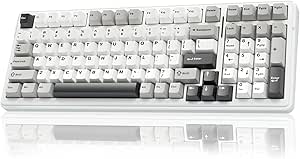



| mechanical keyboards for programmer | Switch type | Layout | Connectivity | Backlighting |
|---|---|---|---|---|
| Keychron C2 Full Size Wired Me | Brown | QWERTY | Wired, USB-C | None |
| MageGee Portable 60% Mechanica | Red linear | Compact, 68 keys | USB 2.0, detachable cable | Blue LED, 16 modes |
| Redragon K580 Wired RGB Mechan | Outemu Blue | QWERTY, 104 keys | Wired, USB-C | RGB |
| AULA F99 Wireless Mechanical K | Pre-lubed linear | 99 keys, AZERTY | Bluetooth 5.0, 2.4GHz, USB-C | RGB |
| Logitech MX Mechanical Wireles | Tactile Quiet | 104 keys | Bluetooth, USB-C | Smart auto-adjusting |
| Redragon K668 108-Key Hot-Swap | Linear | 108 keys, full-size | USB-C wired | RGB |
| Keychron K8 Tenkeyless Wireles | Gateron G Pro Brown | 87-key TKL | Bluetooth 5.1, USB-C wired | — |
| Redragon Mechanical Gaming Key | Linear, Cherry MX Red model listed | 104-key QWERTY | Wired | RGB, 11 preset modes |
| Logitech G413 SE Full-Size Mec | Tactile | 108-key QWERTY, full-size | USB 2.0 wired | White LED |
| Kisnt KN85 Wireless Mechanical | Pre-lubed linear | 75%, 85 keys | Bluetooth 5.0, 2.4GHz, USB-C | Customizable RGB |
| SOLAKAKA KI99 Pro Wireless Mec | Silent linear | 96%, 96 keys | Bluetooth 5.0, 2.4G, USB-C | RGB |
| RK Royal Kludge S98 Wireless M | Linear | 98 keys, QWERTY | Bluetooth, RF, USB-C | RGB |
| Keychron K3 Version 2 QMK 75% | Tactile | 75%, 84 keys | Bluetooth 5.1, wired | Single-color white |
| Cherry KC 200 MX Wired Mechani | Cherry MX2A Silent Red | Full-size QWERTY, 104 keys | USB-A | — |
More Details on Our Top Picks
Keychron C2 Full Size Wired Mechanical Keyboard, Brown Switch, Retro
The Keychron C2 suits programmers who want a familiar full-size layout, including a number pad, without wireless features or lighting to configure. Its Brown switches provide tactile feedback without the pronounced click of the Redragon K580’s Blue switches, which may be a better fit for shared workspaces. Mac and Windows keycaps make it easier to match the legends to your operating system, while the wired USB-C connection keeps the setup simple. The tradeoff is a fairly conventional, wide footprint: unlike the MageGee MK-Box, it doesn’t reclaim much desk space, and its 104-key layout may crowd a compact workstation. It also has no backlighting, so the retro look comes at the cost of visibility in dim rooms.
Pros:- Full-size 104-key layout includes a number pad for numeric entry
- Brown switches offer tactile feedback without Blue-switch clickiness
- Includes extra keycaps for Mac and Windows layouts
- Adjustable feet provide a choice of typing angle
Cons:- Wired-only connection limits portability and multi-device switching
- No backlighting makes keys harder to see in low light
- Full-size footprint uses more desk space than compact options
Best for: Programmers who regularly use a number pad, prefer tactile keys over loud clicky switches, and work at a fixed desk with either Mac or Windows.
Not ideal for: Developers with small desks, those who need a wireless keyboard for multiple devices, or anyone who types in dim rooms and relies on illuminated keys.
- Switch type:Brown
- Layout:QWERTY
- Number of keys:104
- Connectivity:Wired, USB-C
- Keycap material:ABS
- Dimensions:17.1 × 5.1 × 1.5 in
- Operating system compatibility:macOS, Windows
- Backlighting:None
Our verdict“Choose the C2 if you want a full-size, tactile wired keyboard for a dedicated programming desk and can do without backlighting.”
MageGee Portable 60% Mechanical Gaming Keyboard, MK-Box LED Backlit Compact 68 Keys Mini Wired Office Keyboard with Red Switch for Windows, Laptop, PC, Mac – Black/Grey
The MageGee MK-Box is the space-saving pick here: its 68 keys leave more room for a mouse or notes than the full-size Keychron C2 and Redragon K580. That compactness is useful for programmers working at a small desk or carrying a keyboard between locations, but it means some familiar keys and functions aren’t on dedicated keys. Its linear Red switches suit fast, smooth presses, though typists who want a tactile cue may prefer the C2’s Brown switches. Blue LED backlighting offers several modes for dark setups, and full anti-ghosting supports simultaneous key presses. The compromises are a wired-only connection and a smaller layout that can require adjustment, particularly if your workflow depends on dedicated navigation or function keys.
Pros:- 68-key compact design frees up desk space
- Linear Red switches offer smooth key travel
- Blue LED backlighting includes 16 modes
- Full anti-ghosting supports simultaneous key presses
Cons:- Compact layout omits dedicated keys some programming workflows use
- USB connection means there is no wireless option
- Multiple lighting modes may take extra effort to manage
Best for: Programmers with limited desk space who favor a compact layout, smooth linear switches, and a detachable wired connection.
Not ideal for: Developers who rely on a number pad or dedicated navigation and function keys, or who want Bluetooth or other wireless connectivity.
- Layout:Compact, 68 keys
- Switch type:Red linear
- Backlighting:Blue LED, 16 modes
- Connectivity:USB 2.0, detachable cable
- Anti-ghosting:Full
- Typing angle:Adjustable
- Compatibility:Windows, Linux, Mac
Our verdict“Pick the MK-Box when desk space matters more than dedicated keys and you’re comfortable with a compact wired layout.”
Redragon K580 Wired RGB Mechanical Gaming Keyboard with Macro Keys and Media Wheel
For programmers who want dedicated shortcut controls alongside a full layout, the Redragon K580 brings five macro keys, media controls, and a volume roller without giving up its number pad. Those extra controls set it apart from the simpler Keychron C2, which offers tactile typing but no macro keys or media wheel. The K580 also has hot-swappable switches, giving owners a way to change the typing feel later; its included Outemu Blue switches are clicky, however, and may be distracting in a shared office. RGB lighting adds customization, though advanced effects require software. This is a wired keyboard rather than a portable multi-device option like the AULA F99, so it makes more sense for a feature-rich fixed desk than a roaming laptop setup.
Pros:- Five dedicated macro keys can hold frequently used commands
- Media controls and volume roller keep common adjustments at hand
- Hot-swappable switches allow changes to the typing feel
- Full-size layout includes a number pad and RGB backlighting
Cons:- Included Blue switches are clicky and can disturb nearby coworkers
- Wired-only connectivity limits use across devices and locations
- Advanced RGB effects require software
Best for: Programmers who want a full-size keyboard with dedicated macro keys, media controls, and the option to swap compatible switches.
Not ideal for: People in quiet shared spaces who dislike clicky switches, or developers seeking wireless connectivity and a portable setup.
- Model:K580RGB
- Layout:QWERTY, 104 keys
- Switch type:Outemu Blue
- Connectivity:Wired, USB-C
- Backlighting:RGB
- Additional controls:Five macro keys, media keys, volume roller
- Switches:Hot-swappable
- Materials:ABS plastic, aluminum
Our verdict“Choose the K580 if dedicated macros and switch swapping matter more to your desk workflow than quiet typing or wireless use.”
AULA F99 Wireless Mechanical Keyboard, Tri-Mode BT5.0/2.4GHz/USB-C, Hot Swappable, RGB Backlit, 99-Key Compact Design for Gaming and Productivity
The AULA F99 stands out for programmers who move between a computer, tablet, or phone: Bluetooth, 2.4GHz, and USB-C offer more connection choices than the wired Keychron C2 or Redragon K580. Its 99-key layout keeps a number pad while trimming the footprint compared with their 104-key designs. Hot-swappable linear switches let owners change the feel, and PBT keycaps and an 8000mAh battery suit a more feature-heavy wireless setup. The main hurdle is the supplied AZERTY layout, which may not match a programmer’s preferred key mapping or muscle memory. Its extra connectivity and lighting options also add complexity, so this is less appealing if you simply want a plug-in keyboard with a familiar QWERTY arrangement.
Pros:- Bluetooth, 2.4GHz, and USB-C provide several connection options
- 99-key layout retains a number pad in a more compact footprint
- Hot-swappable linear switches allow typing-feel changes
- PBT keycaps and an 8000mAh battery suit extended wireless use
Cons:- AZERTY layout may not suit QWERTY typists or their established key habits
- Feature and connection choices can add setup complexity
- USB-C wired operation requires a cable
Best for: Programmers who switch among several devices, want a number pad in a smaller-than-full-size layout, and already use or prefer AZERTY.
Not ideal for: QWERTY typists who want a familiar layout out of the box, or buyers who prefer a simple wired keyboard without configurable features.
- Layout:99 keys, AZERTY
- Switch type:Pre-lubed linear
- Connectivity:Bluetooth 5.0, 2.4GHz, USB-C
- Backlighting:RGB
- Battery capacity:8000mAh
- Keycap material:PBT
- Compatible devices:PC, tablet, PS, Xbox, smartphone
- Operating system compatibility:Windows 7 or later
Our verdict“The F99 fits multi-device programmers who want wireless flexibility and a number pad, provided AZERTY suits their typing habits.”
Logitech MX Mechanical Wireless Illuminated Keyboard Tactile – Graphite
The Logitech MX Mechanical is the office-focused option for programmers who want tactile feedback without the pronounced noise of the Redragon K580’s Blue switches. Its Tactile Quiet switches and smart backlighting suit long work sessions in shared spaces, while pairing with up to three devices helps developers who split time between a work computer, personal machine, and tablet. Unlike the wired Keychron C2, it also supports Bluetooth and can move between setups without a cable connection. That convenience brings tradeoffs: full customization relies on Logi Options+ software, and battery life varies with use, particularly with illumination. Its full-size 104-key body also occupies more desk space than the MageGee MK-Box, so it is better for a settled workstation than a minimal setup.
Pros:- Tactile Quiet switches provide feedback with less clickiness than Blue switches
- Smart backlighting adjusts to lighting conditions
- Pairs with up to three devices for multi-device workflows
- Supports Bluetooth and USB-C charging
Cons:- Full customization requires Logi Options+ software
- Battery life varies with usage and backlighting
- Full-size layout takes more desk space than compact keyboards
Best for: Programmers in shared offices who want quieter tactile keys, automatic illumination, and easy switching among up to three devices.
Not ideal for: Developers who want a compact keyboard, avoid companion software, or prefer a wired setup that does not depend on battery charge.
- Layout:104 keys
- Switch type:Tactile Quiet
- Connectivity:Bluetooth, USB-C
- Device pairing:Up to three devices
- Backlighting:Smart auto-adjusting
- Battery:Rechargeable Li-Po, 1500mAh
- Operating system compatibility:Windows, macOS, Linux, Chrome OS, iOS, iPadOS, Android
- Weight:828g
Our verdict“Choose the MX Mechanical for quiet, multi-device programming at a full-size desk if software-dependent customization and battery charging suit you.”
Redragon K668 108-Key Hot-Swap Wired RGB Gaming Keyboard with Extra Hotkeys
The Redragon K668 suits programmers who want a complete number pad and room to change switches without replacing the whole keyboard. Its 108-key layout and four dedicated hotkeys can keep calculator or mute controls close at hand, while hot-swappable linear switches offer a path to a different feel later. Compared with the compact Kisnt KN85, the K668 gives up desk space and wireless flexibility in exchange for a full-size layout and simpler wired setup. RGB lighting and two keycap sets add personalization, though they matter less to coding than the switch options and layout. The main limits are its Windows-only compatibility and linear-only switch configuration as specified; its water resistance should not be treated as spill protection.
Pros:- Full-size 108-key layout includes a number pad for numeric work
- Hot-swappable switches allow later switch changes
- Four dedicated hotkeys provide quick access to common functions
- Adjustable feet and ergonomic design support a more customizable typing angle
Cons:- Listed compatibility is limited to Windows
- Wired-only connection offers less flexibility than the wireless Keychron K8
- Linear switches may not suit typists who prefer tactile feedback, and water resistance is not spill-proofing
Best for: Windows programmers who use a number pad, want dedicated utility keys, and may want to swap linear switches later.
Not ideal for: Mac users, frequent travelers, and anyone who needs wireless connectivity, multiple switch feels out of the box, or dependable spill protection.
- Layout:108 keys, full-size
- Switch type:Linear
- Connectivity:USB-C wired
- Backlighting:RGB
- Hot-swappable:Yes
- Compatible devices:PC, laptop
- Weight:880 g
- Warranty:1 year
Our verdict“Choose the K668 if you want a Windows-focused, full-size wired keyboard with hot-swap flexibility rather than a compact or wireless setup.”
Keychron K8 Tenkeyless Wireless Mechanical Keyboard for Mac, White Backlight, Bluetooth, Multitasking, Type-C Wired Gaming Keyboard for Windows with Brown Switch
The Keychron K8 is the clearest fit here for programmers who move between Mac and Windows or want one keyboard for a desk and a second device. Its Bluetooth 5.1 and USB-C wired modes make that setup more flexible than the wired-only Redragon K668, while the 87-key TKL layout keeps the mouse closer than a full-size board. Gateron G Pro Brown switches provide tactile feedback without requiring a separate number pad, a useful middle ground for mixed typing and coding. The tradeoff is less numeric input space than the K668, and there is no hot-swap feature listed for changing the switch feel. Its white backlight is practical rather than customizable, and the keyboard lacks water resistance.
Pros:- Works with MacOS and Windows, as well as tablets and gaming consoles
- Bluetooth and USB-C wired modes support flexible desk setups
- Brown tactile switches provide feedback useful for long typing sessions
- Up to 200 hours of battery life with the backlight off
Cons:- TKL layout omits the dedicated number pad found on the Redragon K668
- No hot-swap capability is specified, limiting switch customization
- White-only backlighting and no water resistance
Best for: Programmers who regularly switch between Mac and Windows devices and want Bluetooth plus a wired fallback.
Not ideal for: Developers who rely on a dedicated number pad, need hot-swappable switches, or want a spill-resistant keyboard.
- Layout:87-key TKL
- Switch type:Gateron G Pro Brown
- Connectivity:Bluetooth 5.1, USB-C wired
- Backlight:White
- Battery capacity:4000 mAh
- Battery life:Up to 200 hours with backlight off
- Compatibility:MacOS, Windows, tablets, gaming consoles
- Weight:1 kg
Our verdict“Pick the K8 if cross-platform use and wireless flexibility matter more to your programming setup than a number pad or switch swapping.”
Redragon Mechanical Gaming Keyboard Wired, 11 Programmable Backlit Modes, Hot-Swappable Red Switch, Anti-Ghosting, Double-Shot PBT Keycaps, Light Up Keyboard for PC & Mac
This Redragon stands out for programmers who want hot-swappable linear switches paired with double-shot PBT keycaps, rather than wireless convenience or a restrained office look. Its 104-key layout keeps a number pad, and anti-ghosting helps register simultaneous inputs reliably. Compared with the Redragon K668, this model highlights PBT keycaps and macro editing, while the K668 specifies four dedicated hotkeys and two keycap sets. The RGB lighting has 11 modes, but the description says its colors are preset, so this is less adaptable than fully customizable lighting may suggest. It is wired-only, and the light linear feel may not provide enough feedback for typists who prefer the K8’s Brown switches. Compatibility is listed for Windows, despite the title’s broader PC and Mac wording.
Pros:- Double-shot PBT keycaps are suited to regular, heavy typing
- Hot-swappable linear switches allow switch changes
- 104-key layout includes a number pad
- Macro editing, multimedia shortcuts, and anti-ghosting add useful controls
Cons:- Wired-only connectivity lacks the flexibility of the Keychron K8
- Backlight colors are limited to preset modes
- Windows is the listed compatible operating system, and light linear switches may not suit tactile typists
Best for: Windows programmers who want a full-size wired board, durable PBT keycaps, and the option to change linear switches.
Not ideal for: Mac-first users, wireless desk setups, and typists who prefer tactile switches or highly configurable lighting colors.
- Layout:104-key QWERTY
- Switch type:Linear, Cherry MX Red model listed
- Connectivity:Wired
- Backlighting:RGB, 11 preset modes
- Keycaps:Double-shot PBT
- Hot-swappable:Yes
- Compatible operating system:Windows
- Water resistance:Listed as water resistant
Our verdict“Choose this Redragon if durable keycaps and a swappable linear full-size layout matter more than wireless use or tactile feedback.”
Logitech G413 SE Full-Size Mechanical Gaming Keyboard – Black
The Logitech G413 SE is for programmers who want a straightforward full-size board with tactile switches and a sturdy aluminum top case, without making wireless features or switch customization a priority. Its white LED backlight favors clear visibility over the K668’s colorful RGB, and its PBT keycaps offer a durable typing surface. Unlike either Redragon option, the G413 SE does not list hot-swappable switches, so the switch feel is a fixed choice rather than a platform to modify. That simplicity can suit a dedicated desk, but the USB 2.0 wired connection is less versatile than the Keychron K8’s Bluetooth and USB-C options. It also lacks wireless operation and listed Mac support is broader in name than the PC-focused product description; check compatibility needs before choosing.
Pros:- Tactile switches provide a defined response while typing
- Aluminum top case gives the board a sturdy construction
- PBT keycaps are suited to frequent use
- Full-size 108-key layout and six-key rollover support everyday typing and input
Cons:- No wireless option or USB-C connection
- White LED lighting has no RGB color options
- No hot-swap support is specified, unlike the Redragon K668
Best for: Programmers who want tactile typing, a number pad, PBT keycaps, and a solid wired keyboard without RGB customization.
Not ideal for: People who want wireless or USB-C connectivity, hot-swappable switches, or a compact keyboard for a crowded desk.
- Layout:108-key QWERTY, full-size
- Switch type:Tactile
- Connectivity:USB 2.0 wired
- Backlighting:White LED
- Top case material:Aluminum
- Key rollover:6-key rollover
- Compatible operating systems:Windows, MacOS
- Dimensions:17.13 × 1.97 × 1.43 in
Our verdict“The G413 SE makes sense for programmers who prefer a sturdy, tactile full-size wired board and can do without customization or wireless features.”
Kisnt KN85 Wireless Mechanical Keyboard, 75% Layout, Bluetooth/2.4GHz/USB-C, Custom RGB Backlit, Hot-Swappable Linear Switch, Retro Beige
The Kisnt KN85 is the space-saving choice for programmers who want arrow keys and a compact footprint without giving up wireless options. Its 75% layout retains 85 keys while freeing desk space compared with the full-size Redragon K668; the cost is losing the dedicated number pad. Tri-mode connectivity—Bluetooth, 2.4GHz, and USB-C—also gives it more connection options than the Keychron K8, while hot-swappable pre-lubed linear switches let owners tailor the feel later. RGB lighting and the retro beige finish add personality, but do not change its core typing tradeoff: linear switches lack the tactile bump of the K8’s Brown switches. The keyboard is not water resistant, and its driver software is Windows-only, which may limit customization for Mac or Linux users.
Pros:- 75% layout saves desk space while retaining 85 keys
- Bluetooth, 2.4GHz, and USB-C offer three connection modes
- Hot-swappable pre-lubed linear switches allow switch customization
- Compatible with Windows, MacOS, Linux, Android, and listed mobile and gaming devices
Cons:- No dedicated number pad, unlike the full-size Redragon K668
- Linear switches may not satisfy typists who want tactile feedback
- Not water resistant, and driver software is available only for Windows
Best for: Programmers with limited desk space who want a compact keyboard that can connect wirelessly to multiple devices or work over USB-C.
Not ideal for: Developers who enter numbers frequently, prefer tactile switches, or need spill resistance and full software support outside Windows.
- Layout:75%, 85 keys
- Connectivity:Bluetooth 5.0, 2.4GHz, USB-C
- Switch type:Pre-lubed linear
- Hot-swappable:Yes
- Backlighting:Customizable RGB
- Battery:4000 mAh rechargeable
- Operating system compatibility:Windows, MacOS, Linux, Android
- Water resistance:Not water resistant
Our verdict“Choose the KN85 if desk space and flexible connections matter more than a number pad, tactile switches, or broad software support.”
SOLAKAKA KI99 Pro Wireless Mechanical Keyboard with Quiet Switches, RGB Backlit, Hot Swappable, Gasket Structure
The KI99 Pro suits programmers who want a near-full layout without giving up desk space or flexible connections. Its 96-key layout keeps a number pad close at hand, while Bluetooth, 2.4G, and USB-C make it easier to move between a work computer and other devices. The silent linear switches and gasket structure are geared toward keeping keystrokes subdued in shared offices—an advantage over the more conventional, full-size Cherry KC 200 MX, which is wired and has 104 keys.
Hot-swappable switches and programmable keys leave room to tailor the board as coding habits change, but getting the most from the customization can mean dealing with software setup. The large battery and RGB lighting add flexibility, though this is a feature-rich choice rather than a simple plug-in typing tool. Pick it for quiet wireless versatility; skip it if you want straightforward setup or no lighting.
Pros:- Tri-mode Bluetooth, 2.4G, and USB-C connectivity supports different desk setups.
- Silent linear switches and a gasket structure are suited to shared workspaces.
- Hot-swappable switches and programmable keys allow customization.
- 96% layout retains a number pad in a more compact footprint than a full-size board.
Cons:- Full customization involves software setup that may take time.
- RGB lighting and feature-rich controls may not suit buyers seeking a plain office board.
- The 96% layout is still larger than compact 75% options such as the Keychron K3.
Best for: Programmers who want a quiet, number-pad-equipped board that can switch between a work PC and other devices.
Not ideal for: Buyers who want a simple wired keyboard with minimal setup, or who prefer a compact layout without a number pad.
- Layout:96%, 96 keys
- Connectivity:Bluetooth 5.0, 2.4G, USB-C
- Switch type:Silent linear
- Keycaps:PBT
- Backlighting:RGB
- Battery:10,000mAh
- Customization:Hot-swappable switches, programmable keys, control knob
- Compatibility:Windows, macOS, PC, laptop, smartphone
Our verdict“Choose the KI99 Pro if you need quiet typing, a number pad, and multiple connection modes in one customizable board.”
RK Royal Kludge S98 Wireless Mechanical Keyboard with Smart Display & Knob
The RK Royal Kludge S98 makes the most sense for programmers who want quick access to media and board controls without reaching for software menus. Its smart display and adjustable knob give it a more control-focused character than the SOLAKAKA KI99 Pro, whose appeal leans more toward quiet typing and programmable keys. The S98 also offers Bluetooth, RF, and USB-C connections, plus hot-swappable linear switches, so it can adapt to different devices and typing preferences.
Sound-dampening features help soften typing noise, but the product data specifies Windows compatibility, making it a less reassuring choice for a Mac-focused setup than the Keychron K3. The integrated stand and 98-key layout favor a feature-packed desk board over a slim travel option. Choose it for accessible controls and wireless flexibility; pass if broad operating-system support is a priority.
Pros:- Smart display and adjustable knob provide convenient onboard controls.
- Bluetooth, RF, and USB-C offer multiple connection options.
- Hot-swappable linear switches allow switch changes.
- Sound dampening helps reduce hollow sound and typing noise.
Cons:- Compatibility is listed for Windows, limiting confidence for non-Windows users.
- At 98 keys, it takes more desk space than the 75% Keychron K3.
- The product details do not specify whether a keycap or switch puller is included.
Best for: Windows programmers who want a wireless keyboard with an onboard display, a media knob, and switch customization.
Not ideal for: Mac-first programmers or anyone seeking a lightweight, compact travel keyboard with clearly stated cross-platform support.
- Layout:98 keys, QWERTY
- Connectivity:Bluetooth, RF, USB-C
- Switch type:Linear
- Backlighting:RGB
- Additional controls:Smart display, adjustable knob, media keys
- Customization:Hot-swappable switches
- Compatible devices:Laptop, PC, smartphone, tablet
- Listed operating system:Windows
- Weight:3 pounds
Our verdict“Pick the S98 if you use Windows and value a display and knob more than portability or broad listed OS support.”
Keychron K3 Version 2 QMK 75% Wireless Low-Profile Mechanical Keyboard
The Keychron K3 V2 is the lineup’s clearest choice for programmers who prioritize a small footprint and firmware-level key customization. Its 75% layout and low-profile design leave more room for a mouse than the 96-key SOLAKAKA KI99 Pro, while its 84 keys retain more everyday function access than a 60% board. Open-source QMK firmware lets users tailor key behavior, a practical advantage for coding shortcuts and repeatable workflows.
Bluetooth 5.1 supports multi-device use, and the board can also connect by wire. Its white backlight is less configurable than the RGB lighting on the KI99 Pro or RK Royal Kludge S98, and the slim form factor means giving up a number pad. The listed tactile switch type may also not suit programmers who specifically want linear or silent switches. Choose the K3 for compactness and layout control, not numeric entry or lighting effects.
Pros:- Compact 75% layout saves desk space while retaining 84 keys.
- QMK firmware supports customizable key behavior.
- Bluetooth 5.1 enables multi-device wireless use, with wired connectivity also available.
- Lightweight aluminum body and slim profile suit portable setups.
Cons:- No number pad, unlike the SOLAKAKA KI99 Pro and RK Royal Kludge S98.
- Single-color white backlighting offers fewer lighting options than RGB rivals.
- Not water resistant, so spills require care.
Best for: Programmers who travel, work at a compact desk, or want to customize key behavior with QMK.
Not ideal for: Users who frequently enter numeric data, want a number pad, or require RGB lighting and water resistance.
- Layout:75%, 84 keys
- Connectivity:Bluetooth 5.1, wired
- Switch type:Tactile
- Firmware:QMK
- Backlighting:Single-color white
- Materials:Aluminum body and plate; ABS keycaps
- Dimensions:12.05 × 4.57 × 0.87 inches
- Compatibility:macOS, Windows
- Water resistance:Not water resistant
Our verdict“Choose the K3 V2 if portability and QMK-based key customization matter more than a number pad or RGB lighting.”
Cherry KC 200 MX Wired Mechanical Office Keyboard with Silent Red Switches
The Cherry KC 200 MX is the straightforward office option here: a full-size, wired keyboard with silent linear switches and a metal enclosure. For programmers who work at one desk and want a familiar number pad, its 104-key layout asks less compromise than the compact Keychron K3 V2. Silent Red switches also make it a more restrained choice for shared rooms than a board focused on RGB effects, such as the SOLAKAKA KI99 Pro.
The tradeoff is flexibility. This model has USB-A only, no wireless mode, and no hot-swappable switches listed, so it is less adaptable than either wireless alternative. Its understated black-and-bronze styling and white status LEDs favor office utility over extensive visual customization. Pick it for dependable wired typing and a full layout; skip it if you switch devices often or need a compact desk setup.
Pros:- MX2A Silent Red switches are designed for smooth, quiet typing.
- 104-key full-size layout includes a number pad.
- Metal enclosure and aluminum plate provide a durable construction.
- Additional quick-access keys, full N-key rollover, and anti-ghosting support practical workstation use.
Cons:- USB-A wired connection offers no wireless flexibility.
- Full-size dimensions take more desk space than the 75% Keychron K3 V2.
- No hot-swap or programmable switch customization is listed.
Best for: Programmers at a fixed workstation who want a quiet, full-size layout with a number pad and a durable metal enclosure.
Not ideal for: People who regularly switch between devices, need wireless connectivity, or have a desk too small for a full-size keyboard.
- Layout:Full-size QWERTY, 104 keys
- Connectivity:USB-A
- Switch type:Cherry MX2A Silent Red
- Enclosure:Metal
- Plate:Aluminum
- Dimensions:16.93 × 4.76 × 1.54 inches
- Lighting:White status LEDs
- Warranty:1 year
Our verdict“Choose the KC 200 MX for quiet, full-size typing at a fixed desk, but pick a wireless model if your setup moves between devices.”

How We Picked
I ranked these keyboards around the demands of programming: comfortable access to letters, numbers, punctuation, and navigation; a layout that suits the reader’s desk; and a switch style that remains tolerable over long sessions. I also weighed wired and wireless options, hot-swap support, build and keycap details where specified, and features that can help or distract during work. The product descriptions do not establish a shared typing test, so I avoid presenting sound, durability, or comfort as measured results.
The Keychron C2 takes the top spot because its full-size layout and straightforward wired connection suit a wide range of desk-based workflows. The K8 and MX Mechanical follow for buyers who prioritize a smaller footprint or low-profile office use. Compact, feature-heavy, and specialist models rank according to how clearly their strengths serve a programming need—and how much their layout, connectivity, or added complexity asks the buyer to give up.
Factors to Consider When Choosing Mechanical Keyboards For Programmers
I’d choose a keyboard by starting with the shape of the workday, not the feature list. These broader tradeoffs can help narrow the field before you decide which model fits.
Choose a layout around your actual coding tasks
A full-size board keeps a dedicated number pad and navigation cluster available, which can help if your work includes spreadsheets, numeric entry, or frequent cursor movement. Tenkeyless models remove the number pad but retain the function row and most navigation keys, making them a practical middle ground. Smaller layouts can reclaim desk space, but often move keys onto layers activated with a modifier. That can suit a practiced typist, yet create friction if you routinely use function keys, arrows, or shortcuts. Before buying, list the keys you reach for without looking and check their location on the exact layout. A compact board is not automatically more productive just because it leaves room for a mouse.
Match switch feel and sound to your workspace
Switch labels offer a starting point, not a guarantee of how a keyboard will sound or feel in your room. Tactile switches provide a noticeable bump, while linear switches move without that bump; silent switches aim to reduce key noise. The case, keycaps, desk surface, and typing force also affect the sound you hear and people nearby hear. If you share an office or take calls near your desk, prioritize an explicitly quiet design over RGB or gaming features. When possible, try a switch sample before committing, since preference is personal and long coding sessions can make small differences matter. Do not assume a switch described as quiet will make every part of the keyboard silent.
Treat wireless and wired as workflow choices
A wired keyboard avoids charging and pairing, and it can keep a permanent desk setup simple. Wireless models can reduce cable clutter and make it easier to move between a computer and other devices, but check which connection modes the specific board supports. Bluetooth and a 2.4GHz receiver are not interchangeable: your devices, ports, and work environment determine which is more useful. Multi-device switching can help if you regularly type on a work computer and a personal laptop, but it adds a control step that some buyers may not need. For a keyboard that stays in one place, a cable may be the lower-fuss choice. For a shared or flexible desk, wireless convenience may justify the extra setup and charging considerations.
Look past hot-swap claims to the maintenance details
Hot-swap sockets let you replace compatible switches without soldering, giving you room to change feel or replace a faulty switch. That flexibility is useful only if you are comfortable researching switch compatibility and doing occasional hands-on maintenance. Check whether the listing specifies the socket type and what parts are included; hot-swap support alone does not tell you which switches will fit. A non-hot-swappable board can still be a sensible choice if you prefer a ready-to-use setup and do not expect to modify it. Also think about dust, spills, and keycap cleaning, since no switch feature removes ordinary upkeep. Buy for the maintenance you are willing to do, not only for hypothetical future customization.
Pay for features that solve a real work problem
A media wheel, programmable macro keys, display, or backlighting can be handy, but none replaces a layout that fits your coding habits. Before paying for extra controls, name the task they would simplify—such as adjusting volume during calls or triggering a repeated command. Programmable macros may depend on software and operating-system support, so check compatibility with your work computer and any restrictions on installing utilities. Backlighting helps in dim rooms, though elaborate lighting modes may add little value in a bright office. A premium low-profile or office-oriented board can make more sense than a feature-packed gaming model if it better fits your environment. Spend on repeated daily benefits rather than specifications that are merely appealing on a product page.
Check operating-system and key-position compatibility
Mac and Windows users may expect different modifier labels and shortcut positions, so confirm how a keyboard handles both before buying. Some models advertise support across systems, but their physical legends or included keycaps may still favor one platform. Programmers who switch computers should check how easy it is to change devices and whether the layout remains comfortable across them. A compact keyboard can place or layer keys differently from a standard board, which may disrupt shortcuts learned over years. If you rely on a particular editor or terminal workflow, verify that its common key combinations are available in a position you can use comfortably. Compatibility means more than whether the keyboard connects; it also includes the arrangement you interact with all day.
Frequently Asked Questions
Is a full-size keyboard better for programming than a compact one?
Neither layout is best for every programmer. A full-size board keeps the number pad and navigation cluster separate, which can help with numeric input and frequent cursor movement. A compact board uses less desk space but may place some functions behind key combinations. If you already use those layers comfortably, a smaller layout can suit your workflow; if you depend on dedicated keys, the saved space may not repay the adjustment. Choose based on the keys you use daily, not on a general claim that smaller is faster.
Should I choose tactile, linear, or silent switches for a shared office?
Start with the people and calls around your desk, then decide how much key feedback you want. Tactile switches have a noticeable bump, while linear switches move without it; silent switches are designed to reduce noise. The complete keyboard can still make sound through its case and keycaps, so a switch label cannot promise a silent setup. If noise is a priority, a model specifically described with silent switches is a more targeted starting point than a gaming board with elaborate lighting. Trying a sample can help you avoid committing to a feel you dislike during long work sessions.
Does a programmer need a hot-swappable keyboard?
No; hot-swap support is most useful if you expect to change switches or want to replace one without soldering. It offers flexibility, but it can also lead to more research about socket and switch compatibility. If you want a dependable, ready-to-type setup and have no plans to modify it, a conventional keyboard may serve just as well. If your preferences are still developing, hot-swap support can make experimentation less of a commitment than buying a new board. Check the specific compatibility details rather than relying on the hot-swap label alone.
Is wireless practical for a programming desk, or should I stick with wired?
Wireless can work well at a programming desk if you value fewer cables or switch between devices. The right choice depends on whether the keyboard supports the connection modes your computers can use and whether you are willing to manage charging or pairing. A wired model avoids those tasks and can be simpler for a keyboard that stays in one place. Some wireless boards also offer a USB connection, which gives you another way to use them at a desk. Compare the actual connection options rather than assuming every wireless keyboard has the same setup.
Which features are worth paying more for on a programming keyboard?
Prioritize features that remove a daily annoyance: a layout that fits your work, a quieter switch setup for shared spaces, or device switching if you use multiple computers. Hot-swap support can be worthwhile if you plan to change switches, but it has little value if you prefer a fixed setup. A display, lighting effects, or macro controls may be useful for some routines, yet they do not make an uncomfortable layout a good choice. Think through a typical workday and identify which task each extra feature would improve. If you cannot name a recurring benefit, it may not merit a higher spend.
Conclusion
For most desk-based programmers, I recommend the Keychron C2 as the best overall for its full-size layout and uncomplicated wired setup. The Redragon K668 is my best value-style pick for buyers who want a full-size hot-swap option with extra hotkeys, while the Logitech MX Mechanical is the best premium office-oriented choice for those drawn to low-profile tactile typing and wireless use. Beginners who want familiar keys and tactile feedback should start with the C2 rather than learning layers on a 60% board. For quieter shared spaces, look at the Cherry KC 200 MX; for a compact layout with wireless options, compare the K8, AULA F99, and Kisnt KN85 against your preferred key arrangement. I’d choose the board that keeps your most-used keys accessible and fits your workspace, then treat lighting and extra controls as secondary.
Evergreen bestsellers Picks

Shark PowerDetect Corded Stick Vacuum with HEPA Filtration, Purple (HZ4001AMZ)

Vitamix Propel Series 510 Professional-Grade Blender, 3 Programs, Black

Ninja Foodi 8-Quart DualZone 6-in-1 Air Fryer, Grey (DZ201)
As an affiliate, we earn on qualifying purchases.