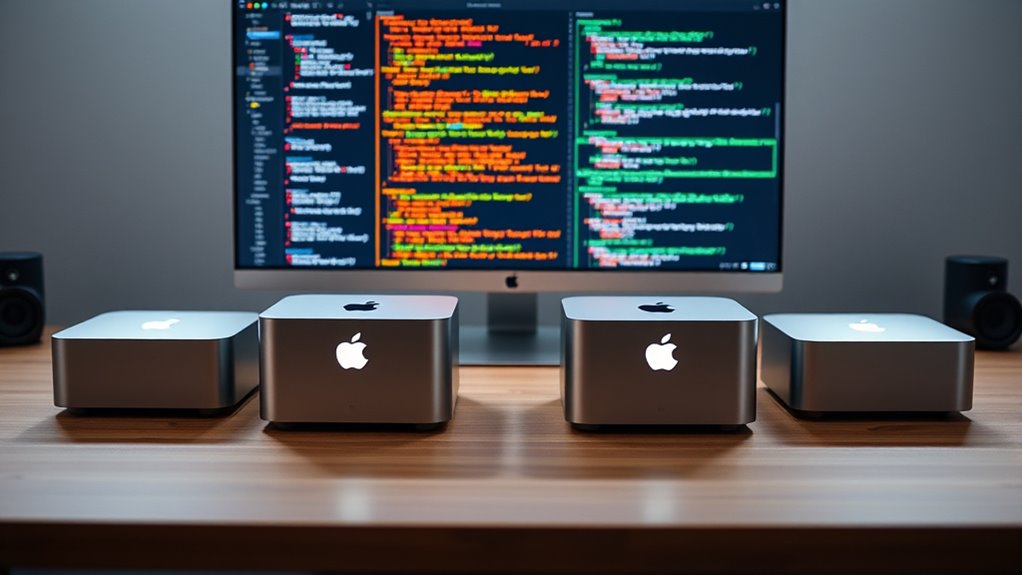

Choosing a Mac mini for software development comes down to matching processor generation, memory, and storage to the work you actually do. I rank the M5 Pro Mac mini first for demanding builds and AI-assisted workloads, the M2 Mac mini as a sensible modern starting point, and the 2018 Intel Core i5 for developers who need Intel compatibility or a larger internal SSD.

Turn the school run and nap time into listening time
- Thousands of audiobooks, podcasts and originals
- Listen on your phone, tablet or Echo — also offline
- Cancel anytime
The tradeoffs are pronounced: newer Apple silicon brings newer connectivity and a stronger runway for current macOS development, while older renewed models may suit narrower budgets or legacy toolchains. Yet every listed configuration has memory or storage limits worth weighing before you buy. I compare them on development-relevant performance potential, practical ports, configuration clarity, and how well each fits common coding setups—not on general desktop appeal.
Complete the kit


Key Takeaways
- The M5 Pro is the strongest fit for demanding development, but the listing does not specify memory or storage configurations, so verify the exact build before purchase.
- The M2 Mac mini is my balanced pick among the fully described Apple silicon options, though its listed 8GB memory can constrain large projects and virtual machines.
- The M1 offers an Apple silicon entry point, but its 8GB memory and 256GB SSD leave less room for containers, simulators, and local project data.
- The 2018 Core i5 has a 512GB SSD and four Thunderbolt 3 ports, which can help with Intel-specific tools and external development storage.
- The Core i3 is best kept to lighter coding and learning; its 8GB RAM and older Intel platform make it a weaker choice for sustained builds.
| Apple Mac mini Desktop Computer with M5 Pro Chip |  | Best Overall for Demanding Development | Processor: Apple M5 Pro | Memory bandwidth: 307GB/s | Storage speed: Up to 2x faster storage | VIEW ON AMAZON | See Our Full Breakdown |
| Apple 2023 Mac Mini with M2 Chip, 8-Core CPU, 8GB RAM, 256GB SSD, Silver (Renewed) |  | Best Balanced Apple Silicon Option | Processor: Apple M2, 8-core CPU | Graphics: 10-core GPU | Memory: 8GB unified memory; configurations up to 24GB stated | VIEW ON AMAZON | See Our Full Breakdown |
| Apple 2020 Mac Mini with Apple M1 Chip, 8GB RAM, 256GB SSD Storage – Silver (Renewed) |  | Best for Entry-Level Apple Silicon Development | Processor: Apple M1 | Processor speed: 3.1 GHz listed | Memory: 8GB | VIEW ON AMAZON | See Our Full Breakdown |
| Apple 2018 Mac Mini with 3.0GHz Intel Core i5, 8GB RAM, 512GB SSD Storage, Gray (Renewed) |  | Best for Intel Compatibility and Larger SSD | Processor: 3.0GHz Intel Core i5, 6-core | Memory: 8GB DDR4 | Storage: 512GB SSD | VIEW ON AMAZON | See Our Full Breakdown |
| Apple Mac Mini Desktop – Intel Core i3, 8GB RAM, 256GB SSD (Renewed) |  | Best for Basic Coding on an Older Intel Mac | Processor: 8th-generation Intel Core i3, 3.6GHz, 4 cores | Memory: 8GB DDR4 | Storage: 256GB SSD | VIEW ON AMAZON | See Our Full Breakdown |
| mac mini for software development | Processor | Ports | Graphics | Memory |
|---|---|---|---|---|
| Apple Mac mini Desktop Compute | Apple M5 Pro | Three Thunderbolt 5, HDMI, two USB-C, headphone jack | — | — |
| Apple 2023 Mac Mini with M2 Ch | Apple M2, 8-core CPU | Two Thunderbolt 4, two USB-A, HDMI, headphone jack | 10-core GPU | 8GB unified memory; configurations up to 24GB stated |
| Apple 2020 Mac Mini with Apple | Apple M1 | — | Integrated 8-core GPU | 8GB |
| Apple 2018 Mac Mini with 3.0GH | 3.0GHz Intel Core i5, 6-core | Four Thunderbolt 3, HDMI 2.0, two USB 3 | Intel UHD Graphics 630 | 8GB DDR4 |
| Apple Mac Mini Desktop | 8th-generation Intel Core i3, 3.6GHz, 4 cores | Four Thunderbolt 3, HDMI 2.0, two USB 3 | Intel UHD Graphics 630 | 8GB DDR4 |
More Details on Our Top Picks
Apple Mac mini Desktop Computer with M5 Pro Chip
I place the M5 Pro Mac mini first because its stated chip, 307GB/s memory bandwidth, and fast storage are the most compelling foundation here for large builds, parallel work, and development that also leans on AI or creative tools. Three Thunderbolt 5 ports, Wi-Fi 7, and 2.5Gb Ethernet make it the most forward-looking connectivity option in this group. It also supports up to three displays, helpful if your coding workflow spreads editors, documentation, and testing tools across screens.
Compared with the M2, this is the more ambitious workstation direction, but the M2 listing is much clearer about its 8GB memory and 256GB SSD. The M5 Pro listing does not specify RAM or storage capacity, and those details matter as much as the processor for software development. I would confirm the exact configuration before ordering rather than treating speed claims as a complete buying picture. Its compact dimensions are attractive, but no included keyboard or other peripherals are specified, so budget for a complete desk setup in planning.
This is my pick for developers whose work can use the latest connectivity and greater compute headroom, provided the configuration checks out. It is a poor match for buyers who need a precisely documented memory and storage setup before committing, or who only run an editor, browser, and small projects. In that lighter case, the M2 or even the M1 may be easier to evaluate from the supplied specs.
Pros:- M5 Pro chip and 307GB/s memory bandwidth suit demanding technical workflows.
- Three Thunderbolt 5 ports, HDMI, and 2.5Gb Ethernet offer strong desk connectivity.
- Supports up to three external displays.
- Compact 5 x 5-inch footprint fits a small workspace.
Cons:- The listing does not state RAM or storage capacity.
- Included accessories and peripheral details are not specified.
- Its capability may be unnecessary for basic coding and learning.
Best for: Developers handling demanding builds, AI-related coding, creative work, or multi-display setups who can verify the exact memory and storage configuration.
Not ideal for: Buyers who need confirmed RAM and SSD capacity upfront, or developers whose light coding workload does not call for a high-end chip.
- Processor:Apple M5 Pro
- Memory bandwidth:307GB/s
- Storage speed:Up to 2x faster storage
- Ports:Three Thunderbolt 5, HDMI, two USB-C, headphone jack
- Networking:Wi-Fi 7, Bluetooth 6, 2.5Gb Ethernet
- Display support:Up to three displays
- Dimensions:5 x 5 x 1.97 inches
- Weight:1.61 pounds
Our verdict“I recommend the M5 Pro for demanding development only after confirming the exact memory and storage configuration.”
Apple 2023 Mac Mini with M2 Chip, 8-Core CPU, 8GB RAM, 256GB SSD, Silver (Renewed)
The M2 Mac mini is my most balanced documented choice for developers who want Apple silicon without stepping up to the M5 Pro. Its 8-core CPU and 10-core GPU give it a modern foundation for everyday coding, while two Thunderbolt 4 ports, USB-A, HDMI, and a headphone jack make it easier to attach familiar accessories than a port-sparse mini PC. Wi-Fi 6E and Bluetooth 5.3 also bring current wireless connectivity to a tidy desktop setup.
The catch is the exact configuration: this listing has 8GB unified memory and a 256GB SSD. That can be restrictive when an IDE, browser tabs, local databases, simulators, and containers all compete for resources. Compared with the M1, the M2 is the newer chip with a 10-core GPU and newer wireless support; compared with the M5 Pro, it is easier to evaluate but has less stated headroom. The listing says memory is supported up to 24GB and storage up to 2TB, but those are alternative configurations, not upgrades I can assume are present in this renewed unit.
Its 90-day limited warranty and renewed status deserve a careful check, especially for a machine expected to serve as a daily development environment. I would choose it for general web development, scripting, and moderate projects, but not if the plan depends on running several virtual machines or keeping a large toolchain and project archive on the internal drive. Since memory and storage are not user-upgradeable in the usual desktop sense, buy the actual configuration you need.
Pros:- M2 8-core CPU and 10-core GPU provide a modern Apple silicon platform.
- Includes Thunderbolt 4, USB-A, HDMI, and a headphone jack.
- Wi-Fi 6E and Bluetooth 5.3 are newer than the M1 model’s stated connectivity.
- The listing describes higher-memory and larger-storage configurations as available.
Cons:- The specific renewed configuration has only 8GB unified memory and 256GB SSD.
- A 90-day limited warranty is shorter than many buyers may prefer for a primary work computer.
- Memory and internal storage are not straightforward post-purchase upgrades.
Best for: Developers seeking a current Apple silicon Mac for general coding, moderate multitasking, and a desk setup with varied ports.
Not ideal for: People planning large container stacks, virtual machines, or extensive local archives on the listed 8GB/256GB configuration.
- Processor:Apple M2, 8-core CPU
- Graphics:10-core GPU
- Memory:8GB unified memory; configurations up to 24GB stated
- Storage:256GB SSD; configurations up to 2TB stated
- Ports:Two Thunderbolt 4, two USB-A, HDMI, headphone jack
- Wireless:Wi-Fi 6E, Bluetooth 5.3
- Ethernet:Gigabit Ethernet; 10Gb Ethernet configurable
- Warranty:90-day limited warranty
Our verdict“For a clearly specified Apple silicon desktop, I would choose the M2 over the M1, while treating 8GB and 256GB as firm limits.”
Apple 2020 Mac Mini with Apple M1 Chip, 8GB RAM, 256GB SSD Storage – Silver (Renewed)
The M1 Mac mini makes sense for a developer who wants an Apple silicon machine for learning, web development, scripting, or modest projects without needing the newest platform. Its compact body and integrated 8-core GPU are more than a basic office setup, and an SSD keeps everyday launches and file access responsive. For someone building a first iOS or macOS development desk, it offers a straightforward way into the Apple ecosystem.
Compared with the M2, though, this model is the older pick: the M2 has a newer CPU, a 10-core GPU, Thunderbolt 4, and Wi-Fi 6E, while the M1 listing gives less connectivity detail. The M1’s 8GB memory and 256GB SSD are the main constraints for development. An IDE plus browser, simulator, and local services can fill both quickly, and there is no easy internal upgrade path after purchase. External storage can ease the SSD limit, but it will not increase the available memory.
This renewed model is a reasonable choice for lightweight workloads, but I would skip it if you plan to run multiple containers, virtual machines, or large local builds. It also arrives without a keyboard according to the supplied information, so a developer moving from a laptop must add the needed peripherals. Against the older Intel options, the M1 is the more appealing general-purpose development platform; against the M2, its lower position reflects age and less flexible headroom rather than an inability to code.
Pros:- M1 chip offers a capable Apple silicon foundation for lighter coding.
- Compact desktop design fits small workspaces.
- Integrated 8-core GPU supports everyday graphics and display work.
- SSD storage supports responsive everyday file access.
Cons:- 8GB memory can restrict development multitasking.
- 256GB internal storage leaves limited room for tools and project data.
- Renewed condition and unspecified warranty details merit checking.
- Keyboard is not included.
Best for: Students, hobbyists, and developers doing lightweight web work or scripting who want a compact Apple silicon Mac.
Not ideal for: Developers using several simulators, containers, virtual machines, or large local repositories at once.
- Processor:Apple M1
- Processor speed:3.1 GHz listed
- Memory:8GB
- Storage:256GB SSD
- Graphics:Integrated 8-core GPU
- Connectivity:Wi-Fi, Bluetooth, USB, HDMI
- Operating system:macOS
- Weight:1.18 kg
Our verdict“I would choose the M1 for learning and modest projects, but pay attention to the M2 if your workload is likely to grow.”
Apple 2018 Mac Mini with 3.0GHz Intel Core i5, 8GB RAM, 512GB SSD Storage, Gray (Renewed)
The 2018 Intel Core i5 Mac mini earns a distinct place for developers who need Intel-based compatibility or prefer a larger listed internal SSD. Its six-core 3.0GHz Core i5, 512GB SSD, and four Thunderbolt 3 ports make it more flexible for external drives, docks, and displays than the M1 listing’s less-detailed port information. For a developer maintaining older Intel-targeted software or testing on an Intel Mac environment, that platform difference can matter more than having a newer Apple silicon chip.
For most new macOS development, I would rank the M2 or M1 ahead of it. The 2018 model is older, has 8GB DDR4 memory, and uses Intel UHD Graphics 630 rather than a modern integrated Apple GPU. Its higher internal storage capacity is useful, but it does not resolve memory pressure during large builds or heavy multitasking. The four Thunderbolt 3 connections are a real advantage for a wired desk, yet port count alone does not make the machine the stronger long-term choice.
Renewed status brings another decision point: the supplied details say it has been inspected, but warranty coverage can vary and should be checked for the specific offer. I see this as a specialized option, not the default value pick. Choose it when Intel compatibility, Thunderbolt 3 expansion, or the 512GB SSD directly supports your workflow; skip it if you simply want the best general-purpose development performance among these models.
Pros:- Six-core Intel Core i5 suits compatibility-focused development.
- 512GB SSD provides more internal workspace than the 256GB models.
- Four Thunderbolt 3 ports plus HDMI 2.0 and USB 3 support varied setups.
- Useful for testing software on an Intel Mac platform.
Cons:- Older Intel hardware trails the Apple silicon choices for general current use.
- 8GB DDR4 memory can constrain multitasking and builds.
- Renewed warranty coverage may be limited or vary by listing.
Best for: Developers maintaining Intel-specific software, testing on Intel macOS, or needing four Thunderbolt 3 ports and a 512GB SSD.
Not ideal for: Buyers prioritizing a newer general-purpose development platform, stronger integrated graphics, or more than 8GB of listed memory.
- Processor:3.0GHz Intel Core i5, 6-core
- Memory:8GB DDR4
- Storage:512GB SSD
- Graphics:Intel UHD Graphics 630
- Ports:Four Thunderbolt 3, HDMI 2.0, two USB 3
- Operating system:Mac OS
- Condition:Renewed
- Weight:3.5 pounds
Our verdict“I recommend this Intel model only when its compatibility or 512GB SSD solves a specific development need.”
Apple Mac Mini Desktop – Intel Core i3, 8GB RAM, 256GB SSD (Renewed)
This renewed Intel Core i3 Mac mini is the most limited recommendation in the lineup, but it can still suit learning, basic scripting, and small projects where an older Intel Mac is specifically useful. The eighth-generation quad-core processor, 8GB DDR4, and 256GB SSD provide a simple desktop base, and the four Thunderbolt 3 ports, HDMI, and two USB 3 ports are generous for connecting a monitor, storage, and peripherals.
Its position below the 2018 Core i5 is easy to explain: both listings have 8GB memory and older Intel graphics, but the i5 model adds two processor cores and doubles the listed SSD capacity. The M1 is a better general-purpose pick for most light development because it moves to Apple silicon, while the M2 is a stronger documented choice for a newer platform. The i3 remains relevant mainly if your software needs Intel compatibility or you already have a reason to choose this exact model.
The 256GB SSD and 8GB RAM make this a poor fit for modern multitasking-heavy development. Local containers, multiple IDEs, large dependencies, and simulators can quickly make the configuration feel cramped. Its 90-day limited warranty is also a relatively short support window for a renewed computer that may become a primary work machine. I would keep this purchase to light coding and basic macOS tasks rather than treating it as a workstation for professional builds.
Pros:- Four-core Intel processor can handle basic coding and light multitasking.
- Four Thunderbolt 3 ports, HDMI 2.0, and two USB 3 ports support a flexible desk.
- SSD storage is responsive for everyday development tools.
- Compact desktop works well in a small workspace.
Cons:- 8GB RAM and 256GB SSD are restrictive for larger projects.
- Older Core i3 platform is weaker than the 2018 Core i5 and Apple silicon options.
- 90-day limited warranty offers a short coverage period.
Best for: Beginners learning to code, or developers who need a low-demand Intel Mac environment for small projects.
Not ideal for: Professional developers running large builds, multiple containers, simulators, or memory-heavy tools.
- Processor:8th-generation Intel Core i3, 3.6GHz, 4 cores
- Memory:8GB DDR4
- Storage:256GB SSD
- Graphics:Intel UHD Graphics 630
- Ports:Four Thunderbolt 3, HDMI 2.0, two USB 3
- Operating system:macOS
- Warranty:90-day limited warranty
- Dimensions:8.15 x 8.03 x 2.56 inches
Our verdict“I would pick the Core i3 only for basic coding or Intel-specific needs, not as a growth-ready development workstation.”

How We Picked
I ranked these Mac minis for software development tasks, not as interchangeable general-purpose desktops. My main questions were whether each model has enough processor capability for compiling and multitasking, whether the listed memory and SSD can support projects and developer tools, and whether the ports make a practical desk setup easier. I also weighed how clearly the configuration is described: a fast chip is less useful as a recommendation when a listing leaves core configuration details unstated.
The order favors the newest and most capable development platform first, then moves toward models with clearer midrange value and specific use cases. The M5 Pro leads on stated chip and connectivity capabilities, but its unspecified memory and storage keep me from recommending it blindly. The M2 is the most balanced documented Apple silicon choice here, while the M1 is a lower-capability alternative. Intel models rank below them for general current development, but I preserve their distinct roles for Intel compatibility, port needs, and lighter workloads.
Renewed condition also affects the guidance. I treat warranty and configuration details as purchase checks, rather than assuming that two listings with similar names have identical support or condition. None of these compact desktops is a strong out-of-the-box choice for a developer who expects to upgrade memory later, so my recommendations account for the configuration you receive.
| mac mini for software development | Ports | Operating system |
|---|---|---|
| Apple Mac mini Desktop Compute | Three Thunderbolt 5, HDMI, two USB-C, headphone jack | — |
| Apple 2023 Mac Mini with M2 Ch | Two Thunderbolt 4, two USB-A, HDMI, headphone jack | — |
| Apple 2020 Mac Mini with Apple | — | macOS |
| Apple 2018 Mac Mini with 3.0GH | Four Thunderbolt 3, HDMI 2.0, two USB 3 | Mac OS |
| Apple Mac Mini Desktop | Four Thunderbolt 3, HDMI 2.0, two USB 3 | macOS |
Factors to Consider When Choosing Mac Mini For Software Development
I would decide by workload and configuration first, then by chip generation. A Mac mini is only the computer itself, so a suitable monitor, keyboard, mouse, and any required adapters or external storage belong in the setup plan.Match memory to the tools you keep open
Development workloads can stack up: an IDE, browser, simulator, local database, and containers may all be open at once. The M1, M2, and both Intel listings specify 8GB of memory, which is most comfortable for lighter coding and focused work. If your routine includes virtual machines or several services running locally, do not assume that a faster processor makes 8GB disappear as a constraint. The M5 Pro listing omits its memory configuration, so I would verify that detail before comparing it with the others.
Estimate storage for tools and project files
The listed 256GB SSDs on the M1, M2, and Core i3 leave less headroom for Xcode, SDKs, simulators, package caches, containers, and source repositories. The 2018 Core i5’s 512GB SSD is more generous internally, although its older Intel platform remains a tradeoff. External drives can hold project archives and other large files, but they do not expand internal memory and may not suit every active build workflow. Check capacity on the exact M5 Pro configuration, since the product details do not state it.
Choose Apple silicon or Intel for a reason
For a new general-purpose development environment, I would start with the Apple silicon options: the M2 has a clear modern configuration, the M1 fits lighter work, and the M5 Pro targets demanding tasks. The 2018 Core i5 and Core i3 retain value for a specific need such as testing on Intel macOS or supporting software that depends on an Intel environment. Before picking an older Intel unit, check that the macOS version and the tools you need remain compatible with that model. A platform match can outweigh raw age when compatibility is the actual requirement.
Plan the desk around ports and displays
Ports affect how easily your development desk comes together. The 2018 Intel models offer four Thunderbolt 3 ports, while the M2 has two Thunderbolt 4 ports plus USB-A and HDMI. The M5 Pro listing describes three Thunderbolt 5 ports, HDMI, two USB-C ports, and support for up to three displays. The M1’s port details are less specific, so check the unit’s exact connections if you depend on several monitors or wired accessories. Count the ports you need for displays, docks, external SSDs, and audio rather than choosing on processor alone.
Treat renewed condition and warranty as part of the configuration
Four listings are renewed, and the M2 and Core i3 details state a 90-day limited warranty. The supplied details do not confirm the same coverage for every renewed model, so read the specific seller and warranty terms before purchase. Also check what is included: the M1 listing says no keyboard is included, and the M5 Pro details do not specify accessories. For a primary coding machine, I would want a clear return window, accurate configuration, and working ports before relying on it for a daily workflow.
Frequently Asked Questions
Which Mac mini in this comparison is best for software development?
I rank the M5 Pro first for demanding development because it has the strongest stated chip and connectivity capabilities, including Thunderbolt 5 and support for up to three displays. Its listing does not specify RAM or storage capacity, however, so I would confirm the exact configuration before purchase. For a clearly documented Apple silicon configuration, the M2 is the more balanced alternative, though its listed 8GB memory and 256GB SSD are limiting for heavier workflows.
Is 8GB of memory enough for coding on a Mac mini?
It can be enough for learning, scripting, and lighter web development if you keep the number of open tools modest. The 8GB configurations in this lineup may feel constrained with multiple simulators, containers, virtual machines, or large IDE projects running together. I would treat the M1, M2, and Intel models as machines for lighter workloads unless the specific configuration offers more memory; the M5 Pro listing needs a configuration check because it does not state its memory capacity.
Should I choose Apple silicon or an Intel Mac mini for development?
For a new general-purpose development setup, I would favor the M1, M2, or M5 Pro, with the M2 as the clearest middle ground in the supplied specifications. The 2018 Core i5 and Core i3 make more sense when your work specifically needs Intel compatibility, or when you want to test software on an Intel Mac. Check the macOS and tool compatibility required by your projects before choosing an older Intel machine.
Is a 256GB SSD enough for software development?
A 256GB SSD can work for smaller projects, but it can fill quickly once developer tools, SDKs, simulators, container images, package caches, and repositories share the drive. The 2018 Core i5’s listed 512GB SSD gives more internal room, though it comes with older Intel hardware. External storage can help with files and archives, but I would not treat it as a substitute for checking internal capacity against the tools and projects you use most.
What should I check before buying a renewed Mac mini?
Verify the exact processor, memory, storage, included accessories, warranty, and return terms for the particular listing. That matters especially for the M2, whose stated 90-day warranty accompanies a renewed unit, and the M5 Pro, whose memory and storage are not specified in the provided details. I would also confirm that required ports work for your monitor and peripherals and that your development tools support the model’s processor and macOS version.
Conclusion
For demanding builds, AI-related coding, and multi-display work, I would choose the M5 Pro after confirming its memory and storage. For a current, clearly specified Apple silicon setup for everyday development, the M2 is my balanced recommendation, provided 8GB RAM and 256GB SSD fit your workload. The M1 is better for students and light coding, while the 2018 Core i5 is the specialist pick for Intel compatibility or a larger built-in SSD. I would reserve the Core i3 for basic learning and small projects. Across the renewed options, check warranty and configuration details before making any model your primary work computer.