The best indoor air quality monitors help you spot changes in pollutants, carbon dioxide, and humidity, but sensor coverage and app features vary widely. I rank the BREATHE AirMonitor Plus Gen 2 as the best overall for its combination of CO₂, particulate readings, and app access. The Qingping Air Quality Monitor Gen 2 stands out for its broad readings and smart-home compatibility, while the Amazon Smart Air Quality Monitor is a simpler choice for Alexa households. The main tradeoff is whether you want a clear standalone display, broader pollutant coverage, or connected alerts and automation. Read on for the full breakdown of all 14 options and the buyer details that help separate them.

Turn the school run and nap time into listening time
- Thousands of audiobooks, podcasts and originals
- Listen on your phone, tablet or Echo — also offline
- Cancel anytime
Complete the kit


Key Takeaways
- Sensor coverage matters more than a high parameter count: the lineup includes models focused on CO₂ and PM readings as well as multi-sensor units, so match the measurements to your actual concern.
- The amazon.com/dp/B0CLYRBRSB?tag=bebedeseado-20&ascsubtag=dc-470722″ target=”_blank” rel=”nofollow sponsored noopener”>BREATHE AirMonitor Plus Gen 2 leads for connected monitoring by pairing CO₂ and particulate readings with app access; shoppers who prefer a visible on-device interface may favor a screen-focused model instead.
- The Qingping Gen 2 offers unusually broad household context with PM2.5, PM10, CO₂, noise, temperature, and humidity, while its smart-home features make it a stronger fit for connected homes.
- Many 10-in-1 and 16-in-1 listings overlap in purpose: a larger sensor count alone does not establish better accuracy or tell you which pollutants are measured.
- Specialists can be the more sensible choice: Temtop’s PM2.5 and CO₂-focused monitors may suit buyers who want a narrower, more direct measurement task instead of a wide dashboard.
| 16-in-1 Indoor Air Quality Monitor with HD Color Screen | 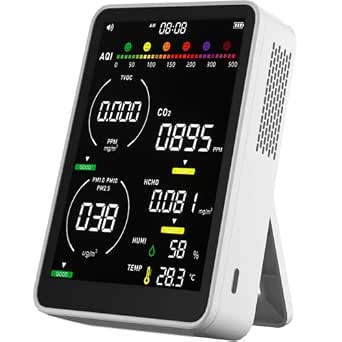 | Best for Broad On-Device Monitoring | Parameters monitored: PM1.0, PM2.5, PM10, CO₂, TVOC, HCHO, temperature, humidity | Display: HD color screen | Battery life: 4–5 hours | VIEW ON AMAZON | See Our Full Breakdown |
| BREATHE Airmonitor Plus Indoor Air Quality Monitor with CO₂, PM, and App (Gen 2) |  | Best for App-Based Tracking | Sensors: CO₂, PM1, PM2.5, PM10, TVOC, formaldehyde, temperature, humidity | Connectivity: Wi-Fi (2.4 GHz) | Data history: 90 days | VIEW ON AMAZON | See Our Full Breakdown |
| Qingping Air Quality Monitor Gen 2, Indoor Air Quality Tester with Alarm Clock, Detects PM2.5, CO2, PM10, Noise, Temperature, Humidity, Smart Home Compatible |  | Best for a Shared Room Display | Display: 4-inch IPS touchscreen | Metrics monitored: PM2.5, CO₂, PM10, noise, temperature, humidity, eTVOC | Connectivity: Wi-Fi (2.4 GHz / 5 GHz) | VIEW ON AMAZON | See Our Full Breakdown |
| Temtop S1 PM2.5 Air Quality Monitor & Indoor Thermometer | 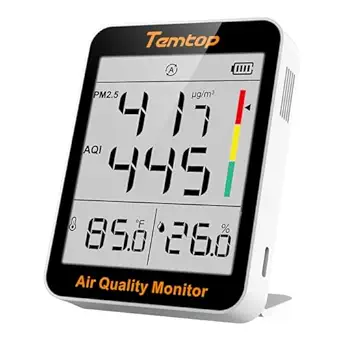 | Best for Simple, Long-Running Checks | Measurements: PM2.5, AQI, temperature, humidity | Battery type: Alkaline | Battery life: Up to 60 days | VIEW ON AMAZON | See Our Full Breakdown |
| 16-in-1 Indoor Air Quality Monitor with HD Color Screen |  | Best for Cord-Free Room-to-Room Spot Checks | Parameters measured: PM1.0, PM2.5, PM10, TVOC, HCHO, temperature, humidity | Display: HD color screen | Battery life: 4–5 hours | VIEW ON AMAZON | See Our Full Breakdown |
| Indoor Air Quality Monitor, 10-in-1 Smart Air Quality Tester |  | Best for Longer Cord-Free Monitoring | Detection: CO₂, HCHO, TVOC, benzene, PM2.5, and PM10 among the listed pollutants | Display: HD color screen | Battery capacity: 2000mAh rechargeable lithium battery | VIEW ON AMAZON | See Our Full Breakdown |
| 16-in-1 Indoor Air Quality Monitor – High-Precision Multi-Parameter Smart Tester with HD Color Screen (Black) |  | Best for Multi-Parameter Readings | Model: AQItech AK16D | Listed sensors: PM1.0, PM2.5, PM10, CO₂, TVOC, HCHO, temperature, and humidity | Display: HD color screen | VIEW ON AMAZON | See Our Full Breakdown |
| Amazon Smart Air Quality Monitor |  | Best for Alexa Households | Measurements: Temperature, humidity, carbon monoxide, PM2.5, and VOCs | Dimensions: 65 x 65 x 45 mm | Weight: 120 grams | VIEW ON AMAZON | See Our Full Breakdown |
| 16-in-1 Air Quality Monitor Indoor – 7″ High‑Precision Real‑Time CO2 Monitor |  | Best for a Large, Visible Display | Listed measurements: CO₂, PM2.5, PM1.0, PM10, HCHO, TVOC, temperature, humidity, and AQI | Display: 7-inch LED | Brightness: Three levels | VIEW ON AMAZON | See Our Full Breakdown |
| 16-in-1 Air Quality Monitor – Indoor High‑Precision CO₂ Monitor with HD Screen | 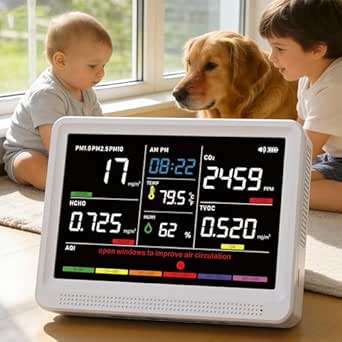 | Best for Balanced Portable Monitoring | Brand and model: YNAK, USWBA03-NEWNEWNEW | Listed sensors: CO₂, TVOC, PM2.5, PM1.0, PM10, HCHO, temperature, humidity, and AQI | Display: 5.5-inch HD LED | VIEW ON AMAZON | See Our Full Breakdown |
| Temtop CO2 Monitor Indoor Air Quality Monitor Portable CO2 Meter, Temperature, Humidity for Home, Office, or School |  | Best for CO2-Focused Monitoring | CO2 range: 400–5,000 ppm | Sensor technology: High-precision NDIR | Temperature range: -10°C to 60°C / 14°F to 140°F | VIEW ON AMAZON | See Our Full Breakdown |
| Indoor Air Quality Monitor 10-in-1 Portable Smart CO2 Detector |  | Best for Broad, At-a-Glance Readings | Measurements: CO2, HCHO, TVOC, PM1.0, PM2.5, PM10, temperature, humidity, and AQI | Display: High-definition color screen | Connectivity: Bluetooth | VIEW ON AMAZON | See Our Full Breakdown |
| GoveeLife Smart Air Quality Monitor with PM2.5, LED Display, Wired |  | Best for Connected PM2.5 Monitoring | Measurements: PM2.5, temperature, and humidity | PM2.5 accuracy: ±15 µg/m³ | Temperature accuracy: ±0.54°F | VIEW ON AMAZON | See Our Full Breakdown |
| ZEMEOLLO Air Quality Monitor Indoor 10-in-1 Smart Air Quality Tester |  | Best Portable Pick for Multiple Pollutants | Listed measurements: CO2, formaldehyde, TVOC, benzene, PM2.5, and PM10 | Stated error margin: Under ±5% | Display: High-definition color LCD with threshold color changes | VIEW ON AMAZON | See Our Full Breakdown |
| indoor airquality monitor | Display |
|---|---|
| 16-in-1 Indoor Air Quality Mon | HD color screen |
| BREATHE Airmonitor Plus Indoor | Color display |
| Qingping Air Quality Monitor G | 4-inch IPS touchscreen |
| Temtop S1 PM2.5 Air Quality Mo | — |
| 16-in-1 Indoor Air Quality Mon | HD color screen |
| Indoor Air Quality Monitor | HD color screen |
| 16-in-1 Indoor Air Quality Mon | HD color screen |
| Amazon Smart Air Quality Monit | — |
| 16-in-1 Air Quality Monitor In | 7-inch LED |
| 16-in-1 Air Quality Monitor | 5.5-inch HD LED |
| Temtop CO2 Monitor Indoor Air | — |
| Indoor Air Quality Monitor 10- | High-definition color screen |
| GoveeLife Smart Air Quality Mo | — |
| ZEMEOLLO Air Quality Monitor I | High-definition color LCD with threshold color changes |
More Details on Our Top Picks
16-in-1 Indoor Air Quality Monitor with HD Color Screen
This model earns its place for buyers who want to check a wide range of pollutants directly on the device. It reports PM1.0, PM2.5, PM10, CO₂, TVOC, and formaldehyde, alongside temperature and humidity, so it covers more categories than the Temtop S1, which focuses on PM2.5 and basic comfort readings. The HD color screen and single-tap controls favor quick room checks over app-based analysis. Its portability also suits moving it between rooms or taking readings in a vehicle. The tradeoff is a 4–5-hour battery life, which is short for continuous monitoring, and the supplied information does not mention app connectivity or data history. Choose it for a broad snapshot on screen, not for long unattended tracking.
Pros:- Measures particulate matter, CO₂, TVOC, and formaldehyde alongside temperature and humidity
- HD color screen makes readings available without opening an app
- Single-tap controls support quick checks
- Portable for use across home, office, and vehicle settings
Cons:- Battery lasts only 4–5 hours per charge
- Frequent charging limits use as a continuously running monitor
- No app connectivity or data logging is specified
Best for: People who want many air-quality readings visible on a screen while moving the monitor between rooms, an office, or a vehicle.
Not ideal for: Buyers who need continuous all-day monitoring, long-term graphs, or remote alerts, since battery life is limited and app features are not listed.
- Parameters monitored:PM1.0, PM2.5, PM10, CO₂, TVOC, HCHO, temperature, humidity
- Display:HD color screen
- Battery life:4–5 hours
- Charging:Type-C fast charging
- Power:Type-C port; AC adapter included
- Dimensions:6.89 × 5.31 × 1.61 inches
- Weight:15.2 ounces
Our verdict“Choose this model if broad pollutant coverage on a built-in screen matters more than long battery life or app-based history.”
BREATHE Airmonitor Plus Indoor Air Quality Monitor with CO₂, PM, and App (Gen 2)
The BREATHE Airmonitor Plus Gen 2 is the strongest fit here for buyers who want to review air conditions after a reading, not just glance at current levels. Its 90-day data history, app alerts, and data export give it a practical advantage over the 16-in-1 HD Color Screen monitor, whose listed features focus on on-device readings without app history. It tracks CO₂, several particle sizes, TVOC, formaldehyde, temperature, and humidity, covering a broad set of indoor concerns. That extra oversight depends on 2.4 GHz Wi-Fi, and the app may feel like more than a casual user needs. Battery life reaches up to six hours, but this remains a portable check-in device rather than a dependable all-day cordless monitor.
Pros:- Tracks CO₂, PM1, PM2.5, PM10, TVOC, formaldehyde, temperature, and humidity
- 90-day data history supports pattern checking over time
- App offers real-time monitoring, alerts, and data export
- Rechargeable USB-C design is portable
Cons:- Up to six hours of battery life may not cover extended cordless use
- Full app features require a 2.4 GHz Wi-Fi connection
- App features and multiple readings may be unnecessary for buyers seeking a simple display
Best for: Homeowners, classroom staff, or office managers who want pollutant alerts and several months of app-accessible readings.
Not ideal for: People who want a simple standalone display, lack 2.4 GHz Wi-Fi, or need a monitor to run cordless for a full day.
- Sensors:CO₂, PM1, PM2.5, PM10, TVOC, formaldehyde, temperature, humidity
- Connectivity:Wi-Fi (2.4 GHz)
- Data history:90 days
- Battery life:Up to 6 hours
- Display:Color display
- Power:Rechargeable, USB-C
- Size:Portable
Our verdict“Pick the BREATHE Gen 2 if app alerts and historical data matter more than simple operation or long battery runtime.”
Qingping Air Quality Monitor Gen 2, Indoor Air Quality Tester with Alarm Clock, Detects PM2.5, CO2, PM10, Noise, Temperature, Humidity, Smart Home Compatible
The Qingping Gen 2 is designed to stay visible in a room: its 4-inch touchscreen combines air readings with an alarm-clock function, making it more of a household display than a grab-and-go tester. It measures PM2.5, PM10, CO₂, eTVOC, noise, temperature, and humidity, while Wi-Fi and the Qingping+ app support remote monitoring and data export. Compared with the BREATHE Airmonitor Plus Gen 2, it adds noise readings and an integrated clock, but the BREATHE provides a stated 90-day data history and formaldehyde measurement. Qingping’s replaceable PM sensor is a useful serviceability feature. Its USB-powered design suits a bedside table or desk; the listed three-hour battery runtime without USB power is not suited to extended portable use.
Pros:- 4-inch IPS touchscreen presents readings on a prominent display
- Tracks PM2.5, PM10, CO₂, eTVOC, noise, temperature, and humidity
- Wi-Fi app supports remote monitoring and data export
- Replaceable PM sensor can be changed rather than replacing the entire monitor
Cons:- Does not measure formaldehyde, unlike the BREATHE Airmonitor Plus Gen 2
- Only three hours of battery life is listed without USB power
- USB-powered setup is better suited to a fixed location than portable monitoring
Best for: Households that want a large, always-visible bedside or desk monitor with noise readings, remote access, and an alarm clock.
Not ideal for: People who need long battery-powered operation, formaldehyde readings, or a small monitor for frequent travel.
- Display:4-inch IPS touchscreen
- Metrics monitored:PM2.5, CO₂, PM10, noise, temperature, humidity, eTVOC
- Connectivity:Wi-Fi (2.4 GHz / 5 GHz)
- Power:USB, 5 V ⎓ 1 A
- Alarm clock:Yes
- Replaceable sensor:PM sensor
- Battery life without USB power:3 hours
Our verdict“Choose Qingping for a room-based touchscreen that doubles as an alarm clock, but look elsewhere for formaldehyde data or longer cordless use.”
Temtop S1 PM2.5 Air Quality Monitor & Indoor Thermometer
The Temtop S1 makes sense for buyers who would rather leave a straightforward monitor in place than manage a broad set of readings or an app. It shows PM2.5, AQI, temperature, and humidity, while its stated 60-day battery life is a clear advantage over the 4–6-hour runtimes of the portable 16-in-1 and BREATHE models. That makes it better suited to a room, nursery, or office where a quick local check is enough. The compromise is narrower coverage: it does not list CO₂, VOCs, or formaldehyde monitoring, all available on those broader alternatives. It also lacks wireless connectivity and app access, so readings stay on the device. Choose the S1 for simple particle and comfort monitoring, not a full indoor pollutant profile.
Pros:- Tracks PM2.5 and AQI alongside temperature and humidity
- Stated battery life of up to 60 days reduces charging interruptions
- Compact format suits room-to-room placement or travel
- Clear display supports quick local checks
Cons:- Does not list CO₂, TVOC, or formaldehyde measurements
- No wireless connectivity or app integration
- Temperature operating range is limited to 10–50 °C
Best for: People who want to leave a compact monitor in a bedroom, nursery, or office and check PM2.5 and comfort readings without frequent charging.
Not ideal for: Buyers who need CO₂, VOC, or formaldehyde readings, remote monitoring, or pollutant history.
- Measurements:PM2.5, AQI, temperature, humidity
- Battery type:Alkaline
- Battery life:Up to 60 days
- Temperature range:10–50 °C
- Temperature accuracy:1 °C
- Operating humidity:10–99%
- Mounting type:Surface mount
Our verdict“Choose the Temtop S1 for long-running PM2.5 and comfort checks, but select a broader monitor if you need gas readings or app access.”
16-in-1 Indoor Air Quality Monitor with HD Color Screen
This version is a portable, screen-first option for buyers who want to carry a monitor between rooms or locations and read results without relying on a phone. It measures PM1.0, PM2.5, PM10, TVOC, formaldehyde, temperature, and humidity, then presents real-time readings on an HD color display. Compared with the B0H8XW8MCY 16-in-1 model, the supplied data for this unit does not list CO₂, so buyers focused on ventilation checks should favor the BREATHE Airmonitor Plus Gen 2 or the other 16-in-1 version. Type-C charging and a 14.4-ounce weight support portability, but its 4–5-hour battery and lack of Wi-Fi or Bluetooth limit ongoing tracking. It is a better fit for short spot checks than a fixed, connected monitoring setup.
Pros:- Measures PM1.0, PM2.5, PM10, TVOC, formaldehyde, temperature, and humidity
- HD color screen displays real-time readings on the device
- Single-tap operation supports quick spot checks
- Type-C charging and 14.4-ounce weight suit portable use
Cons:- CO₂ is not listed among the measurements, unlike the B0H8XW8MCY version
- Battery life is limited to 4–5 hours
- No Wi-Fi or Bluetooth connection is specified
Best for: People who want to carry a handheld monitor for short checks around a home, office, or car and prefer readings on the device.
Not ideal for: Buyers who need CO₂ monitoring, app connectivity, or continuous operation without frequent charging.
- Parameters measured:PM1.0, PM2.5, PM10, TVOC, HCHO, temperature, humidity
- Display:HD color screen
- Battery life:4–5 hours
- Charging:Type-C fast charging
- Connectivity:Type-C port
- Dimensions:1.6 × 5.3 × 6.7 inches
- Weight:14.4 ounces
Our verdict“Choose this version for portable, on-screen checks of particles and several other readings, but not if CO₂ data or connected tracking is required.”
Indoor Air Quality Monitor, 10-in-1 Smart Air Quality Tester
For checking several pollutant categories while moving between rooms, this portable monitor pairs a multi-gas sensor set with up to 20 hours of battery life. It lists CO₂, formaldehyde, TVOC, benzene, PM2.5, and PM10, while the color display and alerts make readings easier to scan than a device that relies on an app. Compared with the AQItech AK16D, its standout advantage is runtime; the AK16D lists only 4–5 hours of continuous sampling and adds temperature and humidity measurements. The tradeoff is that this monitor’s description gives less detail about its operating range and offers no stated app integration. I’d choose it for portable pollutant checks, not as a connected home dashboard.
Pros:- Lists CO₂, formaldehyde, TVOC, benzene, PM2.5, and PM10 detection
- Up to 20 hours of stated battery life supports extended portable checks
- Color display and visual alerts show readings on the device
- One-click operation keeps basic checks straightforward
Cons:- No detailed app or wireless integration is specified
- USB charging is required to recharge the battery
- The product description limits its intended use to indoor settings
Best for: People who want to move a monitor around the home or office and check multiple gases without frequent recharging
Not ideal for: Buyers who want app-based history, remote alerts, or clearly specified temperature and humidity readings
- Detection:CO₂, HCHO, TVOC, benzene, PM2.5, and PM10 among the listed pollutants
- Display:HD color screen
- Battery capacity:2000mAh rechargeable lithium battery
- Battery life:Up to 20 hours
- Power:USB charging cable
- Design:Portable, lightweight design
Our verdict“Choose this model if long battery life and broad pollutant checks matter more than app features or a fully detailed sensor specification.”
16-in-1 Indoor Air Quality Monitor – High-Precision Multi-Parameter Smart Tester with HD Color Screen (Black)
The AQItech AK16D suits buyers who want a broad set of readings in one device: its listed sensors cover PM1.0, PM2.5, PM10, CO₂, TVOC, HCHO, temperature, and humidity. That combination gives more context than the 10-in-1 Smart Air Quality Tester, which emphasizes gases and particles but does not list temperature or humidity in its provided specifications. The AK16D also keeps operation simple with a single tap, an HD screen, and optional audio prompts. Its main compromise is mobility: the stated 4–5-hour runtime is far shorter than the 10-in-1 model’s up-to-20-hour claim, so it is better for shorter spot checks than all-day cordless monitoring. The listing calls it 16-in-1 but names eight sensor categories, so buyers should not assume every claimed parameter is separately identified.
Pros:- Lists PM1.0, PM2.5, PM10, CO₂, TVOC, HCHO, temperature, and humidity
- HD color display presents readings directly on the device
- Single-tap operation and optional audio prompts support quick checks
- Uses a Type-C charging port
Cons:- Stated continuous battery runtime is only 4–5 hours
- Provided sensor list names eight categories despite the 16-in-1 title
- No app or remote-monitoring features are specified
Best for: Home and office users who want particle, gas, temperature, and humidity readings together for short monitoring sessions
Not ideal for: People who need a monitor to run cordless throughout the workday or want a clearly itemized list of all 16 claimed parameters
- Model:AQItech AK16D
- Listed sensors:PM1.0, PM2.5, PM10, CO₂, TVOC, HCHO, temperature, and humidity
- Display:HD color screen
- Battery runtime:4–5 hours of continuous sampling
- Charging port:Type-C fast charging
- Item weight:15.5 ounces
- Package dimensions:6.81 x 5.28 x 1.65 inches
Our verdict“Pick the AK16D for a wide mix of indoor measurements and easy spot checks, but skip it if long battery runtime is a priority.”
Amazon Smart Air Quality Monitor
This is the lineup’s clearest fit for buyers who want air readings tied to a smart-home routine rather than a standalone handheld tester. It tracks PM2.5, VOCs, carbon monoxide, temperature, and humidity, then uses Alexa for notifications and automation. That connected approach differs from the 7-inch 16-in-1 Air Quality Monitor, which shows a wider set of measurements on its built-in display but does not list wireless or app connectivity. Amazon’s compact monitor also has auto calibration and self-cleaning, though it requires a power connection and depends on Wi-Fi and Alexa for its fuller feature set. Its published accuracy ranges are useful context, but some are broad—for example, PM2.5 is listed at ±20 µg/m³ or ±20%. I’d favor it for compatible homes, not for cordless room-to-room checks.
Pros:- Measures PM2.5, VOCs, carbon monoxide, temperature, and humidity
- Alexa integration supports notifications and automation
- Auto calibration and self-cleaning are specified
- Compact 120-gram design with a multicolor LED status indicator
Cons:- Requires AC power rather than offering battery-powered monitoring
- Full functionality depends on Wi-Fi and the Alexa ecosystem
- Published accuracy for PM2.5 and some other readings allows broad tolerances
Best for: Alexa users who want indoor air readings to trigger notifications or smart-home automations
Not ideal for: Buyers seeking a battery-powered portable monitor, a large on-device display, or operation independent of Wi-Fi and Alexa
- Measurements:Temperature, humidity, carbon monoxide, PM2.5, and VOCs
- Dimensions:65 x 65 x 45 mm
- Weight:120 grams
- Connectivity:2.4GHz Wi-Fi and BLE 4.2
- Status indicator:Multicolor LED
- Power supply:AC power, 5.0V 1A (5W)
- Operating conditions:Indoor use; 0°C to 40°C and 0% to 80% humidity
- Warranty:One-year limited manufacturer’s device warranty
Our verdict“Choose this monitor if Alexa alerts and automation matter more than portability or a wide on-device readout.”
16-in-1 Air Quality Monitor Indoor – 7″ High‑Precision Real‑Time CO2 Monitor
The 7-inch LED screen makes this model a strong choice when readings need to be visible from across a desk or room. It covers nine listed measurements, including CO₂, particulate sizes, HCHO, TVOC, temperature, humidity, and AQI, with three brightness levels to adapt the display to different lighting. Compared with the YNAK 5.5-inch monitor, this model offers a larger screen but a shorter stated runtime: up to eight hours versus up to ten. Its seven AQI buzzer alerts can make changes harder to miss, and a mute button gives users control over sound. However, it lacks stated app or wireless monitoring, and its advertised ±0.001 accuracy does not identify measurement units or give separate tolerances for each sensor. It makes most sense as an at-a-glance room monitor.
Pros:- Large 7-inch LED display has three brightness settings
- Lists nine readings, including CO₂, particles, gases, temperature, humidity, and AQI
- Seven AQI buzzer alerts with a mute function
- USB-C charging and up to eight hours of runtime
Cons:- No wireless or app connectivity is specified
- Eight-hour maximum runtime is shorter than the YNAK model’s stated ten hours
- The ±0.001 accuracy claim does not specify units or sensor-by-sensor tolerances
Best for: People who want a large, adjustable display and audible AQI alerts for a home office or shared indoor space
Not ideal for: Buyers who need app access, quiet operation without manually muting alerts, or longer cordless runtime
- Listed measurements:CO₂, PM2.5, PM1.0, PM10, HCHO, TVOC, temperature, humidity, and AQI
- Display:7-inch LED
- Brightness:Three levels
- Accuracy claim:±0.001 units; units and sensor-specific tolerances are not stated
- Battery runtime:Up to 8 hours
- Charging:USB-C; AC adapter included
- Alerts:Seven AQI buzzer alerts with mute function
- Warranty:12 months
Our verdict“Choose this model if a large screen and audible alerts take priority over app features and longer battery life.”
16-in-1 Air Quality Monitor – Indoor High‑Precision CO₂ Monitor with HD Screen
The YNAK USWBA03-NEWNEWNEW balances a readable 5.5-inch HD display with up to 10 hours of battery runtime, making it a practical middle ground between the 7-inch model’s larger screen and its shorter eight-hour runtime. Its listed readings include CO₂, PM1.0, PM2.5, PM10, HCHO, TVOC, temperature, humidity, and AQI, while seven AQI alerts provide on-device notification. That makes it more suitable for moving between rooms than the plug-in Amazon Smart Air Quality Monitor, though Amazon offers Alexa-based notifications and automation that this model does not specify. The YNAK listing also warns that strong odors or perfumes can affect sensors, a meaningful limitation in kitchens or fragranced spaces. Its accuracy claim is not broken down by sensor, so I’d treat it as a convenient indicator rather than a substitute for detailed calibration data.
Pros:- Lists nine readings spanning particles, gases, temperature, humidity, and AQI
- 5.5-inch HD LED screen is larger than a compact status display
- Up to 10 hours of stated runtime exceeds the 7-inch model’s eight hours
- USB-C charging and seven AQI alerts support portable, on-device monitoring
Cons:- No app or wireless connectivity is specified
- Strong odors or perfumes can affect sensor readings
- The ±0.001 accuracy claim is not detailed by sensor or measurement unit
Best for: People who want a portable monitor with a mid-sized screen, several pollutant readings, and longer runtime than the 7-inch alternative
Not ideal for: Alexa users seeking connected alerts, or households that frequently use fragrances near the monitor
- Brand and model:YNAK, USWBA03-NEWNEWNEW
- Listed sensors:CO₂, TVOC, PM2.5, PM1.0, PM10, HCHO, temperature, humidity, and AQI
- Display:5.5-inch HD LED
- Battery runtime:Up to 10 hours
- Charging:USB-C; AC adapter included
- Accuracy claim:±0.001; units and sensor-specific tolerances are not stated
- Alerts:Seven distinct AQI alerts
- Warranty:12 months
Our verdict“Choose the YNAK if you want a portable, multi-reading monitor with a larger display and longer stated runtime than the 7-inch alternative.”
Temtop CO2 Monitor Indoor Air Quality Monitor Portable CO2 Meter, Temperature, Humidity for Home, Office, or School
For buyers who mainly want to know when a room needs more fresh air, this Temtop monitor keeps its measurements focused: CO2, temperature, and humidity. Its NDIR sensor measures CO2 from 400 to 5,000 ppm, while customizable alerts can make rising levels easier to spot in a classroom, office, or nursery. Compared with the GoveeLife Smart Air Quality Monitor, which adds Wi-Fi monitoring and focuses on PM2.5, Temtop gives you CO2 readings but not particulate data or remote smart-home controls. The stated battery life of up to 70 days favors occasional placement changes, though the description also says it needs to be plugged in for real-time monitoring, which limits confidence in its usefulness as a fully cordless tracker. It does not detect carbon monoxide, so it cannot replace a CO alarm.
Pros:- NDIR sensor measures CO2 across a 400–5,000 ppm range.
- Also tracks temperature and humidity, giving room-condition context alongside CO2.
- Customizable alerts can call attention to changing readings.
- Stated battery life is up to 70 days.
Cons:- Does not measure carbon monoxide, formaldehyde, VOCs, or particulate matter.
- The description says real-time monitoring requires a power connection, limiting cordless use.
- No Wi-Fi, Bluetooth, or remote data tracking is specified.
Best for: Teachers, office managers, and households who chiefly want portable CO2, temperature, and humidity readings with configurable alerts.
Not ideal for: Buyers who need PM2.5 or chemical measurements, remote app monitoring, or a device that can serve as a carbon monoxide alarm.
- CO2 range:400–5,000 ppm
- Sensor technology:High-precision NDIR
- Temperature range:-10°C to 60°C / 14°F to 140°F
- Humidity range:0–99% RH
- Stated battery life:Up to 70 days
- Dimensions:5.51 in D × 1.26 in W
Our verdict“Choose this Temtop if CO2 is your main indoor-air concern; choose a broader monitor if you also need particulate or chemical readings.”
Indoor Air Quality Monitor 10-in-1 Portable Smart CO2 Detector
This monitor suits buyers who want more than a CO2 number on one portable display. It lists CO2, formaldehyde, TVOC, PM1.0, PM2.5, PM10, temperature, humidity, and AQI, with a color screen intended to make changing conditions easier to interpret. That wider measurement mix gives it an advantage over the CO2-focused Temtop, which does not report particles or chemical indicators. Bluetooth supports calibration and data tracking, but the listing does not identify an app, explain export options, or provide battery-life details. Those gaps make it harder to judge how useful the tracking will be after setup, and buyers who want clear remote access may prefer the Wi-Fi-connected GoveeLife, despite that model’s narrower PM2.5 focus. This is the flexible, broad-reading choice, not the most clearly documented connected option.
Pros:- Lists CO2, HCHO, TVOC, three particle sizes, temperature, humidity, and AQI.
- Color display offers a quick visual summary of readings.
- Bluetooth supports calibration and data tracking.
- Portable format is intended for use across different indoor settings and vehicles.
Cons:- Battery life and physical dimensions are not specified.
- The listing does not name an app or clarify data export and remote-monitoring features.
- Calibration depends on Bluetooth, which may complicate setup for buyers who prefer a standalone device.
Best for: Homeowners or renters who want a portable screen covering CO2, particles, and chemical indicators in rooms, offices, or vehicles.
Not ideal for: Buyers who need documented battery runtime, named app support, data export details, or dependable remote monitoring.
- Measurements:CO2, HCHO, TVOC, PM1.0, PM2.5, PM10, temperature, humidity, and AQI
- Display:High-definition color screen
- Connectivity:Bluetooth
- Power:Charging cable included
- Form factor:Portable; exact dimensions not specified
Our verdict“Pick this model for a wide range of readings on a portable color display, but look elsewhere if battery details and well-documented app features matter most.”
GoveeLife Smart Air Quality Monitor with PM2.5, LED Display, Wired
The GoveeLife makes the most sense when PM2.5 tracking and remote access matter more than measuring a broad set of pollutants. It reports PM2.5, temperature, and humidity, refreshes readings every two seconds, and connects over 2.4 GHz Wi-Fi for remote monitoring and data export over two years. It can also link with GoveeHome smart devices for automated control, a practical distinction from the standalone ZEMEOLLO, which offers broader pollutant detection but no wireless features. The tradeoff is narrower coverage: this GoveeLife listing does not include CO2, formaldehyde, or TVOC measurements. It also has no built-in battery, so its useful placement depends on access to a power outlet and a compatible 2.4 GHz network. Choose it for connected PM2.5 routines, not as an all-in-one air checker.
Pros:- Two-second response time keeps PM2.5 readings current.
- Wi-Fi supports remote monitoring and data export over two years.
- Can connect with GoveeHome devices for automated control.
- Provides temperature and humidity alongside PM2.5.
Cons:- Measures a narrower set of pollutants than the 10-in-1 options in this roundup.
- Requires constant Type-C power and has no built-in battery.
- Connects only to 2.4 GHz Wi-Fi.
Best for: GoveeHome users and households that want Wi-Fi access to PM2.5 readings, historical data export, and smart-device automation.
Not ideal for: People who need CO2 or chemical measurements, portable monitoring, or a monitor that works on networks other than 2.4 GHz Wi-Fi.
- Measurements:PM2.5, temperature, and humidity
- PM2.5 accuracy:±15 µg/m³
- Temperature accuracy:±0.54°F
- Humidity accuracy:±3%
- Response time:2 seconds
- Connectivity:2.4 GHz Wi-Fi
- Power:Type-C cable; no built-in battery
- Dimensions:5.31 × 1.57 × 2.47 in
- Weight:5.44 oz
Our verdict“Choose the GoveeLife for connected PM2.5 tracking and Govee smart-home automation, not for broad pollutant coverage or portable use.”
ZEMEOLLO Air Quality Monitor Indoor 10-in-1 Smart Air Quality Tester
For buyers who want to move a monitor between a home, car, and office, the ZEMEOLLO combines broad pollutant detection with a rechargeable battery. It lists CO2, formaldehyde, TVOC, benzene, PM2.5, and PM10, with a color LCD that changes hue when readings cross thresholds. Its up-to-20-hour battery gives it a portability advantage over the wired GoveeLife, which must stay connected to power but offers Wi-Fi, remote monitoring, and data export. ZEMEOLLO does not provide those connected features, and the product data gives no individual measurement ranges or accuracy figures beyond a general error margin under ±5%. That makes it harder to evaluate performance pollutant by pollutant. This is a better fit for local, flexible checks than for ongoing monitoring from a phone.
Pros:- Lists CO2, formaldehyde, TVOC, benzene, PM2.5, and PM10 detection.
- Rechargeable 2,000 mAh battery supports up to 20 hours of continuous monitoring.
- Color LCD provides visual alerts when thresholds are exceeded.
- Compact 7-ounce design suits moving the monitor between locations.
Cons:- No wireless connectivity or app integration is specified.
- Does not offer remote monitoring or data export like the Wi-Fi-connected GoveeLife.
- Measurement ranges and pollutant-specific accuracy details are not provided.
Best for: People who want to carry one monitor between rooms or locations and see several pollutant readings without relying on an outlet.
Not ideal for: Buyers who need phone alerts, remote access, historical data export, or detailed accuracy specifications for each measurement.
- Listed measurements:CO2, formaldehyde, TVOC, benzene, PM2.5, and PM10
- Stated error margin:Under ±5%
- Display:High-definition color LCD with threshold color changes
- Battery capacity:2,000 mAh lithium polymer
- Continuous runtime:Up to 20 hours
- Package dimensions:5.39 × 4.06 × 1.85 in
- Weight:7 oz
Our verdict“Choose ZEMEOLLO for portable, locally displayed readings across several pollutants; choose GoveeLife if remote tracking matters more than portability.”

How We Picked
I compared these 14 indoor monitors by the measurements each product claims to track, how readings are presented, and whether the device adds app access, alerts, or smart-home support. I gave more weight to clear, buyer-relevant sensor descriptions than to headline counts such as “10-in-1” or “16-in-1,” since a larger number does not by itself prove that a device measures the pollutants a household cares about. I also weighed portability, display usefulness, and the practical difference between a dedicated CO₂ or particulate monitor and a broader room monitor.
The ranking favors models that offer a useful balance of measurement coverage, readable feedback, and practical everyday use. Connected features raise a product’s standing when they add a meaningful way to review readings or respond to them, but they do not replace clear sensor specifications. Products with similar generic multi-sensor descriptions are ranked by their stated form and features rather than presumed measurement superiority; shoppers should verify the exact sensor list and calibration guidance before buying.
Factors to Consider When Choosing Indoor Airquality Monitors
Before choosing an indoor air quality monitor, decide what question you need it to answer. A device for checking ventilation is not automatically the right tool for tracking particles, and a multi-reading screen can still leave out a pollutant you care about.
Match the sensors to the problem you want to track
Start with the reason you are shopping: stuffy rooms, smoke or cooking particles, moisture concerns, or a general household overview. CO₂ readings can help flag ventilation patterns, while particulate sensors focus on airborne particles; neither measurement is a catch-all air quality score. Temperature and humidity add useful context, but they do not identify every pollutant. A common mistake is treating a model’s “10-in-1” or “16-in-1” label as proof that it measures a particular gas. Check the named sensor list and distinguish direct measurements from calculated or grouped indicators before choosing.
Treat sensor count and accuracy claims with care
Multi-parameter product listings can make comparisons difficult because counts may include environmental readings or derived values alongside pollutant measurements. Read the individual measurement names rather than comparing the headline number alone. Look for clear information on sensor type, stated measurement range, and calibration or maintenance guidance. If a listing does not explain how a reading is produced, avoid assuming it is equivalent to a dedicated sensor. For decisions tied to health, safety, or a formal indoor assessment, a consumer monitor is a useful screening tool, not a substitute for qualified testing.
Choose between a screen, an app, and alerts
A built-in display makes it easy to check a room at a glance, which suits shared spaces and people who do not want to open a phone. App access is more useful for trends and remote checks, though it can add account, connectivity, and setup requirements. Alerts can draw attention to a change, but frequent notifications may be distracting if thresholds are not adjustable. Smart-home links help only if they fit the devices and routines already in your home. Decide whether you want a monitor that informs you, one that records history, or a connected device that can feed an automation.
Think about placement, power, and room coverage
Air readings represent the area around the monitor, not every room in a home. Placement affects what the device reports: a spot next to a cooking appliance, open window, vent, or humidifier may show a local event rather than typical room conditions. For a useful baseline, place a monitor where people spend time and follow its spacing and height guidance. A portable model can move between rooms, but it cannot provide simultaneous readings in multiple spaces. Check whether the unit needs continuous wired power or can run on a battery if you plan to relocate it often.
Know what a monitor can and cannot tell you
Consumer monitors can reveal patterns and prompt practical changes, such as airing out a room or checking a source of particles. They do not all detect the same hazards, and a normal reading for one sensor does not rule out a problem outside its coverage. Do not rely on a general air-quality score as a substitute for a dedicated alarm or a test designed for a specific contaminant. If you have a particular concern, confirm that the device measures that substance directly and check the product’s stated limitations. When readings seem inconsistent, compare conditions over time and review placement before concluding the monitor is faulty.
Pay more for useful coverage, not a longer feature list
A higher-cost model makes more sense when it adds a sensor, a display, reliable access to history, or integration you will actually use. Extra readings are not automatically extra value if the interface is hard to understand or the measurement list is vague. For a single targeted concern, a focused monitor may be easier to interpret than a broad dashboard. For a household that wants several kinds of context, broader coverage can reduce the need to juggle devices. Before buying, compare ongoing requirements too, including app dependence, calibration guidance, power needs, and any replaceable components.
Frequently Asked Questions
Should I choose a 16-in-1 monitor over a focused CO₂ or PM2.5 monitor?
Choose by the measurements you need, not by the number in the product name. A broad monitor may provide a convenient overview, while a focused model can make its primary reading easier to interpret. Check which measurements are named and whether they are direct sensor readings or calculated indicators. If the listing is vague about its sensors, the larger count is not a reliable reason to prefer it. For one specific concern, clarity about that measurement is usually more useful than a long feature list.
Can an indoor air monitor tell me whether my home is safe?
A consumer monitor can show changes in the measurements it supports, but it cannot certify that a home is free of every hazard. Its sensors may cover CO₂ or particles without detecting other substances that matter to a particular household. A reassuring reading for one metric should not be treated as proof that all indoor air is safe. For a suspected contaminant or a health-related concern, use a suitable dedicated test or consult a qualified professional. Treat the monitor as one source of information, not a universal safety device.
Where should I place a monitor to get useful readings?
Place it in the occupied room you want to understand, following the manufacturer’s guidance for height and clearance. Avoid positioning it directly beside a vent, open window, stove, humidifier, or other source that can skew local readings. If you are tracking a specific activity, you can temporarily observe that area, then return the monitor to a representative spot for ordinary conditions. One monitor cannot describe every room at once, so move it between spaces or use separate units if you need simultaneous comparisons. Keep placement consistent when comparing readings over time.
Do I need an app-connected monitor, or is a screen enough?
A screen is often enough if you mainly want to check current readings in the room. An app can be more useful when you want to review patterns, check readings remotely, or receive alerts, but those features depend on setup and connectivity. A phone-connected device may also require an account or keep more of the experience inside an app. Consider who will use the monitor: a shared household display can be easier for everyone to read, while an app may suit someone who tracks trends. Do not pay for smart features unless you expect to use them.
Can I use one monitor to compare air quality across several rooms?
You can move a portable monitor from room to room, but readings taken at different times are not a simultaneous comparison. Conditions change with cooking, occupancy, open windows, and ventilation, so note those factors when interpreting results. A consistent measurement period and similar placement make room-to-room checks more useful. For ongoing comparisons across several spaces, separate monitors provide concurrent readings, though they add setup and maintenance. Start with the rooms where people spend the most time rather than assuming one device represents the whole home.
Conclusion
For most shoppers, I recommend the BREATHE AirMonitor Plus Gen 2 as the best overall because its CO₂ and particulate readings are paired with app access. The Temtop S1 is my best value-style pick for buyers who mainly want PM2.5 monitoring and indoor temperature, while the Qingping Gen 2 is the best premium-style choice for broader household readings and smart-home compatibility. Beginners who want an uncomplicated way to check room conditions may prefer the Amazon Smart Air Quality Monitor, especially in an Alexa setup. For a specific measurement need, choose a focused Temtop model; if you want a wide dashboard, compare the sensor lists of the 10-in-1 and 16-in-1 options before buying. The right choice is the one whose stated measurements, display or app, and power setup match how you will use it.
Cold & flu season Picks
humidifiers
As an affiliate, we earn on qualifying purchases.