For most home bakers, the NutriMill Harvest Electric Stone Grain Mill is the strongest overall choice because its stone-milling design is better aligned with regular flour making than compact spice-style pulverizers. The NutriMill Impact Compact is a good alternative for bakers who want a high-speed electric mill in a smaller format, while the KitchenAid grain mill attachment suits occasional use if you already own a compatible mixer. The main tradeoffs are flour consistency and milling style, batch capacity, noise and cleanup, and whether you want a dedicated appliance or a manual or mixer-powered option. Many high-wattage stainless-steel grinders list large capacities, but those figures alone do not tell you how well a unit handles repeated flour batches. Read on for the full breakdown of all 15 options and guidance on choosing a mill for the way you bake.

Turn the school run and nap time into listening time
- Thousands of audiobooks, podcasts and originals
- Listen on your phone, tablet or Echo — also offline
- Cancel anytime
Complete the kit


Key Takeaways
- Stone mills and high-speed pulverizers serve different baking routines: the NutriMill Harvest is the clearest fit for regular flour making, while many stainless-steel models are presented as multipurpose grinders for both grains and spices.
- Motor wattage is not a flour-quality ranking: several compact grinders advertise very high wattage, but buyers still need to check milling method, batch limits, and suitability for sustained flour production.
- Capacity spans occasional seasoning batches to larger flour runs: the 150g grinders are compact but poorly matched to baking several loaves, while the 1.8 lb VEVOR and larger-capacity models target bigger batches.
- The lineup includes three distinct ways to mill: dedicated electric mills prioritize convenience, the KitchenAid attachment uses an existing mixer, and the Victoria cast-iron mill trades speed for manual operation.
- Small-kitchen buyers have credible alternatives to large grinders: the NutriMill Impact Compact and KitchenAid attachment reduce the need for a separate large appliance, though each asks buyers to accept different capacity and workflow limits.




| grain mills for home baking | Capacity | Material | Dimensions | Voltage |
|---|---|---|---|---|
| 550g Capacity Grain Mill | 550g | 304 stainless steel | 7.87 × 7.87 × 14.57 inches | — |
| NutriMill Harvest Electric Sto | — | — | — | — |
| Electric Grain Mill 750g for W | 750g | — | 7.3 × 6.3 × 14.17 inches | 110V |
| 750g Grain Mill | 750g | 304 stainless steel | 8.3 × 8.3 × 14 inches | 110V |
| High-Speed Electric Grain Grin | 150g | Stainless steel | 16 × 16 × 5 inches | 110V |
| All Metal Grain Mill Attachmen | — | Metal | 4.3 × 8.2 × 4.3 in | — |
| 550g Grain Mill | 550 g | Stainless steel | 5.5 × 5.5 × 14 in | 110 V |
| VEVOR Electric Grain Mill Grin | 1.8 lb | — | 8.66 × 7.48 × 14.76 in | 110 V |
| 3000G Grain Mill | 3000 g (6.6 lb) | Stainless steel | — | — |
| 1000g Commercial Grain Grinder | 1000 g | Stainless steel | — | 110 V |
| High-Speed Stainless Steel Gra | 150 g | Food-grade stainless steel | — | — |
| 1000g Grain Mill | 1,000 g | 304 stainless steel | 9 × 9 × 14.2 in | 110 V |
| Victoria Manual Cast Iron Grai | 2,400 g | Cast iron | — | — |
| NutriMill Impact Compact High- | 20 cups | — | — | — |
| 2000g Stainless Steel Grain Mi | 2,000 g | Stainless steel | 9.8 × 9.8 × 14.2 in | 110 V |
More Details on Our Top Picks
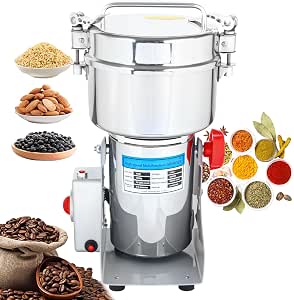
550g Capacity Grain Mill, 2000W Stainless Steel Grain Grinder for Flour, Wheat, Rice, Corn, Coffee, Spices
For home bakers who want a compact mill that can handle more than wheat, this model pairs a 550g capacity with a stated 70–300 mesh range for different grind textures. Its 2000W, 28,000 RPM motor is geared toward fast processing, while the stainless steel body suits a kitchen tool used for dry grains and other ingredients. Compared with the NutriMill Harvest, which uses corundum stones for a more traditional flour-milling approach, this mill offers broader stated texture adjustment but is also presented as a grinder for coffee and spices. The tradeoff is batch size: 550g is limiting if you bake several loaves at once. It is also described as noisy, and its high-speed operation calls for careful handling to avoid spills.
Pros:- 550g capacity accommodates a useful home-sized batch.
- Stated 70–300 mesh adjustment offers a range of textures.
- 304 stainless steel construction.
- Can process grains as well as coffee and spices.
Cons:- Capacity is restrictive for repeated or large baking batches.
- High-RPM operation can be noisy.
- Requires careful handling to avoid spills.
Best for: Home bakers who make modest batches and want one high-speed grinder for grains, coffee, and spices with adjustable texture.
Not ideal for: Frequent large-batch bakers or anyone seeking a quieter, stone-milling style machine; its 550g capacity limits throughput and the high-speed motor is noisy.
- Capacity:550g
- Motor power:2000W
- Motor speed:28,000 RPM
- Material:304 stainless steel
- Mesh range:70–300 mesh
- Dimensions:7.87 × 7.87 × 14.57 inches
- Color:Silver
Our verdict“Choose this mill for adjustable, fast grinding in modest batches, but pick a larger-capacity model if you regularly bake at scale.”
NutriMill Harvest Electric Stone Grain Mill, 450 Watt – White
The Harvest takes a different route from the high-speed stainless steel grinders in this group: its corundum stones and adjustable texture control are aimed at turning grains, beans, and legumes into flour for regular home baking. That makes it a more baking-focused choice than the 550g, 2000W grinder, which also targets coffee and spices and specifies a mesh range. Its 450-watt motor is described as heavy-duty, and the aluminum-and-bamboo design brings a less industrial look to the counter. The available details do not state a batch capacity or a specific grind range, so buyers who need quantified throughput or a precise fineness range may prefer the HORUS 750g mill. Noise is a stated drawback, and the white finish is the only listed color.
Pros:- Corundum stones are suited to milling a variety of grains, beans, and legumes.
- Adjustable texture control supports different flour preferences.
- Designed for regular home use with a heavy-duty 450-watt motor.
- Bamboo details give it a less industrial kitchen appearance.
Cons:- No capacity or numerical grind-range specification is provided here.
- May be noisy during operation.
- Only white is listed as a color option.
Best for: Home bakers who regularly mill varied grains, beans, or legumes into flour and prefer stone milling over a multipurpose blade-style grinder.
Not ideal for: Buyers who need a stated batch capacity, precise mesh specifications, or a grinder for broad ingredient use such as coffee and spices.
- Power:450 watts
- Motor type:Heavy-duty
- Stone material:Corundum
- Other materials:Aluminum and bamboo
- Color:White
- Texture control:Adjustable
- Warranty:See product details
Our verdict“Pick the Harvest if flour from varied grains is your main goal and stone milling matters more than a stated capacity or multipurpose grinding.”
Electric Grain Mill 750g for Wheat, Rice, Corn, Herbs, Spices
With a 750g capacity and a stated 30–300 mesh range, the HORUS 75AMN offers more batch room and a wider listed fineness span than the 550g, 2000W mill. For bakers who want to process dry wheat, rice, or corn alongside herbs and spices, its stainless steel crush chamber and 1800W motor make it a versatile high-speed option. The lid lock and overheating protection add useful safeguards, while included spare blades and accessories may help with upkeep. This is still a dry-food grinder, not a mill for moist ingredients, and the product information calls for careful cleaning without immersion. At 6.5 pounds it is less convenient to move around than its compact dimensions might suggest.
Pros:- 750g capacity is larger than the 550g mill in this lineup.
- Stated 30–300 mesh range provides broad fineness adjustment.
- Lid lock and overheating protection are included.
- Accessories include spare blades and a cleaning brush.
Cons:- Limited to dry, oil-free foods.
- At 6.5 pounds, it is not especially portable.
- Cleaning requires care and the unit must not be immersed in water.
Best for: Home bakers who want a larger dry-grain batch capacity, adjustable fineness, and safety features for regular countertop grinding.
Not ideal for: Bakers who need to grind moist or oily ingredients, want a lightweight portable mill, or prefer simple cleanup with water.
- Brand:HORUS
- Model:75AMN
- Capacity:750g
- Wattage:1800W
- Voltage:110V
- Fineness range:30–300 mesh
- Weight:6.5 pounds
- Dimensions:7.3 × 6.3 × 14.17 inches
- Safety features:Lid lock and overheating protection
Our verdict“Choose the HORUS for larger adjustable batches and built-in safeguards, provided your ingredients are dry and you are comfortable with careful cleaning.”
750g Grain Mill, 304 Stainless Steel Spice Grinder, 2800W High-Speed Commercial Flour Mill for Home Use
This 750g mill is the power-focused pick in this batch, with a stated 2800W motor, timer control, and adjustable fineness. Its capacity matches the HORUS 75AMN, but the supplied details give no numerical mesh range or named safety features, making the HORUS easier to evaluate for buyers who want documented grind adjustment and safeguards. The stainless steel construction and ability to process dried grains, herbs, spices, and coffee suit households that want one machine for several dry ingredients. For baking, the main appeal is fast processing rather than a stone-milled flour profile like the NutriMill Harvest. This is a high-speed tool with real limits: it is intended for dry materials, may be noisy, and the description cautions against handling that could damage the motor.
Pros:- 750g capacity matches the larger batch size of the HORUS mill.
- Stated 2800W motor is the highest power rating among these five products.
- Timer and adjustable fineness controls are listed.
- 304 stainless steel body suits processing a range of dried ingredients.
Cons:- Limited to dry materials.
- May be noisy during operation.
- Product details warn that careless handling can damage the motor.
Best for: Home bakers who prioritize high stated motor power, timer control, and a 750g batch size for dry grains and other ingredients.
Not ideal for: Buyers who want a documented mesh range, stone milling, or a clearly specified set of safety features and quiet operation.
- Capacity:750g
- Material:304 stainless steel
- Wattage:2800W
- Voltage:110V
- Dimensions:8.3 × 8.3 × 14 inches
- Weight:750g (as listed)
- Fineness control:Adjustable
- Timer:Included
Our verdict“Choose this model if high stated power and timer control matter most, but favor the HORUS if you want a stated mesh range and listed safety protections.”
High-Speed Electric Grain Grinder 150g Stainless Steel 850W for Spices, Herbs, and Coffee Beans
At just 150g capacity, this is the small-batch specialist rather than a primary mill for frequent bread baking. Its 850W motor and stated 70–300 mesh range give it flexibility for small quantities of grain, alongside spices, herbs, and coffee. Compared with the 750g HORUS 75AMN, it holds far less per run, but that smaller capacity can suit occasional specialty-flour experiments or a kitchen where storage space matters. The stainless steel body and multiple blades support varied dry ingredients, though the listed dimensions are unusually broad for a compact-capacity grinder, so buyers should check their available counter or storage space. Its operating limit is explicit: up to eight minutes, followed by a five-minute rest, and cleaning is by damp cloth rather than washing with water.
Pros:- Small capacity suits occasional, measured batches.
- Stated 70–300 mesh range allows varied grind fineness.
- 850W motor and multiple blades support several dry ingredients.
- Stainless steel construction.
Cons:- 150g capacity is far below the 750g HORUS mill for baking batches.
- Operation is limited to eight minutes, followed by a five-minute rest.
- Cleaning requires wiping with a damp cloth rather than rinsing with water.
Best for: Bakers who mill small quantities of specialty grains or ingredients occasionally and also want a grinder for herbs, spices, and coffee.
Not ideal for: People baking bread in repeated or large batches; the 150g capacity and required rest intervals make it slower for substantial flour needs.
- Capacity:150g
- Power:850W
- Speed:27,000 RPM
- Grinding fineness:70–300 mesh
- Material:Stainless steel
- Voltage:110V
- Dimensions:16 × 16 × 5 inches
- Use time:Up to 8 minutes, followed by 5-minute rest intervals
Our verdict“Pick this grinder for occasional small-batch flour and ingredient grinding, not as the main mill for regular multi-loaf baking.”
All Metal Grain Mill Attachment for Kitchenaid Stand Mixer, 12-Level Flour Grinder for Home Use
For home bakers who already own a KitchenAid, this attachment offers a way to mill grains without adding a separate motorized appliance. Its 12 grind levels provide more texture choices than a basic coarse-or-fine setting, useful when you want to adjust flour for different baking needs. The metal construction and compact footprint also make it easier to store than the larger VEVOR Electric Grain Mill Grinder. The tradeoff is that the mixer does the driving: buyers without a compatible stand mixer must factor in another appliance, and this attachment is limited to low-oil, low-moisture grains. Unlike the enclosed high-speed mills in this roundup, it also calls for manual brush cleaning and cannot go in the dishwasher. I’d choose it for mixer owners who value a compact add-on over a standalone grinder.
Pros:- 12 grind levels allow adjustments from coarse to fine
- Metal construction suits regular dry-grain milling
- Compact attachment format takes less storage space than a standalone mill
- Included brush supports manual cleanup
Cons:- Requires a separately purchased KitchenAid stand mixer
- Not dishwasher safe, so cleanup requires brushing and manual care
- Restricted to low-oil, low-moisture grains
Best for: Home bakers who already own a KitchenAid stand mixer and want adjustable flour texture without storing a separate powered mill.
Not ideal for: Bakers without a compatible KitchenAid mixer, or anyone who needs to mill oily, moist, or sticky ingredients.
- Material:Metal
- Compatibility:KitchenAid stand mixers
- Grind levels:12
- Weight:1.72 kg
- Dimensions:4.3 × 8.2 × 4.3 in
- Included component:Grain mill attachment
- Model number:MV-KAGWYM-0002
Our verdict“Choose this attachment if you already own a KitchenAid and want a compact, adjustable mill for dry grains; skip it if you need a standalone machine.”
550g Grain Mill, 304 Stainless Steel Spice Grinder, 2000W High-Speed Commercial Flour Mill for Home Use
This mill suits bakers who prepare flour in modest batches and want one appliance for other dry ingredients as well. Its 550 g capacity is smaller than the VEVOR Electric Grain Mill Grinder’s 1.8 lb chamber, so it is a less convenient choice for stocking up or baking several large loaves at once. In return, its narrower footprint takes up less counter space, and the stainless-steel body supports use with grains, spices, herbs, and coffee beans. A 2000W motor and timer-based fineness control give buyers a way to tailor grind time, though they also require care: the product data warns against overheating the motor. Cleanup is by wiping rather than rinsing, which asks more of the user than the advertised easy-operation framing might suggest. I’d pick it for flexible, smaller dry batches—not continuous milling.
Pros:- 550 g chamber fits smaller household batches
- Stainless-steel construction supports grinding a range of dry ingredients
- Timer control gives users a way to adjust grind fineness
- Compact 5.5-inch square footprint is easier to place than larger-capacity models
Cons:- Limited capacity makes large baking batches slower to prepare
- Motor needs careful operation to avoid overheating
- Cleaning requires wiping rather than rinsing with water
Best for: Home bakers who mill flour in small batches and also want a compact dry-ingredient grinder for coffee, herbs, or spices.
Not ideal for: Households that regularly need several pounds of flour at a time, or users who want to rinse mill parts under water.
- Material:Stainless steel
- Power:2000 W
- Capacity:550 g
- Voltage:110 V
- Dimensions:5.5 × 5.5 × 14 in
- Weight:7.7 lb
- Color:Silver
Our verdict“Choose this mill for small, varied dry-grinding jobs; choose the larger VEVOR model if you need more flour per batch.”
VEVOR Electric Grain Mill Grinder, 1.8 lbs, 2100W Stainless Steel Pulverizer for Dry Grains and Spices
The VEVOR is a practical middle ground for bakers who want more room per batch than a 550 g grinder but do not need the 3000 g capacity of the 3600W Grain Mill. Its 1.8 lb capacity helps reduce repeat runs for everyday baking, while the 2100W motor and adjustable timing are designed for fast processing of dry grains and spices. The included sieve and cleaning tools add useful flexibility, though the product data does not specify a range of grind settings comparable to the KitchenAid attachment’s 12 levels. This is a standalone machine, so it does not depend on a mixer, but its dry-ingredient-only limitation rules out wet, oily, or sticky materials. The listed 9.3 lb weight and potential operating noise also make it less appealing for kitchens where frequent moving or quiet use matters.
Pros:- 1.8 lb capacity handles more per batch than the 550 g mill
- 2100 W motor is built for fast dry-grain grinding
- Adjustable timing gives control over processing duration
- Includes a sieve and maintenance tools
Cons:- Suitable only for dry ingredients, not wet, oily, or sticky materials
- May be loud during operation
- At 9.3 lb, it is less convenient to move than a compact attachment
Best for: Home bakers who want a standalone mill with more batch capacity than a small grinder, without stepping up to a very large chamber.
Not ideal for: Bakers who need wet or oily ingredients processed, or who prioritize quiet operation and a lightweight appliance.
- Brand:VEVOR
- Model number:HC-800Y
- Housing and blade materials:430 stainless steel housing; 3Cr13 blades
- Power:2100 W
- Capacity:1.8 lb
- Voltage:110 V
- Weight:9.3 lb
- Dimensions:8.66 × 7.48 × 14.76 in
- Included components:Electric grinder, blade, carbon brush, sieve, socket wrench, and user manual
Our verdict“Choose the VEVOR for a standalone mill with useful everyday capacity; pick the 3000 g model only if you regularly need much larger batches.”
3000G Grain Mill, 3600W Electric Flour Grinder for Home and Commercial Use
For bakers who want to mill flour in substantial quantities, this model’s 3000 g capacity sets it apart from the VEVOR’s 1.8 lb chamber and the 1000 g grinder in this lineup. That larger chamber can reduce the number of runs needed when preparing flour for multiple loaves or a small baking operation. The 3600W motor, 36,000 RPM speed, and stated 30–300 mesh range point toward fine-powder processing, while the 270° swing design is intended to support even grinding. Those capabilities come with a more demanding operating routine: the mill handles only dry, non-oily ingredients and requires care to prevent overheating. Its power and capacity make less sense for occasional small recipes, where a lower-capacity unit is easier to justify and manage.
Pros:- 3000 g capacity reduces repeat runs for large flour batches
- 3600 W motor and 36,000 RPM speed are specified for rapid grinding
- 30–300 mesh range supports a choice of particle fineness
- Overload protection adds a stated safety feature
Cons:- Dry, non-oily ingredients only
- Requires careful operation to avoid overheating
- Large capacity and power may be unnecessary for occasional small-batch baking
Best for: Frequent bread bakers and small-scale baking operations that need to mill large batches of dry grain at once.
Not ideal for: Occasional home bakers who process small amounts, or anyone needing to grind wet, oily, or sticky ingredients.
- Capacity:3000 g (6.6 lb)
- Power:3600 W
- Speed:36,000 RPM
- Mesh range:30–300 mesh
- Material:Stainless steel
- Swing angle:270°
- Ingredient limitation:Dry, non-oily ingredients
Our verdict“Choose this mill when large, frequent dry-grain batches matter more than a compact footprint or small-batch convenience.”
1000g Commercial Grain Grinder, 3000W Electric Grain Mill with 32,000 RPM Motor, Stainless Steel Spice Pulverizer for Coffee, Grains, Spices, Nuts & Herbs
This grinder is a useful fit for bakers who want a more tailored grind without moving to the 3000 g chamber of the 3600W Grain Mill. Its 1000 g capacity offers a middle option between the small 550 g mill and larger batch machines, while the stated 70–300 mesh adjustment gives a broad range for choosing finer or coarser output. The 3000W, 32,000 RPM motor is designed for fast processing, but high power does not remove the need to run it carefully; the product data limits use to dry ingredients and flags overheating as a concern for comparable high-speed mills. Unlike the KitchenAid attachment, this is a standalone machine, but it is less suited to buyers who want a quiet, low-maintenance appliance or need to grind moist, oily, or sticky foods.
Pros:- 1000 g chamber offers more capacity than the 550 g grinder
- 70–300 mesh adjustment allows a broad range of grind textures
- 3000 W motor and 32,000 RPM speed are designed for rapid processing
- Stainless-steel chamber suits dry grains and other listed ingredients
Cons:- Limited to dry ingredients and unsuitable for wet or oily materials
- High motor power can mean greater electricity use
- High-speed operation calls for careful use to manage heat
Best for: Home bakers who want a standalone mill with adjustable mesh settings and a batch size suited to regular, moderate-volume baking.
Not ideal for: Bakers who need to process wet or oily ingredients, or who prefer a low-power mill for occasional, quiet use.
- Motor power:3000 W
- Speed:32,000 RPM
- Capacity:1000 g
- Material:Stainless steel
- Mesh adjustment:70–300 mesh
- Voltage:110 V
- Ingredient limitation:Dry ingredients only
Our verdict“Choose this model if adjustable mesh and a moderate batch size matter more than low power use or the capacity of the 3000 g mill.”
High-Speed Stainless Steel Grain Mill, 150g Capacity – Electric Grinder for Seeds, Flour, Nuts, Wheat, Corn, Herbs, Spices & Seasonings
The LEJIEYIN is the most compact-batch option here: its 150 g capacity suits a little flour for a recipe or occasional spice grinding, not a bread-baking production run. Its 900 W motor and three-blade setup are specified to produce fine powder quickly, while overload protection adds a practical safeguard. Compared with the much larger NutriMill Impact Compact, this is aimed at small quantities of dry ingredients rather than repeated flour batches for regular baking. That speed has limits: the mill needs a 5–10 minute rest after every three minutes of operation, and the bowl must be cleaned without rinsing. It also handles only dry materials, so oily or wet ingredients are out. I’d choose it for occasional, measured batches—not as a primary mill for a household baking mostly with freshly milled flour.
Pros:- 150 g capacity fits small recipe batches and takes up less space than large-batch mills.
- 900 W motor and triple-blade system are specified for fast grinding to a fine texture.
- Automatic overload shutoff provides a safety measure during operation.
- Food-grade stainless steel construction with UL, FCC, and CE certifications.
Cons:- Small capacity makes it inefficient for milling flour for several loaves or regular batch baking.
- Requires a 5–10 minute rest after each three minutes of operation.
- Dry-cloth-only cleaning and dry-ingredient restrictions limit convenience and versatility.
Best for: Home cooks who need small, occasional batches of dry grain or spice powder and have no need to mill flour continuously.
Not ideal for: Frequent bread bakers or anyone who needs larger batches, wet milling, or easy water-based cleanup.
- Power:900 W
- Capacity:150 g
- Rotating speed:22,000 RPM
- Mesh size range:50–300 mesh
- Blade types:Grinding blade, rotary blade, powder removal blade
- Material:Food-grade stainless steel
- Certifications:UL, FCC, CE
- Warranty:1 year
- Model number:MODEL-150
Our verdict“Choose the LEJIEYIN for occasional small batches of dry ingredients, but pick the NutriMill Impact Compact for frequent home-baking flour needs.”
1000g Grain Mill, 304 Stainless Steel Spice Grinder, 3000W High-Speed Commercial Flour Mill for Home Use
This 1000 g mill is a better match than the LEJIEYIN 150 g grinder when a baking session calls for a substantial quantity of flour at once. Its stated 70–300 mesh range and timer control give buyers a way to tailor grinding runs, while the 304 stainless steel body is built for dry grains and other dry ingredients. The 30,000 rpm motor and large stated capacity point toward batch processing rather than the smaller, recipe-sized use of compact grinders. The tradeoff is that the product data warns against extended operation because of overheating risk; high power does not mean uninterrupted milling. It also requires wipe-down cleaning instead of rinsing and cannot process wet ingredients. I’d shortlist it for bakers who value capacity and control, but not for anyone seeking a low-maintenance flour mill for repeated, long sessions.
Pros:- 1,000 g capacity can handle larger batches than the 150 g LEJIEYIN.
- Adjustable fineness from 70 to 300 mesh supports different dry-grinding needs.
- Timer control helps set a repeatable grinding run.
- 304 stainless steel construction is specified for dry grains, herbs, spices, and coffee beans.
Cons:- Extended use can cause overheating, so long milling sessions need care.
- Dry-only operation rules out wet ingredients.
- Wipe-only cleaning is less convenient than a rinseable design.
Best for: Home bakers who mill sizable dry-grain batches and want adjustable fineness and timed operation.
Not ideal for: Bakers who need continuous milling, wet processing, or a mill that can be rinsed clean after use.
- Capacity:1,000 g
- Power:3,000 W
- Rotation speed:30,000 rpm
- Mesh fineness:70–300 mesh
- Material:304 stainless steel
- Dimensions:9 × 9 × 14.2 in
- Voltage:110 V
Our verdict“Choose this model over a small-capacity grinder when you want adjustable fineness for larger dry batches and can work within its rest and cleaning limits.”
Victoria Manual Cast Iron Grain Mill 2400g with High Hopper
The Victoria takes a different path from the high-speed electric mills in this roundup: it uses a manual cast-iron mechanism and offers adjustable coarseness, making it suited to coarse meal and hands-on grinding rather than fine bread flour. Its stated 2,400 g capacity is larger than the LEJIEYIN’s, but that figure does not remove the effort involved in turning a manual mill through a large batch. A clamp that fits tables from 1/2 to 2 inches thick gives it a stable setup where compatible work surfaces are available. Compared with the NutriMill Impact Compact, Victoria is less convenient for finely milled flour but avoids reliance on an electric motor. The main limit is texture: the product data says it cannot produce superfine or powdery results. I’d choose it for coarse grains, brewing, or occasional manual use, not for fine-flour home baking.
Pros:- Manual operation avoids dependence on an electric motor.
- Adjustable coarseness supports different coarse-grinding uses.
- Cast-iron construction is designed for durable, stable use.
- Clamp fits tables from 1/2 to 2 inches thick, with high or low hopper options.
Cons:- Cannot grind to superfine or powdery flour suitable for many baking recipes.
- Manual cranking can become tiring when processing larger quantities.
- The 90-day limited warranty is shorter than the one-year coverage listed for the LEJIEYIN.
Best for: Bakers and home brewers who want manual control for coarse grain or meal and have a sturdy compatible table.
Not ideal for: Bread bakers who need fine, consistent flour or anyone who wants to process large quantities without physical effort.
- Capacity:2,400 g
- Material:Cast iron
- Hopper options:High or low
- Clamp thickness:1/2–2 in
- Discs:White iron, erosion-resistant
- Operation:Manual
- Warranty:90-day limited
Our verdict“Pick the Victoria for manual coarse grinding and brewing, but choose an electric flour mill such as the NutriMill Impact Compact for fine flour used in regular baking.”
NutriMill Impact Compact High-Speed Electric Grain Mill with Stainless Steel Milling Heads
For regular home baking, the NutriMill is the clearest fit in this group: it is described as milling hard grains such as wheat into fine flour, and its 8-cup hopper and 12-cup flour canister support more than occasional teaspoon-sized batches. That makes it a more direct flour-making choice than the Victoria manual mill, which is limited to coarse textures, and more baking-focused than the small LEJIEYIN grinder. The 1,200 W motor and stainless steel milling heads are paired with a canister, lid, and air filter, so the setup is designed around collecting flour as it is milled. Its compact design still does not make it tiny: the product data flags bulk as a concern for small kitchens. Capacity is listed as 20 cups, while the included hopper and canister have separate cup figures. I’d favor it for repeat baking if storage space is available.
Pros:- Designed to grind hard grains such as wheat into fine flour for baking.
- 8-cup grain hopper and 12-cup flour canister suit repeated baking sessions.
- 1,200 W motor and stainless steel milling heads support grain milling.
- Includes an air filter, canister, canister lid, hopper, and motor base.
Cons:- Can be bulky for kitchens with limited counter or storage space.
- The 20-cup capacity listing and separate hopper and canister measurements may make usable batch capacity less clear.
- A dedicated grain mill may be more machine than occasional bakers need.
Best for: Frequent home bakers who mill hard wheat into fine flour and want a dedicated hopper-and-canister setup.
Not ideal for: Small-kitchen users with very limited storage or buyers who only need occasional, very small quantities of ground ingredients.
- Motor power:1,200 W
- Capacity:20 cups
- Grain hopper:8 cups
- Flour canister:12 cups
- Milling heads:Stainless steel
- Color:White
- Included components:Air filter, canister, canister lid, hopper, motor base
- Model number:790700
Our verdict“Choose the NutriMill Impact Compact if you bake often and want a dedicated fine-flour mill, provided you have room to store it.”
2000g Stainless Steel Grain Mill with 3600W High-Speed Motor
With a stated 2,000 g capacity, this is the largest-batch choice among the five products here, ahead of the 1,000 g grinder and the 150 g LEJIEYIN. Its adjustable 70–300 mesh range gives more control over the fineness of dry ingredients, and the 32,000 rpm motor is specified for grains, spices, herbs, and coffee beans. For home baking, the capacity could suit a baker preparing flour for multiple recipes, but the product data describes a general-purpose pulverizer rather than a flour-specific mill with a dedicated flour canister like the NutriMill Impact Compact. That distinction matters if contained flour collection is part of your routine. Overheating precautions, dry-only use, and wipe-only cleaning also temper the headline power. I’d consider it for high-volume dry milling, not for anyone expecting wet processing or hands-off, continuous operation.
Pros:- 2,000 g capacity is larger than the 1,000 g grinder and suits bigger dry batches.
- Adjustable 70–300 mesh fineness allows a range of powder textures.
- 32,000 rpm motor is specified for grinding dry grains, herbs, spices, and coffee beans.
- Stainless steel construction and a listed 110 V supply suit home use.
Cons:- Requires care to avoid overheating during extended operation.
- Not suitable for wet ingredients.
- Wipe-only cleaning is less convenient than rinsing, and no dedicated flour canister is listed.
Best for: High-volume home bakers who want to mill large batches of dry grains and adjust the grind fineness.
Not ideal for: Bakers who need wet milling, simple rinsing, or a dedicated flour canister and straightforward continuous-use workflow.
- Capacity:2,000 g
- Motor power:3,600 W
- Rotation speed:32,000 rpm
- Fineness range:70–300 mesh
- Material:Stainless steel
- Dimensions:9.8 × 9.8 × 14.2 in
- Voltage:110 V
Our verdict“Choose this mill for large, adjustable dry-grain batches, but favor the NutriMill Impact Compact if a dedicated flour-collection setup matters more than capacity.”

How We Picked
I ranked these grain mills for home baking by how clearly their design and stated capacity support turning dry grains into flour for real baking batches. I gave more weight to milling style, usable batch size, and a clear home-baking role than to headline wattage alone: a high-speed motor rating does not establish flour texture, sustained performance, or suitability for repeated batches. I also considered ease of operation, the space a dedicated appliance occupies, and whether the mill can serve other kitchen tasks.
The NutriMill Harvest leads because its stone-mill format is the most directly suited to routine flour making among these choices. The NutriMill Impact Compact and KitchenAid attachment follow for buyers who value a compact electric workflow or already own the mixer. High-capacity stainless-steel grinders rank as flexible alternatives, but their broad spice-and-grain positioning makes them harder to distinguish as dedicated baking mills. Small 150g grinders and the manual Victoria mill have useful niche roles, yet their batch size or effort makes them less suitable as a first choice for frequent home baking.
Factors to Consider When Choosing Grain Mills For Home Baking
Before choosing a mill, decide how it will fit into your baking routine: what grains you use, how much flour a recipe needs, and how often you want to mill. The following factors help separate a dedicated flour mill from a general-purpose grinder and prevent a large motor rating or capacity figure from standing in for the details that matter.
Match the Milling Method to Your Flour Goals
Stone mills and high-speed impact or pulverizing grinders process grain differently, so begin with the flour you want to bake with rather than the motor label. A dedicated stone mill may suit bakers who plan to mill flour regularly and want a mill designed around that task. A multipurpose steel grinder may appeal if you also want to process spices or other dry ingredients, but its broad use claims do not tell you how consistent its flour will be. Check the manufacturer’s guidance for grain types, texture settings, and continuous run limits. If a listing does not explain those points, treat its flour suitability as uncertain rather than assuming that a larger wattage means finer flour. Match the tool to your recipes and be ready to sift or adjust hydration as you learn how freshly milled flour behaves.
Calculate Batch Size From Your Recipes
Capacity labels are most useful when compared with the amount of grain you mill for a typical recipe. A 150g grinder is better suited to small amounts than to producing flour for several loaves, while a larger hopper can reduce the number of repeat batches. Do not assume that a stated maximum capacity equals the amount you should process at once; operating instructions may set lower limits or require pauses between runs. Think through your weekly routine: a small household baking one loaf at a time may prefer manageable batches, while frequent batch baking benefits from fewer refills. Also check whether the mill can handle the grains you use, since capacity alone says nothing about grain compatibility. Leave room for a practical margin rather than planning every bake around a full hopper.
Treat Wattage and RPM as Incomplete Evidence
Listings in this group advertise motors from hundreds to several thousand watts, and some also state a high RPM figure. Those numbers may describe electrical input or motor speed, but they do not independently establish flour fineness, output per minute, or durability under repeated use. Look for clear instructions on run time, cooling pauses, and suitable grain types before choosing a model for frequent baking. A lower headline specification on a dedicated mill can be a better match than a larger number on a grinder primarily described for spices. If performance details are sparse, avoid paying extra based on a number alone. Prioritize the design and operating information that connect directly to your baking needs.
Plan for Counter Space, Noise, and Cleanup
A dedicated electric mill can streamline regular baking, but it also needs storage or counter space and may be noisy while running. Compact units and mixer attachments can make more sense in a small kitchen, though an attachment still requires setup and a compatible stand mixer. Before buying, check how the mill opens, whether its milling parts can be cleaned easily, and whether the manufacturer permits washing or only dry cleaning. Flour dust can spread during transfer, so consider where you will mill and how you will catch the output. A unit that is awkward to clean or store may end up being used less often than a simpler option. Think about the whole routine, from grain storage to flour transfer, not only the time the motor runs.
Choose Between a Dedicated Mill, Attachment, and Manual Design
A dedicated electric mill is the most direct path for frequent flour making because it does not depend on another appliance. A KitchenAid attachment can conserve storage and make sense for someone who already owns a compatible mixer, but it ties milling to that mixer’s setup and operating guidance. A manual cast-iron mill avoids reliance on a motor and can appeal to buyers who prefer hand operation, yet milling takes physical effort and time. These formats are not interchangeable: a manual grinder may be a poor match for large weekly batches, while an attachment may add little value if you do not own the required mixer. Consider how many batches you expect to mill and whether you want a dedicated appliance before choosing a format. This helps prevent buying a compact or manual option that cannot keep pace with your baking routine.
Check Grain Compatibility Before Buying
Not every mill handles every grain or ingredient, even when a listing names wheat, rice, corn, herbs, coffee, or spices. Verify that the manufacturer specifically permits the grains you plan to use, especially if you bake with oily seeds, nuts, or ingredients that may clog a mill designed for dry grain. Mixing grain milling and spice grinding can also leave aromas behind, which matters if you want neutral-tasting flour for bread or pastries. Review cleaning instructions and any restrictions on damp or oily ingredients before treating a multipurpose claim as a benefit. Buyers who mainly bake with wheat may favor a focused flour mill, while cooks seeking one tool for occasional dry ingredients may accept more compromises. Compatibility checks matter more than a long ingredient list on a product page.
Frequently Asked Questions
Is a high-wattage spice grinder a good substitute for a grain mill?
It can be a practical option for occasional small batches if the manufacturer explicitly permits milling the grains you use. High wattage by itself does not show that a grinder produces consistent flour or can run repeatedly without cooling breaks. Many grinders in this roundup are marketed for spices as well as grains, so compare their instructions and capacity with a dedicated mill such as the NutriMill Harvest. A small chamber can also make flour production slow when a recipe calls for a larger quantity. For regular bread baking, choose based on milling design and operating guidance, not the wattage figure alone.
How much grain capacity do I need for baking bread at home?
Start with the amount of flour your usual recipe requires, then check whether the mill’s stated capacity refers to grain loaded at one time or finished flour output. Small 150g models are likely to require repeated batches for a typical bread-making session, while the larger-capacity options can reduce refills if their instructions support the grain and run time you need. Do not treat a maximum capacity as a recommended continuous workload without checking the manual. If you bake only occasionally, a smaller mill may be easier to store and adequate for your routine. Frequent multi-loaf baking makes batch capacity and permitted run time more important.
Should I choose a stone mill or a stainless-steel pulverizer?
Choose by intended use and the product’s stated milling process, not by material alone. The NutriMill Harvest is positioned as a stone grain mill, making it the more direct fit here for buyers focused on regular flour production. Stainless-steel pulverizers in this lineup often emphasize multipurpose grinding and high-speed operation, which may suit cooks who also want to process spices. Their listings do not all provide the same detail about flour texture or sustained use, so verify those points before buying. If you need a mill for frequent baking, a clearly described flour-milling design is a safer basis for comparison than a steel construction claim.
Can a KitchenAid grain mill attachment handle all my home baking?
It may suit a baker who already owns a compatible KitchenAid stand mixer and mills moderate quantities, but the attachment depends on the mixer and its instructions. Check which grains it supports, the available flour settings, and any limits on batch size or operating time. A dedicated electric mill is a more self-contained choice if you mill often or prefer not to set up the mixer each time. The attachment can save storage space, but it does not remove the need to plan for flour collection and cleanup. Compare the convenience of using equipment you already own with the throughput and workflow of a dedicated mill.
Is a manual grain mill practical if I bake every week?
A manual mill can work for weekly baking if you are comfortable with the effort and time required to produce each batch. The Victoria cast-iron model offers a non-electric route, but a large hopper does not make hand milling effortless. It may suit buyers who value manual operation, want to avoid an electric appliance, or only need modest amounts at a time. For repeated larger batches, an electric mill is likely to fit the routine better. Check the mill’s grain compatibility and adjustment range, then compare the physical work with how much flour your recipes use.
Conclusion
For most people seeking grain mills for home baking, I recommend the NutriMill Harvest as the best overall because its stone-mill format is the clearest match for regular flour making in this lineup. For a more compact electric option, the NutriMill Impact Compact is a better fit for buyers who want a dedicated mill but need to conserve space. I would choose the KitchenAid attachment as the best value for existing mixer owners, since it uses equipment already in the kitchen; it is less compelling if you need a standalone mill. Beginners who expect to bake regularly should start with a dedicated mill whose grain guidance and operating instructions are clear, rather than selecting by wattage alone. For larger batches, compare the high-capacity VEVOR and stainless-steel models against their stated run limits; for manual, non-electric milling, the Victoria is the specific-use pick. The right choice comes down to batch size, milling frequency, and whether flour making or multipurpose grinding matters most.