A baby breathing monitor can track movement or related signals, but the products in this roundup use different approaches and are not interchangeable. My best overall pick is the Owlet Dream Sock Smart Baby Monitor for families who want wearable tracking and app-based information; the Babysense 7 is a strong alternative for those who prefer non-wearable sensor pads and no Wi-Fi. For a compact, portable option, the Snuza Hero clips to a diaper and works without cords or Wi-Fi. The main tradeoffs are wearable comfort versus mattress-based setup, portability versus coverage, and connected features versus simpler operation. These monitors are not substitutes for safe-sleep practices or medical care. Continue reading for the full comparison and guidance on choosing a setup that fits your household.

Turn the school run and nap time into listening time
- Thousands of audiobooks, podcasts and originals
- Listen on your phone, tablet or Echo — also offline
- Cancel anytime
Complete the kit


Key Takeaways
- Monitoring method is the biggest dividing line: the lineup includes wearable socks, diaper clips, and under-mattress sensor pads, each suited to a different sleep setup.
- The Owlet Dream Sock is the most connected option: it pairs wearable monitoring with app-based information, while the Babysense 7 favors a non-wearable, no-Wi-Fi approach.
- Portability comes with a narrower setup: the Snuza Hero and Levana Oma Sense attach to a diaper, making them easier to move between sleep spaces than sensor pads.
- The Owlet Dream Duo adds camera monitoring: its 2K HD camera broadens the system beyond movement tracking, but families seeking only a breathing-related monitor may not need that extra component.
- Several listings are variations of the Dream Sock: compare the exact package and included services rather than treating repeated product names as distinct monitoring methods.
| Owlet Dream Sock Smart Baby Monitor with 3 Months of Owlet 360 |  | Best for Connected Vital-Sign Tracking | Monitoring: Pulse rate and oxygen levels | Age range: 1–18 months | Weight range: 6–30 lbs | VIEW ON AMAZON | See Our Full Breakdown |
| BabySmile Baby Movement Monitor for Newborn Sleep, Diaper Clip |  | Best for Simple Portable Movement Alerts | Model: E-202 | Monitoring: Abdominal movement | Alarm trigger: No movement sensed for 20 seconds | VIEW ON AMAZON | See Our Full Breakdown |
| Owlet Dream Sock Smart Baby Monitor |  | Best for Sleep-Trend Insights | Monitoring: Pulse rate and oxygen levels | Age range: 1–18 months | Baby weight range: 6–30 lbs | VIEW ON AMAZON | See Our Full Breakdown |
| Levana Oma Sense Portable Baby Breathing Movement Monitor with Vibrations and Audible Alerts |  | Best for No-Connectivity Monitoring | Monitoring type: Abdominal movement | Age range: 0–6 months | Contact: No direct skin contact | VIEW ON AMAZON | See Our Full Breakdown |
| Babysense 7 Baby Movement Monitor System with 2 Sensor Pads, Non-Wearable, No WiFi |  | Best Non-Wearable Crib Monitor | Sensor pads: 2 | Monitoring type: Under-mattress movement | Connectivity: Non-Wi-Fi | VIEW ON AMAZON | See Our Full Breakdown |
| Owlet Dream Duo 3 Smart Baby Monitor System, Dream Sock + 2K HD Camera |  | Best Complete Monitoring System | Monitoring system: Dream Sock + 2K HD Camera | Video quality: 2K HD | Camera lens: 130-degree wide-angle | VIEW ON AMAZON | See Our Full Breakdown |
| Baby Movement Monitor – Sleep Monitor with Gentle Vibration Alerts |  | Best for Wi-Fi-Free Movement Alerts | Brand and model: BEMPU BBBV20 | Sensor type: Motion sensor | Alert method: Vibration followed by audible alarm | VIEW ON AMAZON | See Our Full Breakdown |
| Snuza Hero Baby Movement Monitor – Patented Sensor Technology, Portable, No WiFi or Cords |  | Best for Simple, Cord-Free Portability | Model: Snuza 10SUH23 | Sensor type: Activity sensor with direct-touch movement detection | Attachment: Diaper-mounted | VIEW ON AMAZON | See Our Full Breakdown |
| Owlet Dream Sock Smart Baby Monitor |  | Best for Pulse and Oxygen Tracking | Monitoring: Pulse rate and oxygen levels with preset-zone alerts | Suitable age: 1–18 months | Weight range: 6–30 lb | VIEW ON AMAZON | See Our Full Breakdown |
| Owlet Dream Sock Smart Baby Monitor, Better Sleep for Baby & You |  | Best for Sleep Trend Insights | Monitoring: Real-time pulse and oxygen tracking with preset-zone alerts | Age range: 1–18 months | Weight range: 6–30 lb | VIEW ON AMAZON | See Our Full Breakdown |
| WUUK BABY Smart Sock Monitor, Tracks Sleep & Movement, No Subscription |  | Best for Longer Battery Life | Brand: WUUK BABY | Monitoring: Sleep and movement tracking through a base station and mobile app | Battery life: Up to 7 days | VIEW ON AMAZON | See Our Full Breakdown |
| baby breathing monitor | Battery life | Connectivity | Monitoring |
|---|---|---|---|
| Owlet Dream Sock Smart Baby Mo | 16 hours | Bluetooth and 2.4 GHz Wi-Fi | Pulse rate and oxygen levels |
| BabySmile Baby Movement Monito | Approximately 6 months | — | Abdominal movement |
| Owlet Dream Sock Smart Baby Mo | Up to 16 hours | Bluetooth and 2.4 GHz Wi-Fi | Pulse rate and oxygen levels |
| Levana Oma Sense Portable Baby | — | No Wi-Fi, radio, or Bluetooth | — |
| Babysense 7 Baby Movement Moni | — | Non-Wi-Fi | — |
| Owlet Dream Duo 3 Smart Baby M | — | Dual-band Wi-Fi (2.4 GHz and 5 GHz) | — |
| Baby Movement Monitor | 56 hours average; up to 7 days typical use | Bluetooth; no Wi-Fi required | — |
| Snuza Hero Baby Movement Monit | Up to 6 months | — | — |
| Owlet Dream Sock Smart Baby Mo | 16 hours | Bluetooth and 2.4 GHz Wi-Fi | Pulse rate and oxygen levels with preset-zone alerts |
| Owlet Dream Sock Smart Baby Mo | Up to 16 hours | Bluetooth and 2.4 GHz Wi-Fi | Real-time pulse and oxygen tracking with preset-zone alerts |
| WUUK BABY Smart Sock Monitor | Up to 7 days | — | Sleep and movement tracking through a base station and mobile app |
More Details on Our Top Picks
Owlet Dream Sock Smart Baby Monitor with 3 Months of Owlet 360
For families who want more than movement detection, the Owlet Dream Sock tracks pulse rate and oxygen levels and sends alerts when readings move outside preset zones. That makes it a different kind of breathing-monitor option from the BabySmile Baby Movement Monitor, which detects abdominal movement but does not report those vital signs. The sock format also gives parents app-based readings and sleep trends, while its stated 16-hour battery life supports overnight use between charges. The tradeoff is a greater setup burden: this model needs Bluetooth and 2.4 GHz Wi-Fi, so it is less appealing if you want a stand-alone monitor like the Babysense 7. It is designed for healthy infants from 1 to 18 months, not as a medical monitor or a fit for every baby.
Pros:- Tracks pulse rate and oxygen levels with alerts for readings outside preset zones
- Sock format provides app-connected readings and sleep trend information
- Up to 16 hours of battery life per charge
- Supports iOS and Android with 256-bit data encryption
Cons:- Requires Bluetooth setup and 2.4 GHz Wi-Fi; 5 GHz Wi-Fi is not supported
- Limited to healthy infants aged 1–18 months and weighing 6–30 lbs
- A wearable and charging routine may be less convenient than the non-wearable Babysense 7
Best for: Caregivers of healthy infants aged 1–18 months who want app-connected pulse and oxygen readings alongside sleep trends.
Not ideal for: Families who need a monitor for a baby outside the stated age and weight range, use only 5 GHz Wi-Fi, or prefer a no-app setup.
- Monitoring:Pulse rate and oxygen levels
- Age range:1–18 months
- Weight range:6–30 lbs
- Battery life:16 hours
- Connectivity:Bluetooth and 2.4 GHz Wi-Fi
- App compatibility:iOS and Android
- Data security:256-bit encryption
Our verdict“Choose this Owlet if you want connected pulse and oxygen tracking for an eligible healthy infant and are comfortable with app and Wi-Fi setup.”
BabySmile Baby Movement Monitor for Newborn Sleep, Diaper Clip
The BabySmile diaper clip keeps breathing-related monitoring simple: it detects abdominal movement and sounds a local alarm if it senses no movement for 20 seconds. Unlike the Owlet Dream Sock, it does not track pulse or oxygen levels or depend on an app connection, which suits caregivers who want a focused movement alert rather than health metrics. Its small, cordless design and stated six-month battery life also make it easier to move between sleep spaces than the under-mattress Babysense 7. The main compromise is the diaper attachment, which has to be positioned properly and may not suit every baby or routine. It also offers no video or audio feed, so it cannot replace a conventional nursery monitor.
Pros:- Cordless and lightweight for portable use
- Detects abdominal movement and provides a local alarm if none is sensed for 20 seconds
- Stated battery life of approximately six months
- Simple movement-focused operation without listed Wi-Fi requirements
Cons:- Tracks movement only and does not provide pulse or oxygen readings
- Must be attached to the diaper, which may be inconvenient or difficult to keep positioned
- No video or audio monitoring
Best for: Caregivers seeking a compact, cordless movement alarm for use at home or while traveling, without app-based monitoring.
Not ideal for: Parents who want pulse or oxygen readings, remote alerts, or a camera and audio feed; also skip it if a diaper-mounted device does not fit your routine.
- Model:E-202
- Monitoring:Abdominal movement
- Alarm trigger:No movement sensed for 20 seconds
- Battery life:Approximately 6 months
- Weight:25 g
- Dimensions:1.85 × 0.98 × 2.17 inches
- Material:ABS
Our verdict“Pick BabySmile for portable, movement-only alerts if you prefer a diaper clip over the Babysense 7’s under-mattress pads.”
Owlet Dream Sock Smart Baby Monitor
This version of the Owlet Dream Sock pairs pulse and oxygen tracking with predictive sleep technology, giving it a stronger sleep-routine angle than the more movement-focused Levana Oma Sense. The wearable sends alerts when readings leave preset zones and can share sleep trends through a connected setup, so it suits caregivers who want health readings and routine information in one system. Compared with the bundled Dream Sock listing, this product data specifically states U.S.-only region compatibility, a useful restriction to check before buying. It also shares the lineup’s practical limits: 2.4 GHz Wi-Fi is required, and the sock is intended for healthy infants aged 1–18 months and 6–30 lbs. The app-based approach offers more data than the Babysense 7, but requires more setup and charging.
Pros:- Real-time pulse and oxygen monitoring with alerts for readings outside preset zones
- Predictive Sleep Technology adds sleep-routine insights beyond movement alerts
- Up to 16 hours of battery life
- 256-bit encryption protects data
Cons:- Works with 2.4 GHz Wi-Fi, not 5 GHz
- Region compatibility is limited to the United States
- Designed for healthy infants aged 1–18 months and weighing 6–30 lbs
Best for: U.S. families with healthy infants aged 1–18 months who want connected pulse and oxygen alerts plus sleep-routine insights.
Not ideal for: Households outside the United States, families using only 5 GHz Wi-Fi, or caregivers seeking a no-wearable monitor for babies outside the stated range.
- Monitoring:Pulse rate and oxygen levels
- Age range:1–18 months
- Baby weight range:6–30 lbs
- Battery life:Up to 16 hours
- Connectivity:Bluetooth and 2.4 GHz Wi-Fi
- Sleep feature:Predictive Sleep Technology
- Data encryption:256-bit
- Region compatibility:U.S. only
Our verdict“Choose this Dream Sock for sleep insights alongside vital-sign alerts if your family is in the U.S. and meets its infant-use limits.”
Levana Oma Sense Portable Baby Breathing Movement Monitor with Vibrations and Audible Alerts
The Levana Oma Sense is for caregivers who want a wearable movement monitor without Wi-Fi, Bluetooth, or radio connectivity. It tracks abdominal movement without direct skin contact, then uses gentle vibration stimulation if movement is not detected; an audible alarm follows if movement does not resume. That response sequence separates it from the BabySmile diaper clip, which provides a local alarm but does not list vibration stimulation. It also avoids the app setup required by the Owlet Dream Sock, though it cannot offer pulse or oxygen readings, remote access, or sleep analytics. Its stated 0–6-month age range is much shorter than the Owlet’s, and caregivers must place it over a diaper or onesie. This is a focused, offline choice rather than an all-in-one nursery monitor.
Pros:- Tracks abdominal movement without direct skin contact
- Uses vibration stimulation before an audible alarm
- No Wi-Fi, radio, or Bluetooth connection required
- Made with medical-grade materials
Cons:- Stated age range ends at 6 months
- Must be worn over a diaper or onesie
- No remote monitoring or app connectivity
Best for: Caregivers of infants aged 0–6 months who want wearable abdominal-movement alerts and prefer to avoid wireless connectivity.
Not ideal for: Families wanting app alerts, remote monitoring, pulse or oxygen data, or a monitor that can be used beyond six months.
- Monitoring type:Abdominal movement
- Age range:0–6 months
- Contact:No direct skin contact
- Response:Vibration stimulation and audible alert
- Connectivity:No Wi-Fi, radio, or Bluetooth
- Material:Medical-grade materials
- Designed in:Canada
Our verdict“Choose the Oma Sense for a wireless-free wearable movement monitor with vibration and audible alerts during the first six months.”
Babysense 7 Baby Movement Monitor System with 2 Sensor Pads, Non-Wearable, No WiFi
For caregivers who do not want to attach anything to a baby, the Babysense 7 uses two sensor pads under the mattress to detect small movements across the crib. Its non-wearable, non-Wi-Fi design is simpler than the app-connected Owlet Dream Sock and avoids the diaper clip used by BabySmile. If movement stops, it provides audible and visual alerts, without requiring an app or subscription. That simplicity comes with a narrower scope: it monitors movement only, not pulse or oxygen, and it does not provide video or audio. Setup also depends on placing the pads under the mattress, and the product data notes that alarm sensitivity may need adjustment for different sleep environments. This is the clearest fit for a crib-based movement alert, not for families seeking remote monitoring or richer health readings.
Pros:- Two under-mattress pads monitor movement without attaching a device to the baby
- Audible and visual alerts if movement stops
- No Wi-Fi, app, or subscription required
- Battery-operated system with stated full-crib coverage
Cons:- Monitors movement only, with no pulse or oxygen readings
- Requires sensor-pad placement under the mattress
- No video or audio monitoring, and sensitivity may need adjustment
Best for: Caregivers who want a non-wearable movement monitor for a crib and prefer local alerts without Wi-Fi or an app.
Not ideal for: Families who want vital-sign readings, phone alerts, video or audio, or do not want to install sensor pads beneath a mattress.
- Sensor pads:2
- Monitoring type:Under-mattress movement
- Connectivity:Non-Wi-Fi
- Alert:Audible and visual if movement stops
- Power:Battery-operated
- Coverage:Full crib coverage
- Setup:Sensor pads placed under the mattress
Our verdict“Choose the Babysense 7 if you want crib-wide, non-wearable movement alerts without the connectivity demands of an Owlet sock.”
Owlet Dream Duo 3 Smart Baby Monitor System, Dream Sock + 2K HD Camera
The Dream Duo 3 is the broadest option here for parents who want breathing-related measurements alongside a camera view. Its sock tracks pulse oximetry, while the 2K camera adds a 130-degree view, zoom, and room temperature and humidity readings. Compared with the sock-only Owlet Dream Sock, this gives caregivers more visual and room-context information in one system; compared with the BEMPU Baby Movement Monitor, it relies on Wi-Fi and a wearable sock rather than a portable, Bluetooth-connected movement clip. That wider feature set also means more setup and more dependence on a stable network. The product description calls the sock medical-grade, but this system should not replace safe-sleep practices or medical advice. Its sock is specified for use up to 18 months, and the listed U.S.-only compatibility limits its appeal for international families.
Pros:- Combines pulse-oximetry sock monitoring with a camera, unlike the sock-only Owlet Dream Sock.
- 2K video, a 130-degree lens, and 4x zoom provide more detail and coverage of the sleep space.
- Tracks room temperature and humidity alongside customizable notifications.
- Dual-band Wi-Fi and listed security protections support a connected monitoring setup.
Cons:- Optimal operation depends on a stable Wi-Fi connection.
- The combined camera-and-sock setup is more involved than standalone movement monitors such as the Snuza Hero.
- Listed as a U.S.-version product, limiting use for international buyers.
Best for: U.S. families who want pulse-oximetry tracking, a wide-angle camera, and room-condition monitoring in one connected setup.
Not ideal for: Caregivers who need a monitor that works without Wi-Fi, or families outside the U.S. who need international compatibility.
- Monitoring system:Dream Sock + 2K HD Camera
- Video quality:2K HD
- Camera lens:130-degree wide-angle
- Zoom:4x
- Connectivity:Dual-band Wi-Fi (2.4 GHz and 5 GHz)
- Sock age range:Up to 18 months
- Additional monitoring:Room temperature and humidity tracking; customizable notifications
- Data security:256-bit encryption; SGS Cybersecurity Mark
Our verdict“Choose the Dream Duo 3 if you want a connected camera and sock system together; skip it if Wi-Fi independence or portability matters more.”
Baby Movement Monitor – Sleep Monitor with Gentle Vibration Alerts
The BEMPU Baby Movement Monitor is aimed at families who want movement alerts without relying on a home Wi-Fi network. It clips to clothing and uses a two-step alert: vibration first, then an audible alarm if movement remains undetected. That makes it a different kind of monitor from the Owlet Dream Sock, which tracks pulse and oxygen readings, and the BEMPU does not provide those measurements. Bluetooth connects it to a phone app, so it is not entirely phone-free, and caregivers need to stay within Bluetooth range to receive app notifications. Its stated battery life varies from an average of 56 hours to up to seven days in typical use, so charging needs may depend on usage. Compared with the Snuza Hero, it adds app alerts but has shorter stated battery life and a connection-range tradeoff.
Pros:- Works without Wi-Fi, making it suitable for travel or homes without a reliable router.
- Vibration followed by an audible alarm gives caregivers two alert stages.
- Lightweight 13 g clip-on design is made for portable use.
- Bluetooth app supports real-time notifications and customizable settings.
Cons:- Bluetooth range can limit how far caregivers can be from the monitor while relying on phone alerts.
- Tracks movement rather than pulse or oxygen levels, unlike the Owlet Dream Sock.
- Battery life is listed as 56 hours on average, with up to seven days in typical use, so charging frequency may vary.
Best for: Caregivers seeking a lightweight, wearable movement monitor with local alerts and phone notifications, especially where Wi-Fi is unavailable.
Not ideal for: Families who want pulse or oxygen tracking, video, or app alerts from a distance beyond Bluetooth range.
- Brand and model:BEMPU BBBV20
- Sensor type:Motion sensor
- Alert method:Vibration followed by audible alarm
- Connectivity:Bluetooth; no Wi-Fi required
- Battery life:56 hours average; up to 7 days typical use
- Recharge time:1 hour
- Weight:13 g
- Dimensions:1.4 x 1.5 x 0.5 inches
- Warranty:1-year non-transferable manufacturer warranty
Our verdict“Pick BEMPU if you want a Wi-Fi-free movement monitor with app alerts, but choose a sock system if physiological readings are your priority.”
Snuza Hero Baby Movement Monitor – Patented Sensor Technology, Portable, No WiFi or Cords
The Snuza Hero keeps the setup simple: it attaches to a diaper and senses movement through direct contact, with vibration and audible alerts if movement is not detected. Unlike the BEMPU Baby Movement Monitor, it does not depend on Bluetooth or an app, which removes a phone-range issue; unlike the Owlet Dream Sock, it does not track pulse or oxygen levels. The tradeoff is that its alerting is centered on the device itself, with no listed video, app, or room monitoring. A stated battery life of up to six months also means less routine charging than BEMPU’s rechargeable design. This is a movement monitor, not a medical device, and the product data says it is not suitable for co-sleeping or bed-sharing. Buyers should also be comfortable with a diaper-mounted device.
Pros:- Direct-touch movement sensing and on-device vibration and audible alerts avoid dependence on a network.
- No app, Wi-Fi, cords, or sensor pad is required.
- Up to six months of listed battery life reduces charging frequency.
- Compact size and a protective carry case support portability.
Cons:- Diaper attachment may not suit caregivers who prefer a sock or clothing clip.
- Provides no audio or video monitoring and does not track pulse or oxygen like the Owlet Dream Sock.
- The product data says it is not suitable for co-sleeping or bed-sharing and is not a medical device.
Best for: Caregivers who want a compact diaper-mounted movement monitor with no Wi-Fi, app, cords, or frequent charging.
Not ideal for: Families who need pulse or oxygen readings, phone-based remote notifications, video, or a monitor suited to bed-sharing.
- Model:Snuza 10SUH23
- Sensor type:Activity sensor with direct-touch movement detection
- Attachment:Diaper-mounted
- Alert method:Vibration and audible alarms
- Battery life:Up to 6 months
- Battery type:Lithium-ion
- Dimensions:2.76 x 1.57 x 0.79 inches
- Weight:1.38 ounces
- Materials:Plastic and silicone
Our verdict“Choose the Snuza Hero for a straightforward, portable movement alert device, not for app-connected or physiological monitoring.”
Owlet Dream Sock Smart Baby Monitor
The Owlet Dream Sock is the focused choice in this group for families prioritizing pulse-rate and oxygen-level readings over camera coverage. It tracks those readings for infants aged 1–18 months and sends alerts when they fall outside preset zones. That makes it more directly focused on physiological monitoring than the movement-only Snuza Hero or BEMPU clip, while the Dream Duo 3 is the more complete pick if a camera and room-condition readings are also wanted. The sock’s 16-hour battery life supports overnight use, but it needs charging and depends on Bluetooth and 2.4 GHz Wi-Fi. It does not support 5 GHz Wi-Fi and is listed for U.S. use only. Families should also distinguish consumer monitoring from medical care and follow clinician guidance for health concerns.
Pros:- Tracks pulse rate and oxygen levels, unlike movement-only monitors such as the Snuza Hero.
- Alerts when readings leave preset zones.
- Fabric sock design and a listed 16-hour battery life support overnight monitoring.
- Uses 256-bit encryption with elliptic curve authentication, according to the product data.
Cons:- Requires Bluetooth and 2.4 GHz Wi-Fi and is not compatible with 5 GHz Wi-Fi.
- U.S.-only compatibility limits use for international families.
- Does not include a camera, unlike the Dream Duo 3, and requires regular charging.
Best for: U.S. caregivers of infants within the listed age and weight range who want app-connected pulse and oxygen readings without a camera.
Not ideal for: Families whose Wi-Fi uses only 5 GHz, international buyers, or caregivers who want a standalone monitor that does not rely on a phone and network.
- Monitoring:Pulse rate and oxygen levels with preset-zone alerts
- Suitable age:1–18 months
- Weight range:6–30 lb
- Battery life:16 hours
- Connectivity:Bluetooth and 2.4 GHz Wi-Fi
- Network limitation:Not compatible with 5 GHz Wi-Fi
- Data security:256-bit encryption and elliptic curve authentication
- Region compatibility:U.S. only
Our verdict“Choose this Dream Sock if pulse and oxygen tracking matter more than video, provided your home network supports 2.4 GHz Wi-Fi.”
Owlet Dream Sock Smart Baby Monitor, Better Sleep for Baby & You
This version of the Owlet Dream Sock pairs pulse and oxygen monitoring with Predictive Sleep Technology, giving it a sleep-routine angle that the other sock listing does not specify. It is a better match for caregivers who want trend insights alongside preset-zone alerts, while the Owlet Dream Duo 3 makes more sense when a camera and room-condition tracking are also needed. Compared with the movement-focused BEMPU and Snuza Hero, this sock measures different signals, but it also brings more network and smartphone dependence. The listed 16-hour battery life can cover an overnight stretch, though it still calls for charging between uses. Compatibility is limited to 2.4 GHz Wi-Fi and the U.S. market, so network setup and location matter before choosing it.
Pros:- Combines real-time pulse and oxygen tracking with preset-zone alerts.
- Predictive Sleep Technology adds sleep trend information beyond movement alerts.
- Up to 16 hours of battery life is specified for overnight use.
- 256-bit encryption with elliptic curve authentication is listed for data protection.
Cons:- Requires a smartphone or tablet for full functionality and uses Bluetooth and 2.4 GHz Wi-Fi.
- Not compatible with 5 GHz Wi-Fi and listed for U.S. use only.
- Offers no camera, unlike the Dream Duo 3, and needs charging between uses.
Best for: U.S. families who want pulse and oxygen alerts plus sleep-trend insights for an infant aged 1–18 months and weighing 6–30 lb.
Not ideal for: Caregivers seeking camera monitoring, a Wi-Fi-free device, or compatibility with 5 GHz-only networks or markets outside the U.S.
- Monitoring:Real-time pulse and oxygen tracking with preset-zone alerts
- Age range:1–18 months
- Weight range:6–30 lb
- Material:Nylon and spandex
- Battery life:Up to 16 hours
- Connectivity:Bluetooth and 2.4 GHz Wi-Fi
- Data security:256-bit encryption with elliptic curve authentication
- Additional feature:Predictive Sleep Technology
- Region compatibility:U.S. only
Our verdict“Pick this Dream Sock if sleep trends are a priority alongside pulse and oxygen alerts, and your household meets its network and regional requirements.”
WUUK BABY Smart Sock Monitor, Tracks Sleep & Movement, No Subscription
I’d choose the WUUK BABY Smart Sock Monitor for families who want sleep and movement tracking in a wearable format without relying on Wi-Fi after setup. Its up to seven-day battery life means less frequent charging than a short-runtime option, while three sock sizes cover babies from birth through 18 months. Compared with the Levana Oma Sense, which clips onto clothing and is designed for portable movement monitoring, WUUK adds app-based sleep history and a base station. That extra tracking comes with more setup: the sock must be paired with both the station and app, and some features may be limited without the app. It tracks movement and sleep, but buyers should not treat it as a medical device or a substitute for safe-sleep practices.
Pros:- Battery life of up to seven days reduces charging frequency.
- Works without Wi-Fi after initial pairing.
- Three sock sizes accommodate babies from 0 to 18 months.
- Lightweight, breathable fabric is designed for a comfortable fit.
Cons:- Requires pairing and use with a base station and mobile app.
- Some features may be limited without the app.
- The stated age range ends at 18 months.
Best for: Caregivers who want app-based sleep and movement history, longer intervals between charges, and a wearable that fits across several baby sizes.
Not ideal for: Families who prefer a simple clip-on monitor with minimal setup, or who need a monitor that supports children beyond 18 months.
- Brand:WUUK BABY
- Monitoring:Sleep and movement tracking through a base station and mobile app
- Battery life:Up to 7 days
- Sock sizes:3 sizes
- Age range:0–18 months
- Wi-Fi:Not required after pairing
- Material:Lightweight, breathable fabric
- Color:Mint
Our verdict“Choose WUUK if you want wearable sleep and movement tracking with longer battery life, and skip it if you want a simpler clip-on monitor.”
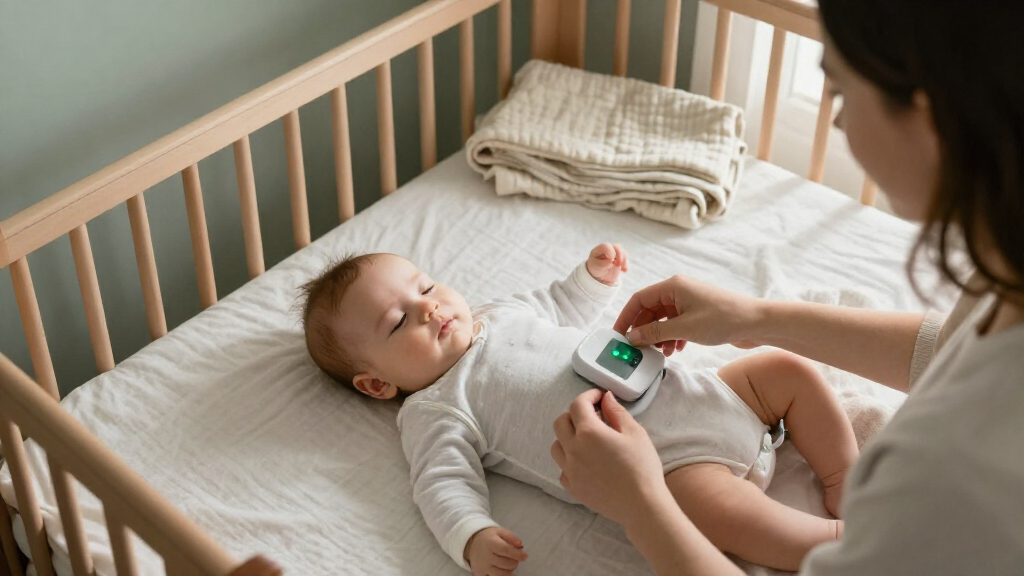
How We Picked
I ranked these products by how clearly their monitoring method fits common household needs, including wearable tracking, portable movement alerts, and sensor pads beneath a mattress. I also considered the practical factors that shape daily use: setup, reliance on an app or Wi-Fi, portability between sleep spaces, alert style, and whether the product adds a camera or other connected features. A breathing-related monitor should be understood as an additional source of information, not a device that prevents or diagnoses a medical event.
The ranking favors options with a clearly defined use case and a useful balance of setup and functionality. The Owlet Dream Sock leads for buyers seeking connected wearable tracking; Babysense 7 ranks higher for families who want a non-wearable system without Wi-Fi. Portable diaper-clip models suit narrower needs, while the Dream Duo earns a premium role for buyers who also want camera monitoring. Repeated Dream Sock listings are treated as package variations, and the right choice depends on what each listing actually includes.
| baby breathing monitor | Monitoring | Connectivity |
|---|---|---|
| Owlet Dream Sock Smart Baby Mo | Pulse rate and oxygen levels | Bluetooth and 2.4 GHz Wi-Fi |
| BabySmile Baby Movement Monito | Abdominal movement | — |
| Owlet Dream Sock Smart Baby Mo | Pulse rate and oxygen levels | Bluetooth and 2.4 GHz Wi-Fi |
| Levana Oma Sense Portable Baby | — | No Wi-Fi, radio, or Bluetooth |
| Babysense 7 Baby Movement Moni | — | Non-Wi-Fi |
| Owlet Dream Duo 3 Smart Baby M | — | Dual-band Wi-Fi (2.4 GHz and 5 GHz) |
| Baby Movement Monitor | — | Bluetooth; no Wi-Fi required |
| Snuza Hero Baby Movement Monit | — | — |
| Owlet Dream Sock Smart Baby Mo | Pulse rate and oxygen levels with preset-zone alerts | Bluetooth and 2.4 GHz Wi-Fi |
| Owlet Dream Sock Smart Baby Mo | Real-time pulse and oxygen tracking with preset-zone alerts | Bluetooth and 2.4 GHz Wi-Fi |
| WUUK BABY Smart Sock Monitor | Sleep and movement tracking through a base station and mobile app | — |
Factors to Consider When Choosing Baby Breathing Monitor
Before choosing a baby breathing monitor, decide what you want the device to track and where your baby will sleep. The right category often matters more than a longer feature list: a wearable sock, diaper clip, and under-mattress pad each bring different setup demands. These broader points can help you avoid buying a system that does not fit your routine.
Choose the Monitoring Method Before Comparing Features
Wearable socks, diaper clips, and sensor pads do not measure or detect movement in the same way. A wearable may suit parents who want information associated with something the baby wears, while a clip is designed around attachment to a diaper and a pad sits beneath the mattress. Start by asking whether you are comfortable placing a device on your baby or prefer equipment outside the sleep space. Then check that the product is intended for the baby’s age, size, and sleep environment. A common mistake is comparing app features before confirming that the physical setup fits your needs. No consumer monitor should be treated as a replacement for safe-sleep guidance or professional medical advice.
Match the Monitor to Every Sleep Space
Think through where naps and overnight sleep happen, including whether the baby regularly sleeps in more than one room. Sensor pads may need to be positioned beneath a compatible mattress, which can make moving the system less convenient. A portable clip or wearable may be easier to carry, but it still needs correct placement and a reliable routine. Check whether the manufacturer specifies mattress, crib, or clothing restrictions before buying. If caregivers will move the monitor between spaces, consider the time needed to reinstall and check it each time. A setup that works in one crib may not transfer neatly to a travel cot or another sleep surface.
Decide How Much Connectivity You Want
Connected monitors can provide app-based information, but that convenience may depend on a phone, account, network, or compatible device. A no-Wi-Fi monitor can appeal to families who want a simpler local setup or prefer fewer connected features. Neither approach is automatically better: decide whether remote access and app records are useful enough to justify the added setup. Check what happens during a network outage, phone notification settings, and whether alerts can be heard from the rooms where caregivers spend time. Do not assume that a product labeled smart will work the same way without internet access. Review the current product instructions for connectivity requirements, since package versions and software features can change.
Understand Alerts and Avoid Treating Them as a Diagnosis
Alerts can prompt a caregiver to check on a baby, but they do not explain the cause of a reading or movement change. Look for clear instructions on what each alert means and what response the manufacturer recommends. Vibration features, audible alarms, and phone notifications can behave differently, so consider which signals caregivers can notice during sleep or while away from the nursery. False or missed alerts can affect confidence and sleep, making correct placement and routine checks important. If a baby has a medical condition or a clinician has recommended monitoring, ask the clinician which device and monitoring plan are appropriate. A consumer product should not replace prescribed equipment or emergency care.
Compare the Full System, Not Just the Main Device
Some listings bundle services or additional equipment, while others focus on a single sensor. The Dream Duo, for example, adds a camera to the Dream Sock concept; that may be useful if video monitoring is also a priority, but unnecessary if movement alerts are your only goal. Check what is included in the exact listing, such as a camera, sensor pads, app access, or a time-limited service offer. Also look for ongoing requirements, replacement parts, charging needs, and care instructions. Repeated product names in this roundup make package checking especially relevant: similar names do not guarantee identical contents. Compare the complete setup you will use rather than relying on the title alone.
Set Priorities for Portability, Comfort, and Routine
A monitor that needs frequent repositioning or charging can become inconvenient even if its feature list looks appealing. Wearables and diaper clips put equipment on the baby, so consider whether the design and fit suit your household’s routine and the manufacturer’s sizing guidance. Sensor pads keep the monitoring device outside the baby’s clothing but need a suitable mattress arrangement. Think about who will put the device on, check it, and respond to alerts during overnight care. For shared caregiving, straightforward instructions and repeatable setup may matter more than extra app functions. Paying more makes most sense when an added feature, such as camera monitoring or connected access, solves a real need rather than duplicating equipment you already own.
Frequently Asked Questions
Can a baby breathing monitor prevent or diagnose a medical emergency?
No. These products provide movement-related or other monitor information, but they do not diagnose a condition or guarantee that an emergency will be prevented. Follow established safe-sleep guidance and use any device according to its instructions. If a clinician has concerns about your baby’s health, ask what monitoring or care is appropriate rather than relying on a consumer monitor. For urgent symptoms, seek emergency medical help instead of waiting for an alert.
Should I choose a wearable monitor or an under-mattress sensor?
Choose based on the setup you can use consistently, not on the assumption that one method is universally more accurate. A wearable sock or diaper clip attaches to the baby and may be easier to move between sleep spaces, while an under-mattress system avoids putting a sensor on the baby but depends on compatible positioning beneath the mattress. Review age, fit, mattress, and placement instructions for the specific model. If you are unsure whether a device suits your baby’s sleep environment, contact the manufacturer or your child’s clinician before purchase.
Do I need Wi-Fi or a phone app for a breathing monitor?
Not always: the Babysense 7, Snuza Hero, and several portable options in this roundup are positioned around operation without Wi-Fi, while the Owlet products emphasize connected, app-based features. Decide whether remote access and app information matter to your household or whether you would rather keep the setup simpler. Check the exact model’s connectivity requirements, since app features and included services can vary by package. Also consider how alerts reach caregivers if a phone is unavailable, muted, or disconnected.
Is the Owlet Dream Duo worth choosing over the Dream Sock alone?
The Dream Duo makes more sense if you also want a camera as part of the nursery setup; its added 2K HD camera extends the system beyond wearable monitoring. If you already have a camera or do not want video monitoring, the Dream Sock alone may be a more focused choice. Compare the exact package contents and any service terms before deciding, since listings can differ. The camera does not turn the system into a medical device, and it should not be treated as a substitute for safe-sleep practices.
What should I check when choosing between similar Owlet Dream Sock listings?
Check the full product name, included accessories, and whether the listing specifies an added service period or bundle. This roundup contains several Dream Sock listings with closely related names, so the title alone may not show what differs. Compare the package details, supported features, and current instructions rather than assuming each listing is a different monitor. If the distinction remains unclear, confirm it with the seller or manufacturer before ordering.
Conclusion
For best overall connected wearable monitoring, I would start with the Owlet Dream Sock Smart Baby Monitor; choose the listing whose package details match what you need. The best non-Wi-Fi value in function is the Babysense 7 for families who prefer sensor pads and do not want a wearable. For best premium setup, the Owlet Dream Duo is the pick when a camera is also wanted, while the Dream Sock alone is the simpler best choice for beginners who want a connected wearable without adding video equipment. If portability is your priority, compare the Snuza Hero and Levana Oma Sense; if you want a different wearable option without a subscription, consider the WUUK monitor. Match the device to your sleep spaces, connectivity preferences, and clinician’s advice, and treat any monitor as an added tool rather than a substitute for safe sleep or medical care.
Halloween Picks
halloween
As an affiliate, we earn on qualifying purchases.